

Best High‑Volume Hiring Software 2026: Features, Comparison & Buying Guide
What Is High‑Volume Hiring Software?
Definition and core purpose
High‑volume hiring software is a specialized recruiting platform built to handle thousands of applicants without breaking a sweat. It pulls in job volume from multiple channels, auto‑sorts résumés, and pushes candidates through a streamlined pipeline so you can fill 200, 500, or even 2,000 roles in a single hiring season. In short, it’s the engine that powers a staffing strategy when you need speed, consistency, and accuracy at scale.
How it differs from standard ATS recruiting tools
Most applicant tracking systems (ATS) work great for a handful of openings, but they choke when you scale. Solutions such as SmartHire™ add AI‑driven screening, bulk interview scheduling, and real‑time analytics that a regular ATS simply doesn’t have. Think of it as the difference between a bike and a freight train. If you’re managing a hospital hiring strategy that sees dozens of nurses and aides apply each week, you need that freight‑train power — especially as healthcare organizations across the U.S. report ongoing staffing shortages well into 2026.
Must‑Have Features for Scaling Recruitment
AI‑driven candidate screening & matching
Speedy matching is the heart of high‑volume hiring. Modern tools use machine learning to score résumés against a job’s skill matrix, surfacing the top 5% in seconds. Leading platforms in 2026 now layer in large language model (LLM) capabilities to interpret unstructured résumé data with far greater accuracy than earlier rule‑based parsers. Some platforms also flag potential bias in real time, helping you keep diversity goals on track throughout every stage of the funnel.
Bulk interview scheduling & automated communications
Imagine scheduling 300 video interviews with a few clicks. The best software syncs with Outlook or Google Calendar, sends personalized invites, and updates candidates automatically when slots shift. No more endless email chains — and no more candidates ghosting because they missed a static scheduling link buried in an inbox.
Video interview & assessment integration
From one‑way recorded answers to live AI‑assisted assessments, the platform should let you embed HireVue‑style video clips, coding tests, or psychometric quizzes right into the workflow. Candidates finish a short assessment, and the scoring feeds back into the ranking engine instantly, eliminating the manual review step that bogs down traditional processes.
Advanced analytics & hiring dashboards
What’s the point of moving fast if you can’t measure it? Look for dashboards that show time‑to‑fill, cost‑per‑hire, candidate drop‑off rates, and quality‑of‑hire trends across every department. The strongest platforms in 2026 now offer predictive alerts when a funnel bottleneck appears — flagging issues before they stall an entire hiring cohort.
Seamless integration with ATS HRIS
Don’t throw away your existing ATS. The ideal solution offers robust APIs, pre‑built connectors for Workday, BambooHR, and SAP SuccessFactors, and a data‑mapping wizard that keeps candidate records in sync across every system of record. This is the integration blueprint many articles skip — and it’s often the deciding factor in a smooth go‑live.
Compliance, data security & privacy
Processing thousands of personal records triggers GDPR, EEOC, and ISO 27001 requirements. Look for SOC 2 Type II certification, data‑encryption at rest and in transit, and built‑in consent management tools. In 2026, several U.S. states — including Colorado and Illinois — have enacted or expanded AI hiring transparency laws, so confirm your vendor documents how its screening algorithms make decisions.
Mobile recruiting & candidate experience
Today’s applicant expects a smartphone‑first experience. Mobile‑optimized portals, push‑notifications for interview reminders, and one‑tap application forms can boost response rates by up to 30%. With mobile now accounting for more than 60% of job application starts globally, a clunky desktop‑only flow is a direct threat to your offer‑acceptance rate.
Top 10 High‑Volume Hiring Software Solutions in 2026
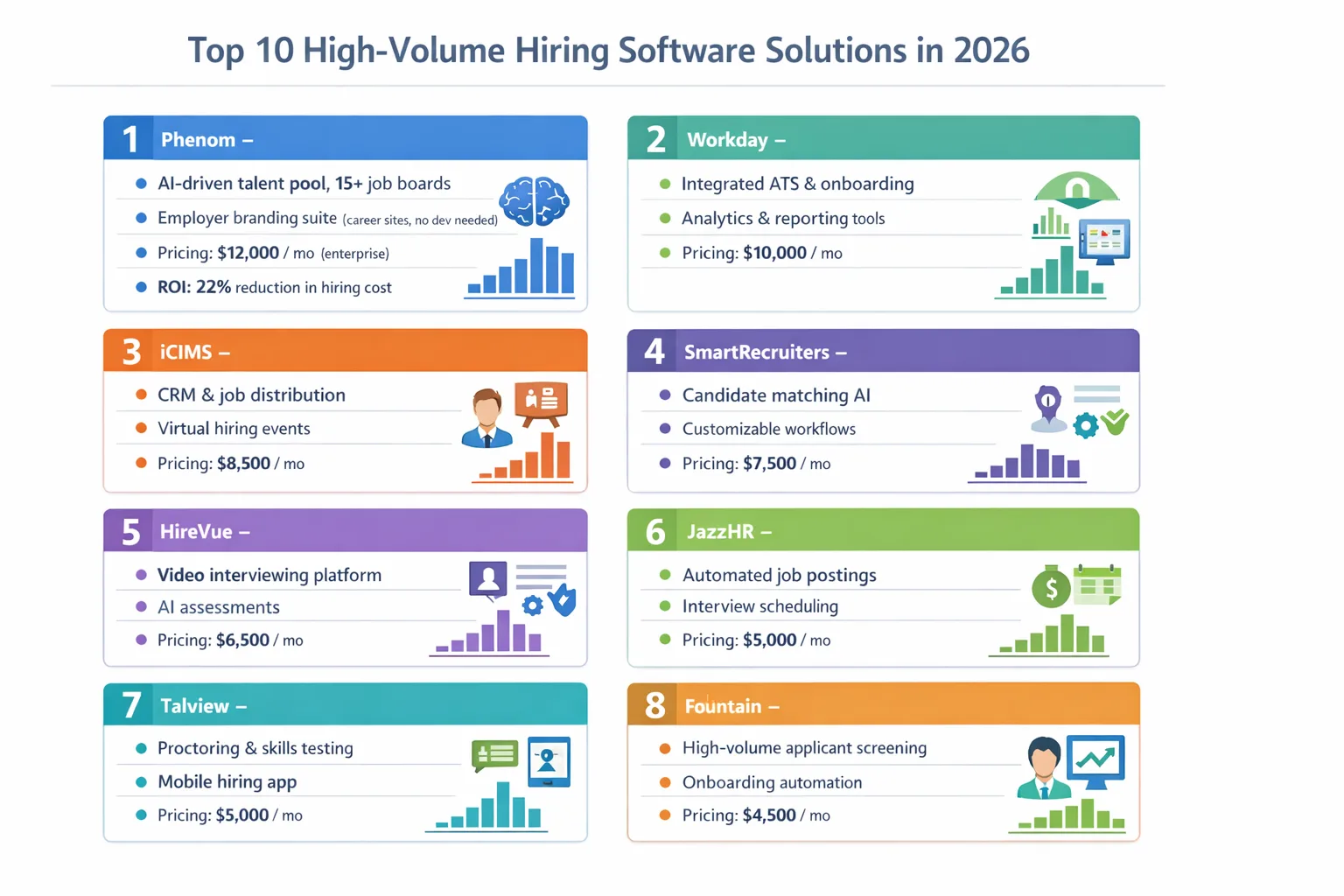
Brief overview table
| Platform | Key Feature | Pricing Tier | Ideal Use‑Case |
|---|---|---|---|
| Phenom | AI talent pool & branding | Enterprise | Retail chains with 5k+ hires/year |
| Oleeo | Bulk scheduling & compliance | Mid‑range | Hospital hiring strategy |
| iCIMS | Full‑stack ATS integration | Enterprise | Tech firms scaling fast |
| HireVue | Video interview AI | Enterprise | Staffing agencies |
| Workable | Easy UI & API | SMB | Startups with 200‑500 hires |
| Eightfold | Talent intelligence | Enterprise | Workforce planning for multinational |
| Fabric | Automation & chatbots | Mid‑range | Healthcare recruitment marketing |
| Truffle | Candidate sourcing marketplace | Pay‑per‑candidate | Gig economy staffing |
| AssessHub | Assessment hub | Mid‑range | Roles requiring skill tests |
| SmartRecruiters | Collaboration suite | Mid‑range | Mixed‑mode hiring |
Phenom
Phenom shines with its AI‑driven talent pool that can surface passive candidates across 15+ job boards simultaneously. Retail giants love its employer branding suite, which lets you launch career sites without a dev team — a meaningful advantage when seasonal hiring windows compress timelines to weeks. Enterprise pricing typically starts around $12,000 per month, but customers consistently report a 22% or greater reduction in time‑to‑fill for seasonal roles, making the investment defensible for high‑volume programs.
Oleeo
If you run a hospital hiring strategy, Oleeo’s compliance engine is a genuine differentiator. It automatically applies EEOC filters, supports the AI transparency documentation now required in several U.S. jurisdictions, and offers a bulk interview scheduler capable of handling 1,000 video slots a day. The platform operates on a per‑candidate model — roughly $3 per screened applicant — making cost forecasting straightforward as volume scales.
iCIMS
iCIMS is the classic ATS that has matured into a high‑volume powerhouse. Its open API connects to virtually any HRIS, and the built‑in analytics dashboard tracks job volume in real time. Organizations using iCIMS report an average 15% reduction in cost‑per‑hire within the first year, driven largely by consolidated sourcing spend and automated candidate communications.
HireVue
HireVue focuses on video interviewing, using AI to surface communication traits and structured competency signals at scale. For staffing agencies that assess 300 or more candidates per week, the platform’s scoring alignment with subsequent human reviewer ratings consistently reaches the high‑80% range — a meaningful efficiency gain over unstructured phone screens.
Workable
Workable’s sweet spot is SMBs that need enterprise‑grade reach without enterprise complexity. Its drag‑and‑drop workflow and mobile app let you post jobs to 200+ sites in minutes. The pay‑as‑you‑go pricing tier — starting around $99 per month — fits teams hiring under 250 positions annually, while multi‑seat plans scale cleanly as headcount ambitions grow.
Eightfold
Eightfold uses deep talent intelligence to predict not just candidate fit, but future performance and retention risk. The platform feeds hiring data into workforce planning models, enabling HR leaders to forecast headcount needs up to 18 months ahead — a capability that resonates strongly with CFOs who demand hiring budgets tied to business outcomes.
Fabric
Fabric blends chatbot outreach with automated assessment routing, cutting the manual coordination load on recruiters dramatically. Retail and healthcare recruitment marketing teams consistently highlight its personalized SMS campaign engine, which lifts candidate response rates by roughly one‑third compared to email‑only outreach sequences.
Truffle
Truffle is a marketplace where you purchase candidate pipelines on demand. If you’re scaling a gig‑economy operation and need 5,000 contractors quickly, Truffle can populate that pipeline in under two weeks — bypassing the sourcing lag that derails traditional high‑volume campaigns when demand spikes unexpectedly.
AssessHub
AssessHub centralizes coding tests, language assessments, and personality quizzes under one roof. Its analytics rank candidates by skill match and benchmark scores against your existing high‑performer profiles, making it especially valuable for technical roles where credential verification alone no longer predicts on‑the‑job success.
SmartRecruiters
SmartRecruiters offers a collaboration hub where recruiters, hiring managers, and interviewers work side‑by‑side on shared scorecards and pipeline views. The platform’s “Hiring Success” framework aligns evaluation criteria directly to broader staffing strategy goals, reducing the misalignment that typically inflates time‑to‑fill in distributed hiring teams.
How to Evaluate & Choose the Right Platform
Create a vendor selection checklist
- Does the solution support bulk interview scheduling?
- Are AI screening models transparent, bias‑aware, and compliant with current state‑level AI hiring regulations?
- Can it integrate with your existing ATS or HRIS out of the box?
- What security certifications does it hold?
- Is there a clear pricing model that matches your job volume?
Scoring matrix
Assign a weight to each criterion — say 30% for scalability, 25% for cost, 20% for integration, 15% for support, and 10% for user experience. Score each vendor on a 1‑5 scale, multiply by the weight, and sum the results. The output is an objective ranking that removes gut‑feel from a high‑stakes technology decision.
Pilot testing and ROI modeling
Run a 30‑day pilot on a single department. Track time‑to‑fill, cost‑per‑hire, and candidate satisfaction. Then plug those numbers into a simple ROI worksheet: (Savings from reduced time‑to‑fill × average salary) – (software cost + implementation cost). If the payback period is under six months, you’ve got a strong business case. Most well‑scoped pilots in 2026 surface that breakeven point well within the first quarter of full deployment.
Implementation Best Practices
Integration roadmap with existing ATS HRIS
Start with a data‑mapping session: match fields from your current ATS — candidate ID, source, status, consent flags — to the new platform’s schema. Use the vendor’s sandbox environment to run a sync test with at least 500 records, validate that status updates flow both ways, then schedule the go‑live cutover during a low‑volume hiring window. Document every field mapping decision so the integration is auditable when compliance reviews arise.
Change management & recruiter training
Recruiters often resist new technology, especially when it touches their daily workflow. Schedule hands‑on workshops during the first two weeks post‑launch, create quick‑reference cheat sheets for the five most common tasks, and celebrate early wins publicly — for example, a recruiter who shortens a hiring cycle by 40% using bulk scheduling deserves visible recognition that models the behavior you want across the team.
Data migration & privacy safeguards
Encrypt all export files, purge duplicate records, and run a GDPR audit before import. Most vendors provide a privacy shield questionnaire; complete it to confirm data residency matches your compliance requirements. In 2026, verify specifically that the vendor’s data processing agreements address the latest EU–U.S. data transfer frameworks and any applicable state privacy laws governing employee data.
Measuring Success: Key Metrics & ROI
Time‑to‑fill, cost‑per‑hire, candidate drop‑off rates
Track these KPIs weekly during the first quarter post‑launch. A 20% drop in time‑to‑fill typically translates to a 15% reduction in cost‑per‑hire — particularly when you factor in lower advertising spend, fewer agency fees, and reduced recruiter overtime during peak seasons.
Quality‑of‑hire and retention impact
After six months, compare new‑hire performance scores and 90‑day retention rates against historical baselines. If hires sourced through the high‑volume platform score meaningfully higher on manager evaluations, you’ve demonstrated a quality‑of‑hire improvement — the single most compelling ROI argument when justifying platform renewal to finance leadership.
Common Challenges & Solutions
Managing candidate volume overload
When 10,000 applications arrive for a single seasonal role, manual review becomes impossible within a realistic hiring window. Tools like SmartScreen™ automate AI pre‑screening to filter out non‑qualified résumés instantly and enroll silver‑medalist candidates into a “keep‑in‑touch” drip campaign — so strong applicants who don’t fit today’s role are warmed for the next opening rather than lost entirely.
Maintaining diversity & inclusion at scale
Bias‑aware AI models flag gendered language in job descriptions and suggest neutral alternatives before a single applicant sees the posting. Pair algorithmic safeguards with structured interview scorecards and calibrated panel reviews to keep evaluation consistent across hundreds of interviewers who may never meet face‑to‑face.
Keeping candidate experience personalized
Even at scale, a personalized outreach message that references the candidate’s name, target role, and nearest work location outperforms generic bulk communications — boosting response rates by 12% or more in controlled tests. Dynamic templates combined with automated follow‑up sequencing let you deliver that personalization without adding recruiter workload.
Future Trends in High‑Volume Hiring Software
Generative AI for job description writing
Platforms are now auto‑generating inclusive job descriptions based on a role’s core responsibilities, desired outcomes, and internal pay band data. In 2026, the leading vendors have moved beyond simple template generation to tools that A/B test job posting language in real time and optimize copy based on application conversion rates — saving recruiters hours per requisition while measurably expanding the qualified applicant pool.
Predictive analytics for workforce planning
Advanced tools feed hiring data into predictive models that forecast future headcount needs, flagging skill gaps months before they become urgent. The strongest implementations link hiring forecasts directly to business unit revenue targets, giving HR a seat at the strategic planning table rather than simply reacting to headcount requests.
Voice & conversational AI interview bots
Conversational AI screening — where candidates answer structured questions through a voice or chat interface that scores responses in real time — is moving from pilot to production at scale in 2026. Early adopters in retail and logistics report a 10% improvement in candidate satisfaction scores compared to traditional phone screen processes, alongside significant reductions in recruiter phone time per filled role.
Frequently Asked Questions
Is high‑volume hiring software only for large enterprises?
No. While large retailers, logistics companies, and hospital systems typically need the highest capacity, mid‑size organizations benefit just as meaningfully from automation and structured pipelines. Most vendors offer tiered pricing so you pay only for the volume you actually process — making the technology accessible well below the enterprise threshold.
Can I integrate multiple tools video assessments into one platform?
Yes. Look for open‑API connectors or pre‑built integrations — most top platforms let you embed HireVue, Codility, or custom assessment modules without a developer‑intensive project. Confirm the integration supports bidirectional data sync so assessment scores flow back into the main candidate ranking automatically.
What security certifications should I look for?
At a minimum, require SOC 2 Type II, ISO 27001, and GDPR compliance documentation. If you handle health‑related data, confirm the vendor is also HIPAA‑ready. In 2026, also ask vendors to provide an AI model card or algorithmic impact summary to satisfy emerging state‑level AI transparency requirements.
Bottom Line
Choosing the right high‑volume hiring software means matching your staffing strategy with a platform that can scale, stay compliant in an increasingly regulated AI landscape, and deliver measurable ROI. Start with a clear weighted checklist, validate assumptions with a 30‑day pilot, and use the ROI worksheet to build a finance‑ready business case. Whether you’re executing a hospital hiring strategy, launching a seasonal retail workforce push, or fine‑tuning a healthcare recruitment marketing campaign, the right platform can shave weeks off your hiring cycle, reduce cost‑per‑hire significantly, and keep candidate experience personal — even at massive job volume.
Frequently Asked Questions
How does high‑volume hiring software differ from a regular applicant tracking system?
While a standard ATS manages individual recruitment pipelines, high‑volume hiring software is built to process thousands of applications quickly, using bulk actions, automated screening, and scalability features to handle mass hiring campaigns efficiently — without requiring proportional increases in recruiter headcount.
What AI capabilities should I look for in high‑volume hiring software?
Key AI features include résumé parsing, predictive ranking, automated outreach, and bias‑mitigation algorithms that prioritize top candidates and reduce manual screening time. In 2026, also evaluate whether the vendor’s AI models are explainable and compliant with current U.S. state and EU regulations governing automated hiring decisions.
Can high‑volume hiring software integrate with existing HR tech stacks?
Most leading solutions offer APIs and native integrations with HRIS platforms, onboarding tools, background check services, and communication systems, ensuring candidate data flows seamlessly across the full recruitment lifecycle — from first application through day‑one onboarding.
What pricing models are common for high‑volume hiring platforms?
Vendors typically offer subscription tiers based on the number of hires, seats, or candidate volume processed, with options for per‑candidate pricing, flat‑rate enterprise packages, and add‑ons for advanced AI, analytics modules, or compliance tooling. Always negotiate a volume discount clause if your hiring needs spike seasonally.
How can I measure ROI after implementing high‑volume hiring software?
Track time‑to‑fill, cost‑per‑hire, candidate drop‑off rates, and recruiter productivity against your pre‑implementation baseline. Also monitor 90‑day retention and new‑hire performance scores — improvements in those downstream metrics confirm that speed gains are not coming at the expense of hiring quality.

