

HR Tech Explained: How Modern HR Technology Transforms the Workplace
What Is HR Tech?
Definition and scope
When you hear “HR tech” you’re really hearing a shorthand for the software tools that automate, connect, and visualize everything from recruiting to retirement. In plain English, it’s the digital backbone that lets people teams work faster, smarter, and with fewer manual spreadsheets.
Key components
- Applicant Tracking Systems – the engine behind modern recruiting.
- Payroll and workforce management – the nuts‑and‑bolts for paying staff on time.
- Performance and talent management – where goals, feedback, and development meet.
- Learning and development platforms – the online classrooms for upskilling.
- Benefits administration – the portal that lets employees choose health plans with a click.
Why HR Tech Matters Today
Business benefits
First off, the numbers speak for themselves. Companies that adopted integrated HR suites saw a 20% drop in administrative costs within the first year. Data‑driven decisions become possible when every hire, turnover, and raise is logged in one place. And compliance? Automated alerts keep you out of costly fines.
Employee experience and engagement impact
Imagine a new hire who can accept an offer, set up direct deposit, and enroll in benefits—all before their first day. That smooth start boosts engagement scores by up to 15 points, according to a recent Gartner poll. Employees also love self‑service portals; they cut HR email traffic by roughly one‑third.
Core HR Tech Solutions
Applicant Tracking Systems
ATS systems act like a digital funnel. They collect resumes, run keyword filters, and let hiring managers score candidates in a single view. Modern platforms—such as SmartHire™—even pull data from LinkedIn, making sourcing a breeze. One mid‑size tech firm reported a 30% reduction in time‑to‑hire after swapping a paper‑based process for an ATS.
Payroll & Workforce Management
Payroll isn’t just about writing checks. Cloud‑based solutions handle multi‑state tax calculations, overtime rules, and gig‑worker payments. With workforce automation, time‑clock data syncs directly to payroll, erasing the manual entry nightmare.
Performance & Talent Management
The days of annual reviews are fading. Today’s platforms support continuous check‑ins, goal‑setting, and real‑time dashboards. Managers can spot skill gaps early and align learning paths, which drives internal mobility and reduces external hiring costs.
Employee Self‑Service Portals
From updating personal details to requesting PTO, employees now manage the mundane themselves. This not only frees HR staff but also gives workers a sense of control—exactly what modern talent expects.
The Role of AI & Automation in HR Tech
AI‑powered sourcing and screening
Recruiting systems equipped with AI, like SmartScreen™, can scan thousands of profiles in seconds, flagging the best matches based on experience, cultural fit, and even personality traits. It’s not magic; it’s pattern recognition built on historic hiring data.
Predictive analytics for turnover and engagement
By feeding performance, tenure, and engagement scores into a model, you get an early warning signal for potential resignations. Companies that act on these predictions cut voluntary turnover by up to 12%.
Chatbots and conversational AI for HR help desks
Need to know how many vacation days you have left? A simple chat with an AI‑driven bot can answer in seconds, 24/7. These bots handle routine queries, letting human HR pros focus on strategy.
Implementing HR Tech Successfully
Needs assessment and stakeholder buy‑in
Start by asking the right people what they struggle with today—recruiters, finance, line managers. Build a business case that ties technology to concrete pain points. When leaders see a direct line from a tool to cost savings, buy‑in skyrockets.
Data migration and integration challenges
Moving legacy data to the cloud is rarely a drag‑and‑drop job. You’ll need a clear integration roadmap: map fields, clean duplicates, and test each connector. APIs are your best friends here; they let your new HR tech talk to existing payroll or ERP systems without a hitch.
Change management and training
Even the flashiest platform fails if people resist it. Roll out short, hands‑on workshops, create quick‑reference videos, and celebrate early adopters. And remember: a little humor in training sessions goes a long way—people remember a joke more than a bullet point.
Measuring ROI and HR Metrics
Key performance indicators
Track time‑to‑hire, cost‑per‑hire, and HRIS adoption rates. If your adoption stalls below 70%, dig into why—maybe the UI isn’t intuitive or the data isn’t trusted. Also watch payroll error rates; a 0.5% drop equates to millions saved for large enterprises.
Future Trends in HR Tech
Hybrid‑workforce platforms
As remote and on‑site teams blend, platforms will offer desk‑booking, virtual coworking, and real‑time capacity planning. Think of it as a digital office map that updates itself.
Advanced analytics & people intelligence
Beyond basic dashboards, next‑gen tools will predict skill shortages months ahead, recommend internal moves, and even suggest compensation adjustments based on market trends.
Privacy‑first design and compliance
Regulators are tightening the screws. Systems built with privacy in mind—data minimization, consent tracking, and encryption by default—will be the ones that survive audits without breaking a sweat.
Real‑World Case Studies
Mid‑size tech firm cuts hiring time by 30%
A 250‑person software company swapped a manual spreadsheet process for an ATS system integrated with LinkedIn Recruiter. Within six months, their average time‑to‑fill dropped from 45 days to 31 days. The HR team also reported a 40% reduction in email back‑and‑forth, freeing time for strategic projects.
Retail chain improves payroll accuracy with SaaS
A regional retailer with 12 stores moved its payroll to a cloud‑based workforce automation platform. Errors fell from 2.3% of paychecks to 0.2%, and the finance director saved roughly $200,000 in overtime costs during the first year.
Security, Data Privacy, and Compliance
GDPR, CCPA, and industry‑specific regulations
If you handle employee data in Europe or California, you’re already bound by GDPR or CCPA. HR tech vendors must offer tools for data subject access requests, breach notifications, and data‑retention policies. Ignoring these can cost you fines that run into six figures.
Best practices for data encryption and access control
Encrypt data both at rest and in transit—nothing else will keep a hacker out of a poorly secured database. Use role‑based access so only HR managers see salary info, while employees only see their own records. Multi‑factor authentication adds another layer of protection without slowing down daily workflows.
Integration Roadmap: From Legacy to Cloud
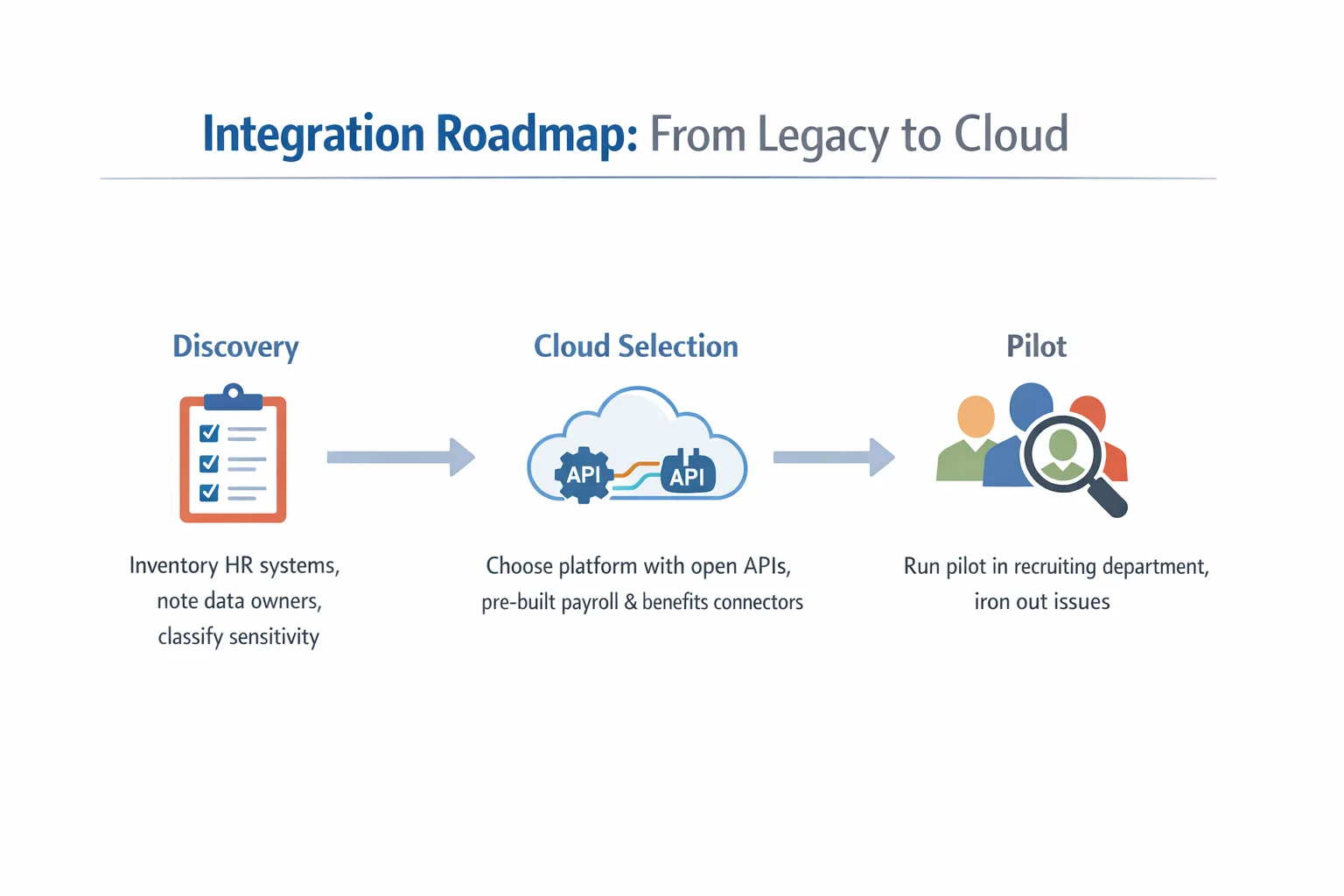
Begin with a discovery phase: inventory every HR system, note data owners, and classify data sensitivity. Next, choose a cloud platform that supports open APIs and offers pre‑built connectors for your payroll and benefits providers. Then, run a pilot with one department—maybe recruiting—to iron out sync issues. Finally, roll out organization‑wide, monitoring data flow with automated health checks.
Now that you’ve seen the landscape, it’s clear why HR tech isn’t just a nice‑to‑have—it’s a must‑have for any organization that wants to stay competitive in today’s fast‑moving talent market.
Key takeaways: HR tech unifies recruiting, payroll, performance, and learning into a single digital experience; AI and workforce automation amplify efficiency; successful adoption hinges on clear needs, solid data migration, and people‑focused change management; ROI is measurable through time‑to‑hire, error rates, and adoption metrics; and security, privacy, and integration are non‑negotiable pillars of any modern implementation. Embrace these principles, and you’ll turn HR from a cost center into a strategic growth engine.
Frequently Asked Questions
How does HR tech improve employee engagement?
HR technology streamlines communication, provides self‑service portals, and delivers personalized learning and development resources, which boost transparency and satisfaction. Real‑time feedback and performance analytics also help managers recognize and reward contributions promptly.
What are the main benefits of using an Applicant Tracking System (ATS)?
An ATS automates job posting, resume parsing, and candidate communication, reducing time‑to‑hire and administrative workload. It also centralizes data for better reporting, improves candidate experience, and helps ensure compliance with hiring regulations.
How can small businesses adopt HR technology without overspending?
Small firms can start with cloud‑based, subscription‑based platforms that offer modular pricing, allowing them to add features as they grow. Leveraging free trials, focusing on core functions like payroll and time tracking, and integrating with existing tools can further control costs.
What emerging trends are shaping the future of HR tech?
AI‑driven talent analytics, predictive workforce planning, and employee wellness platforms are gaining traction. Additionally, decentralized HR data using blockchain and immersive learning via AR/VR are beginning to influence the market.
In what ways does HR tech help ensure compliance with labor laws?
HR systems embed regulatory rules into workflows, automatically updating tax tables, overtime calculations, and reporting requirements. Audit trails and centralized documentation also simplify proof of compliance during inspections or legal reviews.

