
The ChatGPT era demands abandoning resume screening in favor of verified capability assessment
The Magnitude of the Problem: AI-Generated Content Is Now Mainstream
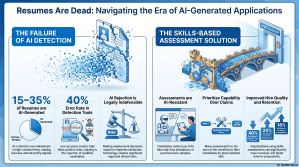 ChatGPT reached 100 million users in January 2023. By mid-2023, resume generation was one of its top-5 use cases. Today, in 2024-2025, professional estimates suggest 15-35 percent of resumes submitted to high-volume employers contain ChatGPT or similar LLM-generated content (or are partially generated).
Why do candidates generate AI resumes? The pitch is compelling: ‘Write a professional resume highlighting retail management experience and customer service skills.’ The output is grammatically perfect, competently structured, and completed in 30 seconds. It’s hard for a candidate to say no.
What makes AI-generated resumes dangerous is that they’re extremely difficult to detect. Unlike plagiarism (which copies existing text), AI generation creates novel content. Existing plagiarism detection tools (Turnitin, Copyscape) won’t catch it.
A joint study by the University of Michigan and OpenAI (2024) analyzed linguistic markers in 100,000 resumes submitted to major retailers. Using transformer models trained to identify LLM-generated text, researchers flagged approximately 24 percent of entry-level resumes as ‘likely AI-generated’ based on linguistic patterns.
The content itself is the problem. An AI-generated resume for a retail position might include: ‘Synthesized cross-functional stakeholder engagement initiatives to optimize operational metrics’ (a phrase no retail employee would use). It includes perfectly parallel bullet structures, no personal details, vocabulary that doesn’t match the role, and zero idiosyncratic information.
The result: resumes can no longer be trusted as a signal of honest communication, relevant experience, or writing ability.
Why Detection Is Hard and Why Relying on It Is a Losing Strategy
Before discussing solutions, understand why detection is not a realistic defense.
Detection Tools Are Imperfect
Several AI detection vendors (Turnitin’s AI-Academy, ZeroGPT, GPTZero, etc.) claim to identify AI-generated text. Their accuracy is typically 60-80%, meaning they have false positive and false negative rates of 20-40%. When hiring 500+ people per year, a 20% false positive rate means you’re rejecting qualified candidates. A 20% false negative rate means AI-generated resumes slip through.
Moreover, AI language models are improving rapidly. New models (GPT-4o, Claude 3) generate text with greater linguistic variety, making detection harder. An AI detection tool trained on GPT-3.5 output will perform poorly on GPT-4 output.
Legal and Ethical Risks of Detection-Based Rejection
If you reject a candidate because ‘detection indicates your resume is AI-generated,’ you’ve made an employment decision based on a technology with 20-40% error rate. This is legally indefensible. Moreover, some candidates use AI assistance ethically (grammar checking, rephrasing) rather than wholesale generation. Rejecting them is unfair.
A safer approach: stop making hiring decisions based on resume content entirely. Don’t try to detect AI—make AI detection irrelevant by not using resumes to screen.
The Futility of Resume Policing
Even if detection tools were perfect, ‘We reject all AI-generated resumes’ creates perverse incentives. Candidates who can’t write perfectly are punished. Candidates without access to AI assistance are punished (they’re competing against AI-polished resumes). You’re not selecting for honest communication—you’re selecting for who has access to generative AI.
The Real Solution: Abandon Resume Screening Entirely
The only sustainable response to AI-generated resumes is to stop relying on resumes to make hiring decisions.
This isn’t a new insight—I/O psychologists have said this for decades. Resumes are poor predictors of job performance. For hourly roles, they’re especially poor. Research shows resume-based screening has minimal correlation with job success (r = 0.08-0.15). The AI era has simply made the problem impossible to ignore.
The alternative: shift to skills-based assessment and demonstrated capability.
Instead of asking: ‘Does your resume claim customer service experience?’
Ask: ‘Can you demonstrate customer service capability in a realistic scenario?’
This is a fundamental change in hiring philosophy, but it’s the only approach that survives the AI era.
Why skills assessment is AI-resistant:
- Practical assessments (role plays, work samples, situational judgment tests) cannot be faked via AI resume generation. A candidate can have an AI-generated resume claiming POS experience, but they cannot have the AI take a 5-minute POS simulation for them.
- Work samples directly measure the capability you care about. You don’t infer ability from claimed experience—you directly observe capability.
- Assessments are identical for all candidates. AI cannot generate different capabilities for different candidates in real-time.
For example: Instead of screening resumes for ‘retail experience,’ use a 5-minute POS simulation where candidates process a mock transaction. Candidates either demonstrate the skill or don’t. The assessment result is honest and unambiguous.
Practical Assessment Integration: Moving from Resume to Capability Screening
Transitioning from resume-based screening to skills-based assessment requires three changes: (1) candidate communication, (2) assessment design, (3) hiring workflow.
- Candidate Communication
When candidates apply, communicate clearly: ‘We review applications based on demonstrated skills, not resumes. You’ll complete a 10-minute skills assessment that mirrors actual job tasks. We use this, not your resume, to evaluate fit.’
This transparency manages expectations and reduces candidate frustration. Candidates who are honest about their skills proceed. Candidates who inflated their resume know they’ll be caught during assessment, so they self-select out.
- Assessment Design
For each role, identify 3-4 core job tasks. Design practical assessments that directly measure capability on those tasks:
Role: Retail Associate
Core Tasks: (1) Customer service, (2) POS/transaction processing, (3) Product knowledge, (4) Safety/loss prevention
Assessments:
- Customer Service: Situational judgment scenario (‘Upset customer wants a return. What do you do first?’) — 3 min
- POS: Mini-simulation or written walkthrough (‘Walk me through processing a refund’) — 3 min
- Product Knowledge: 5 quick questions about your products — 2 min
- Safety: 3 questions about loss prevention procedures — 1 min
Total time: 9 minutes. Candidate either demonstrates capability or doesn’t. Result is honest and unambiguous.
- Hiring Workflow
Sequence: (1) Application (basic info only, ignore resume quality), (2) Knockout questions (location, availability), (3) Skills assessment (5-15 min), (4) Phone screen or interview (for candidates who pass assessment).
This workflow makes resume content irrelevant. A candidate could have a perfect AI-generated resume or a terrible hand-written resume—it doesn’t matter. What matters is their performance on the skills assessment.
Best-in-class integration: Use an ATS that embeds assessments directly in the application workflow. Candidates who apply immediately see: ‘Before we review your application, complete a 10-minute skills test.’ Link goes directly to assessment, not external website. Completion rate: 85-95%. Candidates understand the assessment is part of the application process, not an optional next step.
Authenticity Signals: Using Assessment Data to Detect Fraud
While you can’t reliably detect AI-generated resumes, you can use assessment performance to detect fraudulent candidates.
When a resume claims experience but the candidate fails a relevant skills assessment, this is a red flag. Examples:
- Resume claims ‘3 years POS experience’; candidate cannot answer basic POS simulation questions → Fraudulent claim
- Resume claims ‘excellent customer service background’; candidate scores below 30th percentile on customer service scenario → Fraudulent claim or skill atrophy
- Resume claims ‘proficient in [specific software]’; candidate cannot demonstrate basic functionality → Fraudulent claim
Use this rule: If resume claims directly contradict assessment results, the candidate is not a hire. This creates a powerful disincentive for inflating resumes—the resume will be tested.
Additionally, track patterns:
- Candidates who fail assessments but somehow have strong resumes (excellent writing, impressive credentials) may be AI-resume generators. They invested effort in a good resume but lack actual capability.
- Candidates whose resume is mediocre/brief but who score well on assessments are likely authentic. They have capability but didn’t invest time in resume polishing.
Over time, you’ll develop intuition for authenticity: strong assessment performance + modest resume = likely genuine. Strong resume + weak assessment = likely fabricated.
The Assessment Advantage in an AI-Flooded Landscape
In a hiring landscape where resumes are increasingly unreliable, organizations that shift to skills assessment gain a competitive advantage.
Why?
- Filtering Efficiency: Candidates who inflate resumes but lack skills self-select out when faced with assessments. Your pipeline gets cleaner—you’re only interviewing candidates with demonstrated capability, not resume claims.
- Hire Quality: You’re hiring based on proven capability, not claimed capability. This directly improves hire quality, 90-day performance, and tenure.
- Recruitment Brand: Candidates respect assessments more than resume screening. They perceive skills assessments as fair (you’re testing actual ability, not subjective judgment). This improves employer brand and word-of-mouth referrals.
- Competitive Advantage: Most of your competitors are still screening resumes (and getting fooled by AI-generated content). By using assessments, you’re identifying genuinely capable candidates that competitors are missing.
A 2024 Workable study found that organizations using skills assessments for high-volume hiring had:
- 40% lower first-90-day turnover (due to better hire quality)
- 25% faster time-to-productivity (candidates had already demonstrated core skills)
- 18% higher employee engagement at 6 months (better fit between actual and claimed capability)
These benefits compound. Better hires → lower turnover → more experienced staff → improved customer experience → higher sales. The ROI of shifting to skills assessment extends far beyond hiring efficiency.
Future-Proofing Your Process: Why Resume-Based Hiring Is Dead
The AI era is not a temporary problem that will be ‘solved’ by better detection technology. Generative AI is getting better, not worse. By next year, detection will be even harder.
The only sustainable hiring approach is one that doesn’t rely on resume content. This means:
- Capability over Claims: Stop making inferences from stated experience. Measure actual capability through assessments.
- Process Consistency: Use identical assessments for all candidates. This eliminates opportunities for bias and makes every candidate comparable.
- Authentic Data: Assessments produce honest, unambiguous data about capability. ‘Candidate scored 78/100 on the customer service scenario’ is meaningful. ‘Resume looks impressive’ is not.
- Candidate Self-Selection: When candidates know they’ll be assessed on actual capability, fraudsters self-select out. Honest candidates proceed with confidence.
Organizations that make this transition now are positioning themselves for hiring success in 2025 and beyond. Organizations that continue relying on resume screening are increasingly hiring AI-generated fiction.
The choice is not ‘How do we detect AI resumes?’ The choice is ‘How do we eliminate resumes from our hiring decisions?’ For high-volume hourly hiring, the answer is clear: skills-based assessment, standardized across all candidates, measured consistently, with results documented in your ATS.
This is not just better hiring—it’s the only defensible hiring approach in the AI era.
References and Further Reading
- University of Michigan & OpenAI. (2024). Language Pattern Analysis of AI-Generated Resume Content. Collaborative Research Study.
- LinkedIn. (2024). The State of AI in Recruitment: 2024 Report. LinkedIn Talent Solutions.
- Workable. (2024). Skills-Based Hiring Impact on Turnover and Performance. Workable Research.
- Watermark Insights. (2024). Detecting AI-Generated Content: Challenges and Solutions. Research Report.
- IEEE. (2024). The Limits of AI Detection Systems. IEEE Computer Society Publication.
- Society for Industrial and Organizational Psychology (SIOP). (2023). Selection Best Practices in an AI-Driven World. SIOP Guidelines.
- Deloitte. (2023). Resume Screening and Applicant Quality: Findings from High-Volume Hiring. Deloitte Insights.
- Gartner. (2024). AI in Recruitment: Implications for Hiring and Selection. Gartner Research Report.
How Cadient Talent SmartSuite™ Helps
Cadient Talent’s SmartSuite™ platform automates compliance workflows, embeds regulatory guardrails directly into your hiring process, and maintains audit-ready documentation at every stage—so your team can focus on finding great talent while staying protected from costly violations.
