
Master when and how to conduct criminal background checks under Fair Chance laws
Understanding Ban-the-Box and Fair Chance Laws
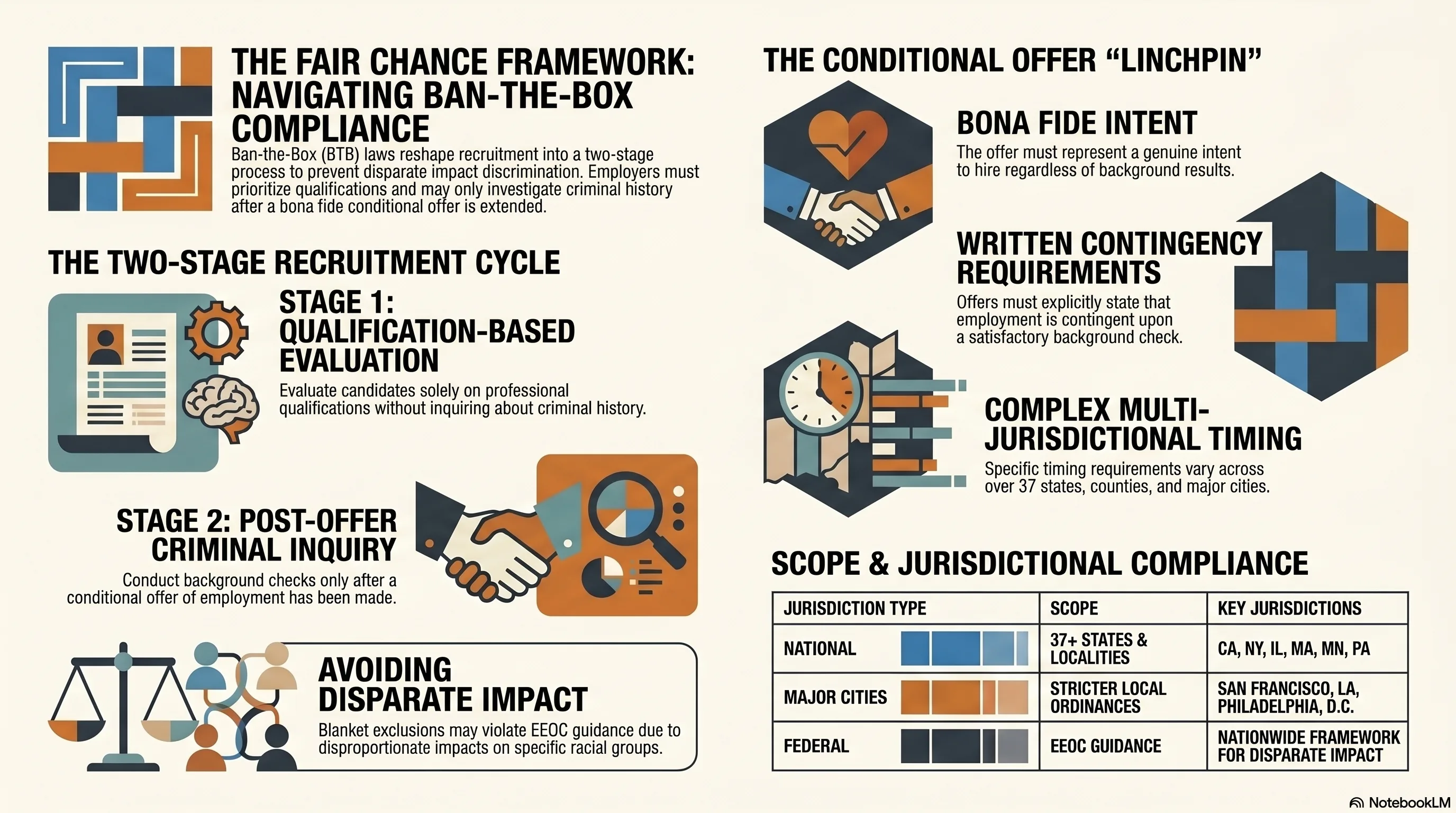
Over 37 U.S. states, counties, and cities have enacted Ban-the-Box (BTB) or Fair Chance laws that restrict when employers can inquire about an applicant’s criminal history. These laws fundamentally reshape recruitment compliance by creating a two-stage process: first, employers evaluate candidates based on qualifications alone; second, only after a conditional offer of employment can criminal history become relevant.
The EEOC’s 2012 Enforcement Guidance on the Consideration of Arrest and Conviction Records in Employment Decisions (updated 2021) provides the federal framework. While federal law doesn’t outright ban criminal inquiries, the guidance establishes that blanket criminal record exclusions may constitute disparate impact discrimination because of the disproportionate impact on certain racial groups. This creates a legal environment where state and local BTB laws operate alongside federal EEOC doctrine.
Key states with comprehensive BTB laws include California, New York, Illinois, Massachusetts, Minnesota, and Pennsylvania. Cities like San Francisco, Los Angeles, Philadelphia, and Washington, D.C. have enacted even stricter ordinances. The timeline for when employers can conduct criminal inquiries varies significantly: some jurisdictions allow inquiries only after a conditional offer; others permit them at the background check stage but restrict the final decision-making process.
The Conditional Offer Framework
A conditional offer is the legal linchpin of Ban-the-Box compliance. It is an offer of employment contingent upon satisfactory results of a criminal background investigation. Under BTB laws, employers may not inquire about criminal history before making a conditional offer.
The conditional offer must be bona fide—meaning the employer genuinely intends to hire the candidate unless the background check reveals disqualifying information. Courts scrutinize offers that appear designed merely as a pretext to gather criminal records. In Chen v. City of Philadelphia, 2020 U.S. Dist. LEXIS 87815 (E.D. Pa. 2020), the court found that if offers are routinely revoked for trivial infractions, the process becomes discriminatory in effect.
Best practice framework for conditional offers:
The written offer should explicitly state that employment is contingent on a satisfactory criminal background check. Document the offer issuance date, the candidate’s acknowledgment, and preserve the communication. Many jurisdictions require that the offer remain open for a defined period (typically 5-10 business days) to allow candidates to provide context or dispute inaccuracies.
Critically, do not make different assessments of criminal records for different candidates based on the severity of the offense without documented criteria. San Francisco’s Fair Chance Ordinance (Chapter 12T, S.F. Administrative Code) explicitly requires an individualized assessment process that applies consistently across all candidates who reach the conditional offer stage.
State-by-State Timing Requirements
The timing restrictions for criminal inquiries create a complex compliance landscape. Here are the primary jurisdictions and their requirements:
California
California Labor Code §432.7 prohibits employers from asking about criminal arrests that did not result in conviction. For convictions, employers must use the Green factors (discussed below) and cannot inquire about convictions older than seven years in most circumstances, with exceptions for certain positions (law enforcement, healthcare). The inquiry may occur at the conditional offer stage but conviction history from more than seven years prior is generally not accessible in background checks anyway.
New York
New York Human Rights Law §296(16) and the 2015 Fair Chance Act prohibit most employers from asking about arrests, charges, or convictions before making a conditional offer. Public employers have slightly different rules. After the conditional offer, employers must provide a copy of the criminal background report and allow the candidate to respond.
Illinois
Illinois Human Rights Act §2-103.1 requires that most employers delay criminal history inquiries until after a conditional offer. Some exceptions exist for positions involving care of children or elderly persons. The statute also requires individualized assessment of all disqualifying factors.
Massachusetts
Massachusetts General Laws Chapter 149 §24L restricts inquiries to the conditional offer stage. The law specifically allows inquiries only after the offer letter is signed and before the candidate’s first day of employment.
Minnesota
Minnesota Statutes §181B.0725 prohibits most employers from asking about criminal history before a conditional offer. Public sector employers have more flexibility but must still apply consistent assessment criteria.
Philadelphia
Philadelphia Code §9-4801 allows inquiries only at the conditional offer stage and imposes strict requirements around the timing and contents of adverse action notices. Employers must provide 10 business days for candidates to respond after receiving an adverse action notice.
San Francisco
San Francisco’s Fair Chance Ordinance (Chapter 12T) prohibits inquiries until after a conditional offer is made. The ordinance is among the strictest, requiring documented individualized assessment of all candidates and preservation of assessment records.
Los Angeles
Los Angeles Municipal Code §104.01 restricts criminal inquiries to the post-offer stage. Employers must provide comprehensive written notice of what information was obtained and afford the candidate 10 business days to dispute or contextualize any findings.
Washington, D.C.
The D.C. Fair Chance Act (D.C. Code §32-531.01) allows inquiries only after a conditional offer and requires employers to document the individualized assessment process with specific attention to position-specific risk.
The Green v. Missouri Pacific Railroad Factors
The seminal case Green v. Missouri Pacific Railroad, 523 F.2d 1290 (8th Cir. 1975), established the framework now enshrined in EEOC guidance for assessing whether a criminal record should disqualify a candidate. These three factors form the backbone of individualized assessment under modern BTB laws.
Nature and Gravity of the Offense: The first factor examines how serious the offense was. A felony conviction carries different weight than a misdemeanor; a violent offense carries different implications than a property crime. An offense directly related to the position (e.g., embezzlement for a financial role) carries more weight than an unrelated offense. Employers must document the specific nature of the crime, any aggravating factors in how it was committed, and how it correlates to the actual job duties. Generic blanket policies (“no felons”) violate this requirement because they don’t assess gravity.
Time Elapsed Since the Offense and Conviction: The second factor acknowledges that rehabilitation occurs. The EEOC guidance suggests that convictions more than seven years old become increasingly difficult to use as a basis for exclusion, particularly if the candidate has maintained employment and avoided further offenses. However, the relevant timeline is not just years elapsed but the pattern of behavior during that time. A 15-year-old conviction may weigh heavily if the candidate has been incarcerated repeatedly since then. Conversely, a 5-year-old conviction may be discounted if the candidate has maintained steady employment, completed rehabilitation programs, and established ties to the community.
Time elapsed calculations should begin from the date of conviction, not arrest, and should account for any incarceration, parole, or probation periods. States like California explicitly exclude arrest-only records, making time-elapsed assessments clearer in those jurisdictions.
Nature of the Job Held or Sought: The third factor is position-specific. A conviction for driving under the influence has obvious implications for a delivery driver role but less obvious relevance to an accountant. A conviction for sexual assault has clear implications for positions working with vulnerable populations but less relevance to manufacturing positions. This factor requires honest assessment of actual job duties, not speculative risk.
Beyond the Three Factors: EEOC guidance recognizes additional considerations that strengthen individualized assessment: evidence of rehabilitation (completion of educational or vocational programs, sustained employment history, community ties, family responsibilities, testimonials from employers or mentors), job performance history and references, and the specific nature of any overlap between the offense and the position’s duties and risks.
Permitted Questions Post-Offer
Once a conditional offer is extended, the scope of permissible questions expands, but limitations remain. Employers cannot inquire about arrests that did not result in conviction (with narrow exceptions in California for convictions, and some states may vary). Employers cannot ask about sealed, dismissed, or expunged convictions. Employers cannot ask about diversionary programs successfully completed without a conviction.
Permitted questions should be carefully worded and job-related. Examples of compliant questions include:
“Have you been convicted of a felony in the past seven years?” (if following state law timelines)
“Have you been convicted of a crime involving dishonesty or breach of trust?” (for positions handling sensitive information)
“Have you been convicted of a crime involving violence or sexual offense?” (for positions involving vulnerable populations)
Non-compliant questions include:
“Have you ever been arrested?” (arrests without conviction are off-limits in most BTB jurisdictions)
“Have you been charged with a crime?” (charges that did not result in conviction are improper)
“Have you ever had contact with law enforcement?” (too vague and captures arrests and other contacts)
The best practice is to use a background check authorization form that clearly states what information will be sought and provide the candidate with a copy of any investigative report before making an adverse decision. This transparency supports compliance with both BTB laws and FCRA requirements.
Documentation and Record-Keeping Requirements
Documentation is the foundation of compliance proof in the event of a charge. Title VII requires employment records be kept for at least one year. For criminal history decisions, preservation should extend longer because these decisions are more vulnerable to legal challenge.
Essential documentation includes:
A copy of the written conditional offer with the date it was extended and the candidate’s acknowledgment of receipt. This proves the offer preceded the criminal inquiry.
The authorization form for the criminal background check, signed and dated by the candidate, clearly stating what information will be obtained and how it will be used.
The criminal background report itself, received from the third-party investigator, showing what information was discovered.
A contemporaneous written assessment documenting the application of the Green factors to the candidate’s specific record and position. This document should be created before the adverse decision is communicated and should show the evaluator’s reasoning. A template might state: “Conviction: [offense], Date: [date], Nature and Gravity: [analysis], Time Elapsed: [analysis], Job-Related Risk: [analysis], Conclusion: [decision with rationale].”
The adverse action notice provided to the candidate, including the information that triggered the decision, their right to respond or dispute, and the timeline for response.
Documentation of any candidate response or rebuttal, and the employer’s consideration of that response.
Proof of final hiring decision and its date.
This documentation chain proves that the decision was not made based on discriminatory intent and was applied consistently according to established criteria.
Individualized Assessment and Legal Defensibility
Individualized assessment is the legal requirement that transforms criminal history decisions from automatic disqualifications into case-by-case evaluations. This is the core distinction between compliant and non-compliant practices.
Non-compliant approaches include blanket exclusions (“no applicants with felony convictions”), category-based automatic denials (“any drug conviction equals automatic rejection”), or failure to consider time elapsed and rehabilitation. The Third Circuit’s decision in United States v. Bronstein, 849 F.2d 1503 (11th Cir. 1988), established that blanket policies are per se discriminatory under Title VII when they have disparate impact, particularly regarding the overrepresentation of Black applicants in certain criminal categories.
To achieve defensible individualized assessment:
Create written criteria that establish which offenses are relevant to which positions. For example: “For finance roles, embezzlement and fraud convictions are directly relevant. For roles involving background checks, felony convictions of any type are relevant. For roles with no access to sensitive materials, non-violent felonies more than 10 years old are generally not disqualifying.”
Train decision-makers on the Green factors and on implicit bias. Ensure that multiple reviewers assess important decisions to reduce the chance of subjective discrimination.
Document the assessment at the time of decision, not retroactively. A contemporaneous written record is far more persuasive in litigation than a post-hoc explanation.
Apply the same factors to all candidates in the same role. Inconsistent application—approving one candidate with a 10-year-old DUI conviction while rejecting another—signals discriminatory intent.
Maintain the assessment records separate from the main personnel file but indexed for easy retrieval in litigation. Many employers use a sealed personnel file specifically for criminal history decisions.
Review and monitor outcomes annually to identify patterns. If candidates from certain demographic groups are disproportionately rejected based on criminal history, conduct a statistical analysis and reassess the criteria.
Disparate Impact Analysis and Compliance Monitoring
Disparate impact is the legal theory that applies most readily to criminal history screening. Unlike disparate treatment (which requires showing the employer’s intent to discriminate), disparate impact requires only showing that a policy has a disproportionate adverse effect on a protected class.
Data consistently shows that Black applicants are disproportionately represented in criminal records. According to The Sentencing Project, Black Americans comprise 13% of the U.S. population but 39% of the incarcerated population. This disparity means that any criminal history policy that is not carefully tailored risks creating illegal disparate impact.
The 80/20 or Four-Fifths Rule (from the EEOC’s Uniform Guidelines on Employee Selection Procedures) provides a benchmark: if a selection rate for any protected class is less than 80% of the highest selection rate, the practice may constitute illegal disparate impact. For criminal history decisions, this means:
Track applicant flow data disaggregated by race/ethnicity. Separate data on how many applicants from each racial group reached the conditional offer stage and how many were ultimately rejected due to criminal history.
Calculate the selection rate for each group. For example, if 100 White applicants received conditional offers and 80 were hired (80% hire rate), and 40 Black applicants received offers but only 20 were hired (50% hire rate), the Black hire rate (50%) is well below 80% of the White rate (64%), indicating potential illegal disparate impact.
If disparate impact appears, conduct a validity study to determine whether the criminal history criteria are actually predictive of job performance and safety. This burden shifts to the employer to prove the policy is job-related and consistent with business necessity.
Consider alternative selection procedures that are less discriminatory in effect but serve the same legitimate business purpose. For example, a position requiring background checks might exclude only convictions within the past 5 years rather than 10 years, or might exclude only convictions related to dishonesty rather than all felonies.
Cadient Talent’s SmartSuite platform can automate applicant flow tracking and flag demographic patterns, enabling proactive compliance monitoring.
Jurisdictional Penalties and Enforcement
Violations of Ban-the-Box laws carry significant penalties that vary by jurisdiction, and enforcement is aggressive.
California penalties: Labor Code §432.7 violations carry civil penalties of $100 to $1,000 per violation, plus attorney’s fees. DFEH (Department of Fair Employment and Housing) investigates complaints and can order cease-and-desist, back pay, and compensatory damages.
New York: Violations of the Fair Chance Act can result in civil penalties up to $500 per violation for first offenses and up to $750 for subsequent violations, plus attorney’s fees. The NYC Department of Investigation and the State Division of Human Rights enforce.
Illinois: Violations can result in damages awarded by the Illinois Human Rights Commission, including back pay, compensatory damages, and attorney’s fees.
San Francisco: The Office of Labor Standards Enforcement (OLSE) aggressively enforces Chapter 12T. Penalties include $500 to $1,000 per violation, plus corrective measures. Retaliation is strictly prohibited and carries enhanced penalties.
Philadelphia: The Commission on Human Relations can assess civil penalties and order corrective measures. Class action litigation is common.
Beyond statutory penalties, violations trigger EEOC investigation under Title VII, can result in class action lawsuits (particularly when patterns of discrimination are demonstrated), and damage company reputation and recruitment efforts. A single violation can trigger discovery of all hiring decisions, forcing disclosure of criminal history assessments across years of hiring.
Enforcement is increasing. In 2023, the EEOC issued new strategic enforcement guidance explicitly naming criminal record exclusions as a priority area. Several class action settlements have resulted in seven-figure payouts to applicants rejected solely due to criminal history.
Best Practice Implementation Checklist
- Audit current job descriptions and identify which positions truly require criminal history screening based on specific duties and risks.
- Create written criteria for when criminal history is relevant and how the Green factors will be assessed for each position category.
- Establish a conditional offer procedure that includes a separate, written communication clearly stating that the offer is contingent on a satisfactory criminal background check.
- Design criminal inquiry questions that comply with your jurisdiction’s BTB law, avoiding arrest history and focusing on convictions relevant to the specific role.
- Select a background check vendor that understands BTB compliance and can filter results appropriately for your jurisdiction (e.g., excluding arrests without conviction).
- Create a standardized criminal history assessment form for evaluators that documents analysis of all three Green factors with space for decision rationale.
- Train hiring managers and HR staff on disparate impact risk, implicit bias, and the legal requirements of BTB laws specific to your jurisdictions.
- Implement applicant flow tracking disaggregated by race, ethnicity, and gender to monitor for disparate impact in criminal history decisions.
- Develop an adverse action notice process that provides candidates with the criminal information that will be considered and the timeline to respond or dispute.
- Establish a record retention protocol ensuring that criminal history assessments, applicant flow data, and decision documentation are preserved for at least three years.
- Conduct an annual audit of criminal history decisions to identify patterns, review consistency of application, and calculate selection rates by demographic group.
- If disparate impact appears, engage legal counsel to review your criteria and consider more tailored approaches that still serve legitimate business purposes.
References and Further Reading
- EEOC Enforcement Guidance on the Consideration of Arrest and Conviction Records in Employment Decisions (updated 2021), https://www.eeoc.gov/laws/guidance/arrest-and-conviction-records-employment-decisions
- California Labor Code §432.7 (Inquiries about criminal arrests and convictions)
- New York Human Rights Law §296(16) and the Fair Chance Act of 2015
- Illinois Human Rights Act §2-103.1 (Criminal history inquiries)
- Massachusetts General Laws Chapter 149 §24L (Criminal conviction and arrest inquiries)
- Minnesota Statutes §181B.0725 (Criminal background checks)
- San Francisco Administrative Code Chapter 12T (Fair Chance Ordinance)
- Los Angeles Municipal Code §104.01 (Fair Chance Initiative for Hiring Ordinance)
- Philadelphia Code §9-4801 (Ban-the-Box Law)
- D.C. Code §32-531.01 (Fair Chance Act)
- Green v. Missouri Pacific Railroad, 523 F.2d 1290 (8th Cir. 1975)
- Chen v. City of Philadelphia, 2020 U.S. Dist. LEXIS 87815 (E.D. Pa. 2020)
- The Sentencing Project, Criminal Justice Facts (2023), https://www.sentencingproject.org/criminal-justice-facts/
- EEOC Uniform Guidelines on Employee Selection Procedures (29 CFR §1607)
- Title VII of the Civil Rights Act of 1964, 42 U.S.C. §2000e et seq.
How Cadient Talent SmartSuite™ Helps
Cadient Talent’s SmartSuite™ platform automates compliance workflows, embeds regulatory guardrails directly into your hiring process, and maintains audit-ready documentation at every stage—so your team can focus on finding great talent while staying protected from costly violations.
