
Apply the McDonnell Douglas burden-shifting framework to build legally defensible rejection documentation
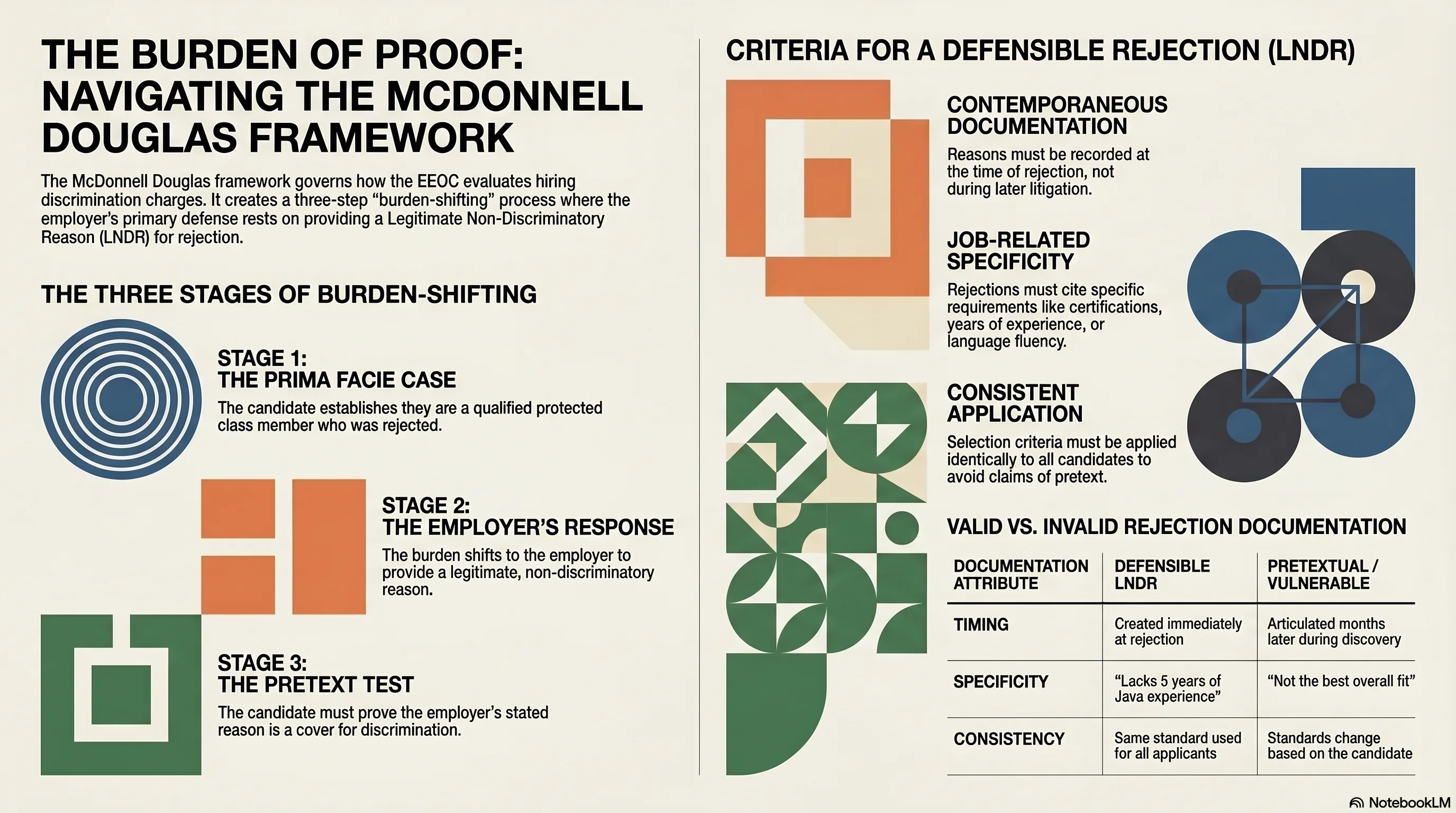
The McDonnell Douglas Framework and Its Litigation Importance
When a candidate files an EEOC charge alleging discrimination in hiring, the legal burden-shifting framework established in McDonnell Douglas Corp. v. Green, 411 U.S. 792 (1973), determines how the case proceeds. Understanding this framework is essential for knowing what documentation is legally required.
McDonnell Douglas establishes a burden-shifting framework where:
First, the candidate establishes a prima facie case of discrimination by showing: (1) they are a member of a protected class (race, color, religion, sex, national origin, age, disability); (2) they applied for a position for which they were qualified; (3) they were rejected; and (4) similarly situated candidates outside the protected class were treated more favorably.
Second, upon the candidate’s showing of a prima facie case, the burden shifts to the employer to articulate a legitimate, non-discriminatory reason (LNDR) for the rejection. The employer must provide evidence that the decision was based on job-related factors, not protected characteristics.
Third, if the employer articulates a legitimate reason, the burden returns to the candidate to prove that the employer’s stated reason is pretextual—that it is not the true reason for the rejection and that discrimination was the real motivation.
The critical point: an employer that cannot articulate a legitimate, non-discriminatory reason loses at the burden-shifting stage. Even if the employer did not intend to discriminate, lack of documented job-related reasons constitutes a legal loss.
This framework applies to all Title VII cases (race, color, religion, sex, national origin), ADEA cases (age), and ADA cases (disability). Federal contractors face similar requirements under the OFCCP’s burden-shifting framework.
The employer’s vulnerability is in the second stage. If an employer cannot produce contemporaneous documentation of the job-related reasons for rejection, courts infer that discrimination was involved. As one court stated, “The court may infer discrimination from the employer’s failure to articulate a clear and specific reason for rejecting the plaintiff’s application.” Lack of documentation shifts the inference to discrimination.
What Constitutes a Legitimate Non-Discriminatory Reason
Not every stated reason is a legitimate, non-discriminatory reason (LNDR). Courts apply several criteria to evaluate whether an employer’s stated reason is legitimate:
Job-relatedness: The reason must relate to a genuine business need or job requirement. Examples of legitimate reasons include: “The position required five years of experience in [specific field], and the candidate had two years,” or “The candidate lacked the required technical certification,” or “The position required fluency in [language], and the candidate was not fluent,” or “The position required the ability to lift 50 pounds, and the candidate could not meet this requirement without accommodation.”
Consistent application: The reason must be applied consistently across all candidates. If a candidate is rejected for lacking experience but other candidates with similar experience were hired, the stated reason is not legitimate. If a candidate is rejected for “interpersonal fit” but candidates with poor interpersonal skills were hired, the stated reason appears pretextual.
Documentation: The reason must be documented contemporaneously with the decision. Courts are suspicious of reasons articulated long after a rejection, during litigation discovery, or in response to a charge. Reason documentation should be created before or immediately after the rejection decision, not months later.
Clear specificity: Vague reasons like “best overall fit,” “stronger candidate,” or “didn’t click with the team” are weak. Courts view these as code for protected characteristic-based discrimination. Better reasons: “The position required [specific skill], and Candidate A demonstrated [specific evidence of skill] while Candidate B did not.” Specific reasons allow the candidate an opportunity to prove pretext.
Legitimate examples of LNDR:
“The position required a bachelor’s degree in accounting. The candidate had a bachelor’s degree in marketing. Other candidates had the required degree.”
“The position required familiarity with [software system]. The candidate had no experience with this system. Other candidates had 2-5 years of experience.”
“The role requires managing a team of 15 people. The candidate’s most recent role was as an individual contributor with no supervisory experience. Other candidates had experience managing teams of 10-20 people.”
“The candidate’s salary expectations [$X] exceeded the budgeted range [$Y-$Z] for this position. Other candidates accepted offers in the budgeted range.”
“The candidate’s most recent employment ended 2 years ago without explanation. We required candidates to have recent, continuous work experience to ensure they had up-to-date knowledge of current practices.”
Weaker examples that invite pretext challenges:
“The candidate wasn’t a good cultural fit.” (Vague; suggests protected-characteristic-based bias.)
“We felt [other candidate] was stronger.” (Comparative without specifics; insufficient.)
“The candidate’s background didn’t match what we were looking for.” (Too vague.)
“We had concerns about the candidate’s ability to succeed.” (No specifics; suggests speculation.)
Illegal examples that are NOT legitimate:
“We prefer candidates who are [age range, race, gender, religion, etc.].” (Explicitly discriminatory.)
“We were concerned about the candidate’s accent.” (National origin discrimination.)
“We questioned whether the candidate could handle the stress of the job given her family responsibilities.” (Sex/family status discrimination.)
“The candidate’s religious holiday observances would conflict with job requirements.” (Religion discrimination; must be analyzed as accommodation question.)
The Critical Importance of Contemporaneous Documentation
Courts and the EEOC place enormous weight on whether documentation was created contemporaneously with the decision. Contemporaneous documentation is created at the time of the hiring decision or immediately thereafter, while memory is fresh and without knowledge of whether a charge will be filed.
Why contemporaneous documentation matters: Decisions documented at the time demonstrate good faith decision-making. Decisions documented months or years later, after a charge is filed or litigation is initiated, appear defensive and suspect. Courts recognize that people do not typically sit down and write a detailed explanation of a hiring decision unless they are forced to (by litigation) or unless the decision was carefully made.
Timing guidelines:
Ideal: Documentation completed immediately after the decision (same day or next day), while the decision rationale is fresh in the decision-maker’s mind.
Acceptable: Documentation within 1-2 weeks of the decision.
Problematic: Documentation created months after the decision.
Highly problematic: Documentation created after an EEOC charge is filed or litigation is initiated.
Comtemporaneous documentation also serves a practical purpose: it ensures that the decision-maker actually articulates the reasons, making bias more likely to be caught and corrected. If a hiring manager is forced to explain in writing why a candidate was rejected, vague biases like “culture fit concerns” are more likely to be questioned internally.
Who documents: The person making the decision should document their own reasoning. A hiring manager who makes a decision should document it; an HR person should not retroactively document what the hiring manager was thinking. If multiple people were involved in the decision (e.g., panel interview), each should document their assessment, and the final decision-maker should document the reasoning for their ultimate conclusion.
What if documentation doesn’t exist: If a decision was made but documentation is not created, the employer can still defend the decision by having the decision-maker provide a detailed affidavit during litigation. However, this is weaker than contemporaneous documentation. Courts view the absence of contemporaneous documentation as suspicious. The pattern of having documentation for some decisions but not others raises questions about whether the missing documentation was intentional (to hide bias).
Documentation preservation: Once documentation is created, it must be preserved. Title VII requires employment records be kept for one year. Best practice is three years. Once a charge is filed or litigation is anticipated, a litigation hold must be implemented ensuring that all related documents are preserved and cannot be destroyed.
The FCRA Adverse Action Requirement and Its Interaction with Hiring Decisions
Many hiring decisions involve background checks, and background check decisions are governed by the Fair Credit Reporting Act (FCRA). FCRA adds documentation requirements that interact with hiring documentation.
FCRA Section 1681e(b) requires that if a background check is used in making a hiring decision, the employer must provide an adverse action notice to the applicant before making a final rejection decision. The notice must include a copy of the background report and notice of the applicant’s right to dispute inaccuracies.
How this affects documentation: The employer’s stated reason for rejection based on a background check finding must clearly explain what was found in the background check and how it relates to the job. Simply stating “background check finding” is insufficient. The documentation should state: “Background check revealed [specific finding]. The position requires [specific job duty]. The finding indicates [specific risk]. Therefore, we determined the candidate was not qualified for this position.”
If an employer relies on a criminal history finding, the background check reason documentation should also include analysis of the Green factors (nature and gravity of the offense, time elapsed, nature of the job) showing that the conviction disqualifies the candidate for the specific job.
Title VII interaction: If the FCRA adverse action is the only documented reason, but applicant flow data shows that background checks are being applied or interpreted differently for candidates of different races, the uniform application requirement becomes important. If a White candidate with a 10-year-old felony conviction is hired while a Black candidate with a 5-year-old felony conviction is rejected, the background check reason appears pretextual if the only difference is race.
Building the Rejection Decision File: Key Documentation Elements
A legally sufficient rejection decision file contains several elements:
Job description: A current job description identifying essential functions and required qualifications. This proves that the company had documented job requirements (not just ad-hoc preferences) and shows what qualifications were being assessed.
Application materials: The candidate’s resume, cover letter, and any assessments or questionnaires completed as part of the application process. These document what the candidate presented as their qualifications.
Screening notes: If a recruiter or initial screener reviewed the application, their notes on why the candidate was advanced or rejected at the screening stage. These should include: specific job requirements assessed, specific information from the application that was evaluated, and specific conclusion (advanced or rejected, and why).
Interview materials and notes: If the candidate interviewed: (1) interview questions asked and competencies assessed; (2) notes taken during the interview capturing the candidate’s responses; (3) rating form or evaluation documenting how the candidate performed on each competency or criterion; (4) indication of which candidates were compared and their relative performance. If a panel interviewed the candidate, each panel member should complete their own evaluation.
Comparable candidate information: Documentation of how other candidates in the same hiring cohort performed on the same criteria. If a candidate is rejected for lacking experience, document that others were hired with similar or more experience. If a candidate is rejected for weak communication skills, document the communication performance of hired candidates for comparison. This comparison proves consistent application of criteria.
Backgroundcheck results and analysis: If a background check was obtained, include: (1) the background check authorization form; (2) the background report; (3) documented analysis of the finding in relation to the job (FCRA requires this); (4) if criminal record, analysis of Green factors. FCRA also requires that an adverse action notice was provided before the final decision.
Reference check notes: If references were checked, include notes on what was asked, what was learned, and how reference information affected the decision. If a candidate is rejected based on reference information, the notes should document: (1) what was reported by the reference; (2) how the reference information relates to job requirements; (3) how this information compared to references from hired candidates.
Final decision documentation: A written decision memo stating: (1) the candidate’s name and position; (2) the decision (rejected or hired); (3) the specific reasons for the decision, referencing the candidate’s performance on specific job-related criteria; (4) documentation of who made the decision and when; (5) documentation of whether the candidate was notified and how. This memo should be detailed enough that someone reading it months later could understand exactly why the decision was made.
Sample final decision memo:
“Rejection Decision for [Position], [Candidate Name]
Date of Decision: [date]
Decision: We have decided not to move [Candidate Name] forward for this position.
Position Requirements: The [Position Title] position requires: [1] 5+ years of experience in [field], [2] proficiency in [specific software], [3] bachelor’s degree in [field] or equivalent experience, [4] strong communication skills demonstrated in customer-facing situations.
Candidate’s Qualifications:
[1] Experience: Resume indicates 2 years in [field]. Position requires 5 years minimum. In our interview, candidate acknowledged lack of depth in several key areas of [field]. Other candidates had 5-8 years of experience.
[2] Technical Proficiency: Interview assessment of technical knowledge was 2/5 (below expectations). Candidate could not explain [specific technical concept] despite this being essential to the role. Other candidates rated 4-5/5 on technical knowledge.
[3] Education: Candidate has bachelor’s in [different field]. While equivalent experience was considered, candidate’s lack of experience in [field] meant this degree did not provide the background needed. Other candidates had either the relevant degree or 8+ years of compensatory experience.
[4] Communication Skills: During interview, candidate’s responses were often vague or off-topic. Interview rating on communication was 2/5. When asked to walk through a customer scenario, candidate could not articulate clear explanations. Other candidates rated 4-5/5 on communication.
Conclusion: While [Candidate Name] was professional and pleasant, the candidate did not meet the essential qualifications for the position. The primary gaps are lack of required experience and technical proficiency. These are not areas that can be quickly remedied and are essential to success in the role.
Decision Made By: [Name, Title]
Date Candidate Notified: [date] via [phone/email/letter].”
Avoiding Common Documentation Failures
Many companies create documentation that they believe is sufficient but which actually creates liability. Common failures:
Generic rejection reasons: “We selected a stronger candidate” without explaining how the selected candidate was stronger is not sufficient. Specify: “The selected candidate had 7 years of experience in [field] while [rejected candidate] had 1 year. The selected candidate demonstrated strong technical proficiency on [specific assessment]; [rejected candidate] did not. The selected candidate’s interview ratings were 4-5/5 on all competencies; [rejected candidate]’s were 2-3/5 on technical knowledge and communication.”
Reason asserted only after charge is filed: If an employer cannot produce documentation of the stated reason from the hiring decision date but produces it after a charge is filed, courts assume the reason was invented to defend against the charge. Always document at the time of decision.
Reason that contradicts other decisions: If an employer states it rejected a candidate for lacking experience but hired another candidate with identical experience, the stated reason is pretextual. Before stating a reason, compare it to how the same reason was applied to hired candidates. If hired candidates were treated differently, revise the stated reason to explain the difference or adjust the decision.
Reason that appears coded for protected characteristics: Reasons like “culture fit,” “chemistry,” “interpersonal dynamics,” “personality fit,” or “gut feeling” are red flags for bias. Courts recognize these as potential code for “we don’t like working with people like this” and may interpret them as discriminatory. Be specific: “The position requires independent decision-making without frequent guidance. During the interview, the candidate asked multiple clarifying questions on hypothetical scenarios, suggesting they would need support. The hired candidate demonstrated ability to analyze scenarios and reach decisions independently.”
Inconsistent documentation: Some candidates have detailed documentation; others have minimal notes. This inconsistency can suggest that some hiring decisions were made carefully and others were made based on bias. Consistent documentation practices across all hiring decisions reduce this risk.
Documentation that reveals bias: If documentation includes subjective judgments about protected characteristics (“seemed too old for the role,” “wasn’t really a team player,” “has an accent”), these notes become evidence of discrimination. Train hiring managers that documentation should be objective and job-related, never personal.
Failing to update records when decision changes: If a candidate is initially rejected but reconsidered and hired after an appeal or additional evaluation, document the reconsideration and the new decision. Failure to update creates confusion about what the actual hiring decision was.
OFCCP Requirements for Federal Contractors
Federal contractors (companies with federal contracts of $50,000 or more) must comply with additional record-keeping requirements under the Office of Federal Contract Compliance Programs (OFCCP), which enforces Executive Order 11246 (affirmative action).
OFCCP documentation requirements:
Applicant tracking: The contractor must track all applicants and their demographic characteristics (race, ethnicity, sex, disability, veteran status). The contractor must be able to report how many candidates applied, how many were hired, and the demographic breakdown of each group.
Selection decision documentation: For any candidate not hired, the contractor must have documentation of the selection criteria and how the candidate was evaluated. This is similar to the McDonnell Douglas requirement but OFCCP enforces it proactively rather than only in litigation.
Records retention: OFCCP requires records be retained for one year from the date of record creation. For hiring decisions, this means the hiring file must be retained for one year from the hire date.
Responsiveness to OFCCP audit: If OFCCP conducts a compliance audit (which happens periodically), the contractor must be able to produce hiring documentation that demonstrates non-discrimination. Inability to produce documentation is itself a violation.
Affirmative action plan requirements: Contractors with 50+ employees must develop written affirmative action plans including: (1) self-analysis of hiring patterns; (2) identification of underutilization of minorities, women, and veterans in specific job categories; (3) goals and timetables to address underutilization; (4) monitoring of progress against goals. This requires applicant flow data disaggregated by protected characteristics.
Documentation strategy for federal contractors: Maintain hiring files that include all elements described above (job description, resume, screening notes, interview materials, final decision memo). Additionally, maintain applicant flow tracking spreadsheets showing: applicant source, date applied, position applied for, demographic information (if known), hiring action taken, and date of action. This allows ready response to OFCCP inquiries.
From Documentation to Legal Defense: Litigation Strategy
When a candidate files an EEOC charge, strong documentation of hiring decisions becomes the foundation of the employer’s defense. Here’s how documentation is used in litigation:
Prima facie case evaluation: If the candidate alleges they were rejected due to race, the EEOC (or court) looks at applicant flow data. If the rejection decision file is complete, the employer can quickly identify and compare the rejected candidate’s qualifications to hired candidates. If the rejected candidate was clearly less qualified on objective, documented criteria, the prima facie case is weak. If documentation does not exist, the EEOC assumes discrimination and the employer must defend speculatively.
Legitimate non-discriminatory reason articulation: The employer’s hiring file becomes the basis for articulating the LNDR. The final decision memo states the specific reasons; the comparability documentation proves those reasons were applied consistently.
Pretext analysis: The candidate will attempt to show the stated reason was pretextual. If the documentation shows that the hired candidate had significantly more experience, stronger interview ratings, and better references, pretext is difficult to prove. If documentation shows inconsistent application (hired candidate with worse performance), pretext is likely proven.
Evidence of discriminatory intent: The quality and objectivity of documentation can support or refute inference of discriminatory intent. Careful, objective, job-related documentation supports good faith. Biased or absent documentation supports inference of discrimination.
Settlement: Strong documentation often leads to early settlement dismissal. If the employer produces documentation showing objective reasons for the decision applied consistently, the candidate’s attorney recognizes the case is weak and settlement value is low. Weak documentation invites defense and higher settlement demands.
Litigation cost: Detailed documentation reduces litigation costs. The employer can respond quickly to discovery requests, document review is faster, and witness preparation is easier. Absent or scattered documentation means the employer must do expensive reconstruction of facts and reconstructing missing rationales invites attack.
Best Practice Implementation Checklist
- Ensure all positions have current, detailed job descriptions identifying essential functions and required qualifications (not just desired qualifications).
- Develop standardized screening criteria identifying the specific qualifications (experience, education, skills, certifications) that will be evaluated for each position type.
- Create a standardized job application form requiring candidates to provide relevant information (education, work history, skills) that correlates with documented job requirements.
- Establish a process requiring documented notes (not just ‘pass/fail’) at the screening stage identifying which requirements the candidate met and which they did not.
- For all interviews, use structured interview process with documented questions, competency frameworks, and rating scales with behavioral anchors (see EEOC article on Structured Interviews).
- Require interviewers to complete rating forms immediately after interviews documenting competency ratings with specific behavioral examples supporting each rating.
- If background checks are used, ensure the authorization form is signed before the check and the results are analyzed and documented in relation to job requirements and the Green factors (if criminal record).
- For rejected candidates, have the hiring manager or decision-maker document a final decision memo within 1-2 days of the decision including: specific job requirements, candidate’s performance on each requirement, comparison to hired candidates, and specific reasons for rejection.
- For hired candidates, similarly document a brief hiring decision memo documenting who was selected and why (specific qualifications and performance).
- Ensure that stated rejection reasons are applied consistently across all similarly situated candidates by reviewing rejection reasons in aggregate to identify patterns.
- Establish quality assurance process: monthly review of sample hiring files to ensure documentation is complete, objective, job-related, and consistent.
- For federal contractors, maintain applicant tracking spreadsheet disaggregating applicant flow and hiring outcomes by job category and demographic characteristics.
- Train all hiring managers on what constitutes sufficient LNDR documentation, the importance of contemporaneous documentation, and examples of documentation that is and is not sufficient.
- Retain all hiring documentation (applications, resumes, screening notes, interview ratings, background reports, decision memos) for a minimum of one year, preferably three years.
References and Further Reading
- Title VII of the Civil Rights Act of 1964, 42 U.S.C. §2000e et seq.
- Age Discrimination in Employment Act (ADEA), 29 U.S.C. §621 et seq.
- Title I of the Americans with Disabilities Act (ADA), 42 U.S.C. §12101 et seq.
- McDonnell Douglas Corp. v. Green, 411 U.S. 792 (1973)
- Texas Department of Community Affairs v. Burdine, 450 U.S. 248 (1981)
- St. Mary’s Honor Center v. Hicks, 509 U.S. 502 (1993)
- Fair Credit Reporting Act (FCRA), 15 U.S.C. §1681 et seq.
- Executive Order 11246 (Affirmative Action)
- EEOC Compliance Manual, Chapter 3: Hiring
- OFCCP Directive 4110.1K (Federal Contractor Compliance Manual)
- EEOC Uniform Guidelines on Employee Selection Procedures, 29 CFR §1607
How Cadient Talent SmartSuite™ Helps
Cadient Talent’s SmartSuite™ platform automates compliance workflows, embeds regulatory guardrails directly into your hiring process, and maintains audit-ready documentation at every stage—so your team can focus on finding great talent while staying protected from costly violations.
