
A single compliance error in your background check authorization can expose your company to class action liability of $100-$1,000 per violation.
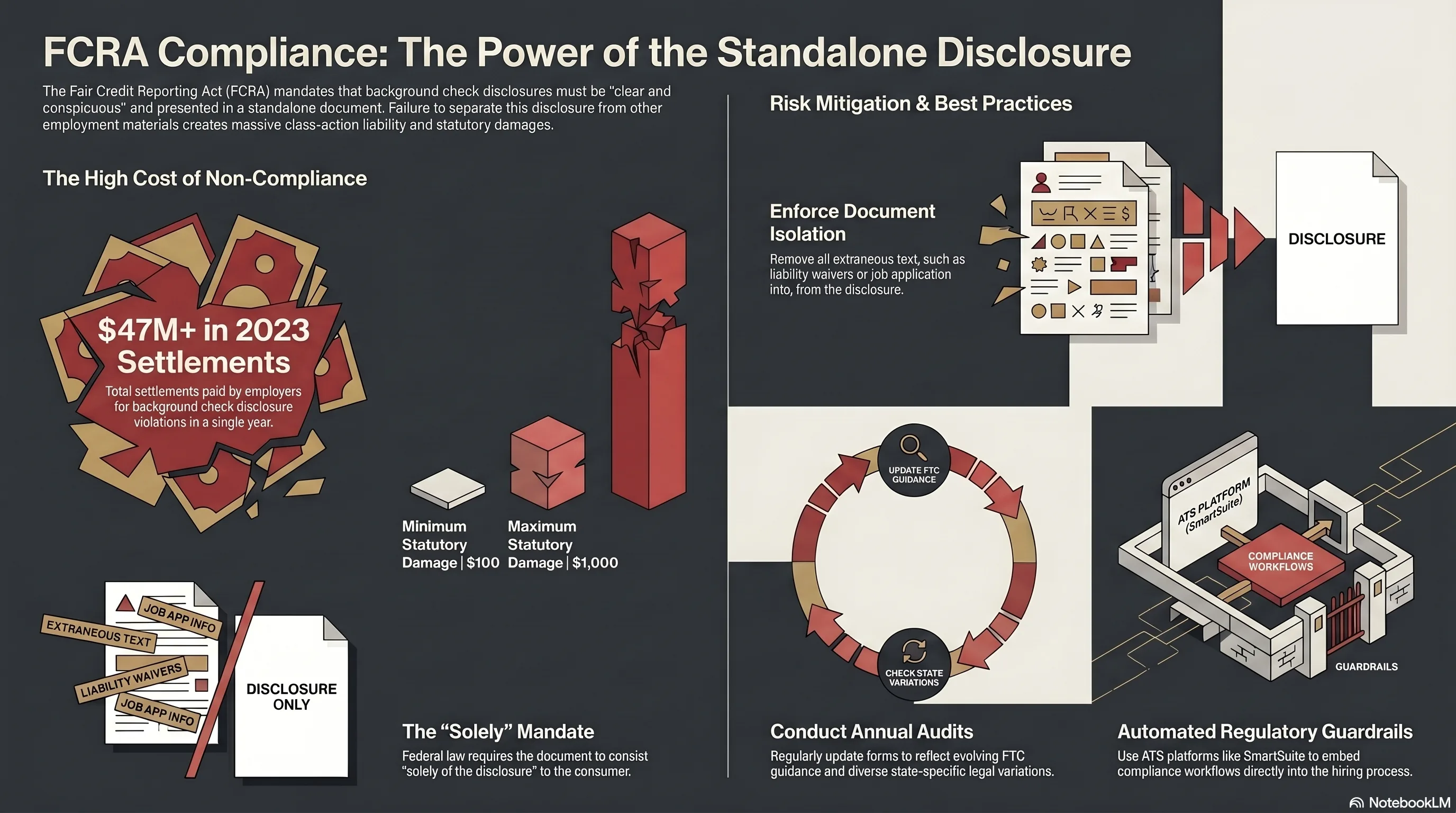
Executive Summary: Why Standalone Disclosure Matters
The Fair Credit Reporting Act (FCRA), enacted in 1970 and codified at 15 U.S.C. § 1681b(b)(2)(A), imposes a seemingly simple but legally critical requirement: employers must obtain “clear and conspicuous” written disclosure and authorization before requesting a consumer report for employment purposes. The word “clear and conspicuous” is not merely stylistic guidance—it is a statutory mandate that has spawned decades of litigation and class action settlements costing employers millions of dollars.
This requirement mandates that the disclosure about the background check must exist as a standalone document separate from job applications, offer letters, employment agreements, or other materials. When employers bundle the FCRA disclosure with other employment documents, they expose themselves to statutory damages of $100 to $1,000 per individual violation, with class action exposure multiplying this risk exponentially. In 2023 alone, FCRA background check disclosure settlements exceeded $47 million across multiple class actions. For companies using high-volume ATS platforms like SmartSuite, implementing a compliant standalone disclosure form is not optional—it is foundational risk mitigation.
This article provides a comprehensive guide to FCRA standalone disclosure compliance, including statutory requirements, controlling case law, state-specific variations, implementation checklists, and audit protocols.
The FCRA Statutory Framework: 15 U.S.C. § 1681b(b)(2)
The foundational statute governing employer use of consumer reports is 15 U.S.C. § 1681b(b)(2)(A), which states:
“Except as provided in paragraph (3), a person may not procure a consumer report, or cause a consumer report to be procured, for employment purposes with respect to any consumer, unless—(A) a clear, conspicuous, and readily understandable written disclosure has been made in a document that consists solely of the disclosure to the consumer in writing…”
The italicized language is critical: “consists solely of the disclosure.” Congress deliberately required that the disclosure stand alone, unencumbered by terms of employment, compensation structures, confidentiality clauses, or job application information. This statutory isolation requirement reflects a fundamental FCRA principle: before an employer requests sensitive information about a candidate’s financial history, criminal record, or credit profile, the candidate must clearly understand that this specific action is about to occur and must affirmatively consent to it.
The statute further requires that any authorization must be given with knowledge that it “may be used for employment purposes.” The disclosure must also include a statement that the employer may take an adverse action based on information in the consumer report, subject to the right to dispute the report’s accuracy. Violations of this requirement carry statutory damages of not less than $100 and not more than $1,000 for each violation, plus actual damages and attorney’s fees. In class action contexts, this creates exposure of millions of dollars when companies fail to use standalone disclosures.
Landmark Case Law: Syed v. M-I LLC and Walker v. Fred Meyer
Two judicial decisions define the boundaries of what constitutes “clear and conspicuous” and “sole disclosure.”
In Syed v. M-I LLC, 974 F.3d 670 (5th Cir. 2020), the Fifth Circuit reviewed an employer’s disclosure form that was presented to the applicant as a single form but which mixed FCRA statutory language with other employment-related terms and conditions. Although the FCRA disclosure language appeared first, the court found that the inclusion of additional terms—such as authorization for medical examination and drug testing—on the same document compromised the clarity and conspicuousness of the background check disclosure specifically. The court held that by intertwining the FCRA authorization with other requirements, the employer diminished the applicant’s ability to focus on and understand the specific implications of authorizing a background check. The court’s decision reinforced that “sole” means sole: not one paragraph in a multi-paragraph form, but a dedicated, isolated disclosure.
In Walker v. Fred Meyer, Inc., 992 F. Supp. 2d 1248 (D. Or. 2014), the court examined an even more problematic scenario in which an employer embedded the FCRA disclosure within a general job application form containing personal information fields, medical history questions, and other unrelated provisions. The court found this violated the FCRA because an applicant completing a normal job application might not recognize or focus on the background check disclosure embedded within the document. The court emphasized that “clear and conspicuous” means that the disclosure “stand[s] out” from surrounding text and is not “buried” or “minimized by surrounding information.”
These cases establish that compliance requires: (1) a physically separate document dedicated solely to FCRA authorization, (2) clear formatting with appropriate font sizes and spacing to ensure legibility, (3) no extraneous content that might diminish focus on the authorization itself, and (4) affirmative acknowledgment from the applicant indicating they have read and understood the disclosure.
State-Specific Variations and Enhanced Requirements
While the FCRA establishes the federal floor, several states have enacted additional requirements that employers must satisfy:
**California**: California’s Fair Employment and Housing Act (FEHA) and the state’s consumer protection statutes impose stricter requirements than the FCRA. California requires not only a clear disclosure but also separate, explicit authorization to obtain consumer reports. Additionally, California Labor Code Section 432.7 restricts employers from making hiring decisions based on certain criminal history, requiring that disclosures explicitly address these limitations. Employers must also provide California applicants with specific notice of their right to dispute information in the background report before adverse action is taken.
**New York**: New York General Business Law Section 380-l(2) requires employers to provide “clear and conspicuous” notice (similar to FCRA) but adds that employers must provide applicants with 10 business days’ notice before using background information to make an adverse hiring decision. The state also prohibits employers from considering certain sealed, expunged, or youthful offender records. New York courts have enforced strict disclosure requirements, with the courts finding that standalone disclosure forms must be provided in the applicant’s preferred language.
**Illinois**: The Illinois FCRA (50 Ill. Adm. Code 907) mirrors federal requirements but mandates that employers maintain detailed records of when disclosures were provided and when reports were requested. Additionally, Illinois restricts consideration of certain criminal history, requiring that disclosure forms inform applicants of these protections.
**Colorado**: Colorado’s Consumer Reporting Agencies Act (Colo. Rev. Stat. § 12-14.3-101, et seq.) requires stand-alone written disclosure for consumer reports obtained for employment purposes. Colorado additionally requires employers to provide a copy of the applicant’s right to counsel or a representative during disputes and to request a reinvestigation of any challenged information.
**Massachusetts**: Massachusetts requires employers to make background check disclosures in English and any other language in which the employer ordinarily communicates with applicants. The state also prohibits consideration of records of conviction until after a conviction determination is rendered, requiring special disclosure notice of these protections.
For multi-state employers, the safest approach is to use the most stringent standard across all jurisdictions. This typically means: standalone disclosure form, clear and conspicuous formatting, explicit statement of right to copy of report and right to dispute, and explicit notice of adverse action process before final hiring decisions are made.
Anatomy of a Compliant FCRA Standalone Disclosure Form
A legally compliant FCRA standalone disclosure form contains five critical elements:
**1. Title and Opening**: The document should be titled clearly, such as “Disclosure of Consumer Report Use for Employment Purposes” or “Background Check Authorization and Disclosure.” The opening should contain the applicant’s name and the employer’s name, establishing that this is a bilateral authorization document.
**2. Statutory Notice of Consumer Report Use**: The form must explicitly state that the employer may request a “consumer report” (defined by the FCRA as information about the applicant’s creditworthiness, credit standing, credit capacity, character, general reputation, personal characteristics, and mode of living). The disclosure should specifically state that this may include records from consumer reporting agencies regarding the applicant’s credit history, criminal records, motor vehicle records, and employment history.
**3. Rights Under the FCRA**: The form must include notice of the applicant’s rights to: (a) request and receive a copy of any consumer report obtained, (b) dispute the accuracy of information in the report, and (c) request reinvestigation of disputed items. The form should direct applicants to the FTC’s website (www.ftc.gov) for additional information on consumer rights, or provide the address of the FTC at 600 Pennsylvania Ave. NW, Washington, DC 20580.
**4. Authorization**: The form must contain an explicit authorization checkbox or signature line in which the applicant acknowledges: “I authorize [Employer Name] to obtain a consumer report about me for employment purposes and understand that my employment, assignment, or job status may be based in part on information in that report.”
**5. Certification of Compliance**: The form should contain a certification statement indicating the applicant has received and read the disclosure and understands their rights and the employer’s use of the background report.
Example Language:
“I hereby authorize [Company Name] to request and receive consumer reports regarding my background, including criminal history, employment records, driving records, and credit history, for the purpose of evaluating my suitability for employment. I understand that my employment or continued employment may be based upon information in such reports. I also understand that I have the right to request a copy of any consumer report obtained and to dispute the accuracy of information contained in such report by contacting the consumer reporting agency directly. I have received and read this Disclosure and Authorization form, and I understand my rights under the Fair Credit Reporting Act.”
Signature/Date:
_____________________________ ______________
Applicant Signature Date
A fully compliant form typically spans 1.5 to 2 pages in length due to the verbosity required by statute.
Common Mistakes That Create Liability
Employers frequently make the following errors in FCRA disclosure compliance:
**Bundling with Job Application**: The most common error is including the FCRA disclosure on the same page or form as job application information (name, address, phone, education history, prior employment). Even if the FCRA disclosure appears first on the form, courts have found that applicants do not experience the disclosure as “clear and conspicuous” when they must also fill out other fields. Compliant employers use a separate, dedicated form that is delivered to the applicant before or concurrent with the background check request.
**Burying the Authorization in Fine Print**: Some employers include the FCRA authorization as part of a longer section of terms and conditions in small font. Courts consistently find this violates the statutory requirement because it is not “conspicuous”—that is, it does not stand out from surrounding text. Compliant forms use clear, readable font (typically 11-14 point), clear section headers, and adequate whitespace to ensure the authorization language is readable.
**Missing Statement of Adverse Action Process**: Many employers provide FCRA disclosure at the application stage but fail to remind applicants in the disclosure form itself that they have a right to dispute report accuracy before the employer takes final adverse action. While this is technically a separate requirement (discussed in detail in articles on adverse action process), many litigation experts view it as part of comprehensive disclosure compliance. Including notice of adverse action procedures in the standalone disclosure form is a best practice.
**Combining with Other Authorizations**: Some employers create a single form that authorizes background checks, drug testing, medical examination, reference checks, and e-verify verification. While these may be necessary authorizations, the FCRA specifically requires that the disclosure “consist solely of the disclosure.” Using separate, sequenced forms for each authorization is the compliant approach.
**Failing to Obtain Affirmative Acknowledgment**: Some employers provide disclosure forms but do not obtain signed acknowledgment. Best practice includes a signature line or date field confirming that the applicant has received and understood the disclosure. This creates evidence in litigation that the applicant was properly informed.
**Outdated or Missing FTC Contact Information**: Forms that provide outdated FTC contact information or fail to include the FTC website create compliance risks. Forms should be updated annually to reflect current FTC guidance and contact information.
Statutory Damages and Class Action Risk
The FCRA provides for statutory damages of $100 to $1,000 per violation. In the context of background check disclosures, a “violation” is typically defined as a single failure to provide a compliant disclosure to a single applicant. For a company that receives 10,000 job applications per year, a non-compliant disclosure form exposes the company to potential liability of $1,000,000 to $10,000,000 in statutory damages alone (10,000 applicants × $100-$1,000 per violation). Actual damages and attorney’s fees are awarded in addition to statutory damages.
Recent class action settlements illustrate this risk:
- In 2021, a major technology company settled an FCRA class action alleging defective background check disclosures for $15 million, covering approximately 15,000 class members. Average per-applicant recovery was approximately $1,000.
- In 2022, a retail employer settled FCRA disclosure violations for $8.75 million, with the settlement covering over 8,000 class members who applied during the period of non-compliance.
- In 2023, a logistics company paid $12 million to settle allegations that its disclosure forms failed to be “clear and conspicuous” and violated state-specific background check laws.
Courts have allowed such class actions to proceed on an “opt-out” basis, meaning applicants are automatically included unless they affirmatively exclude themselves. This dramatically increases potential damages exposure compared to opt-in class actions.
Attorney’s fees in FCRA cases often equal or exceed statutory damages, as prevailing applicants’ attorneys recover hourly rates of $200-$400 per hour for significant litigation efforts. Some cases involve thousands of attorney hours, resulting in attorney’s fee awards of $3-$7 million.
The practical lesson: implementing a legally compliant standalone disclosure form costs approximately $500-$2,000 in legal review but prevents exposure to litigation costs and settlements in the millions of dollars.
Auditing Existing Disclosures and Implementation in ATS Platforms
Employers should conduct annual audits of their FCRA disclosure practices:
**Step 1: Document Review**: Pull the exact form provided to applicants during the background check process. Do not rely on what employment lawyers drafted years ago—use the actual form presented to recent applicants. Review the form against the statutory requirements and case law standards outlined in this article.
**Step 2: Formatting Assessment**: Evaluate whether the disclosure stands out from other text, whether font size is adequate (minimum 11-point), and whether the authorization language is set apart with clear headers and whitespace.
**Step 3: Content Audit**: Confirm the form includes: (a) explicit disclosure of consumer report use, (b) notice of rights to copy and dispute, (c) reference to the FTC or FTC website, (d) explicit authorization language, and (e) notice of potential adverse action based on report contents.
**Step 4: State Law Verification**: If the company operates in multiple states, verify that the form does not fall below the requirements of any state in which applicants are recruited. Implement the most stringent standard across all states.
**Step 5: Applicant Acknowledgment Protocol**: Establish a process to ensure applicants sign or date the form and retain a copy. Document in the ATS that the disclosure was provided and acknowledged for each applicant.
**Implementation in SmartSuite and Similar ATS Platforms**: Modern ATS platforms like SmartSuite allow employers to embed or integrate FCRA disclosure forms directly into the application workflow. Best practice implementation includes:
- Hosting the standalone disclosure as a dedicated web form or PDF that appears before or alongside the background check request.
- Requiring applicants to acknowledge receipt and understanding through a checkbox that reads: “I have read and received the Disclosure of Consumer Report Use, and I authorize [Company] to obtain a consumer report for employment purposes.”
- Logging the date and time the disclosure was provided and acknowledged, maintaining a permanent record in the ATS.
- Generating an acknowledgment letter or form that is provided to the applicant, creating a paper trail of compliance.
- Flagging any applicant who declined to acknowledge the disclosure and preventing background check requests until acknowledgment is obtained.
Companies using high-volume ATS platforms should work with their platform vendor to ensure the disclosure workflow is compliant. SmartSuite and similar platforms include compliance automation features that simplify this process and reduce manual oversight burden.
Practical Checklist and Next Steps
Use the following checklist to ensure FCRA standalone disclosure compliance:
□ Does your disclosure form exist as a separate, dedicated document (not bundled with application, offer, or employment agreement)?
□ Does the form use clear, readable font (minimum 11-point) and adequate whitespace to ensure conspicuousness?
□ Does the disclosure explicitly state that a “consumer report” will be requested and may be used for employment decisions?
□ Does the disclosure include notice of the applicant’s right to request a copy of the report?
□ Does the disclosure include notice of the applicant’s right to dispute information in the report?
□ Does the disclosure provide the FTC website (www.ftc.gov) or FTC contact information?
□ Does the form include explicit authorization language that the applicant must affirmatively acknowledge (signature or checkbox)?
□ Is the disclosure form available in the primary languages spoken by your applicant pool?
□ Have you reviewed your form against state-specific requirements in all jurisdictions where you recruit (California, New York, Illinois, Colorado, Massachusetts, etc.)?
□ Does your ATS log the date and time that the disclosure was provided and acknowledged for each applicant?
□ Do you maintain a copy of the form provided to each applicant (forms evolve; evidence of what was said when is critical in litigation)?
□ Is your disclosure form reviewed and updated annually to reflect any changes in FTC guidance or state law?
□ Have you conducted mock litigation discovery exercises to test your documentation practices?
Next Steps: Consult with employment counsel to review your current disclosure form and compare it against the standards outlined in this article. If non-compliance is identified, implement corrective measures immediately. For companies with high application volumes, the risk is proportional to the number of applicants processed under a defective form. Implementing compliant practices immediately halts the accrual of new violations.
References and Further Reading
- 15 U.S.C. § 1681b(b)(2)(A) – Fair Credit Reporting Act, Consumer Reporting Agency Requirements
- Syed v. M-I LLC, 974 F.3d 670 (5th Cir. 2020) – FCRA Standalone Disclosure Requirement
- Walker v. Fred Meyer, Inc., 992 F. Supp. 2d 1248 (D. Or. 2014) – Embedded Disclosure in Job Application
- FTC Regulations Implementing the Fair Credit Reporting Act, 16 CFR Part 600
- California Fair Employment and Housing Act (FEHA), Cal. Gov. Code § 12950 et seq.
- California Labor Code Section 432.7 – Restrictions on Criminal History Consideration
- New York General Business Law Section 380-l(2) – Adverse Action Procedures
- Illinois FCRA, 50 Ill. Adm. Code 907 – State Disclosure Requirements
- Colorado Consumer Reporting Agencies Act, Colo. Rev. Stat. § 12-14.3-101 et seq.
- Massachusetts Consumer Report Law, Mass. Gen. Laws c. 149, § 24L
- FTC Guidance on “Clear and Conspicuous” Disclosures – FTC.gov/FCRA
- EEOC Compliance Manual Section 15 – Background Checks and Hiring Decisions
How Cadient Talent SmartSuite™ Helps
Cadient Talent’s SmartSuite™ platform automates compliance workflows, embeds regulatory guardrails directly into your hiring process, and maintains audit-ready documentation at every stage—so your team can focus on finding great talent while staying protected from costly violations.
