
Multi-level approval bottlenecks, pre-approved ranges, and delegation frameworks that enable day-one offers.
The Approval Bottleneck: Where Offers Get Stuck
An interview ends on Tuesday. The hiring manager knows they want to hire the candidate. But the offer doesn’t reach the candidate until Friday.
Why the 3-day delay?
- Hiring manager notes need to be compiled (recruiter gathers feedback)
- Recruiter needs to “check with leadership” (email sent, may not be immediately answered)
- Offer letter is drafted (template exists but needs customization)
- Offer goes to HR for compliance review (24-hour review window)
- HR sends back requests for changes (counter-email cycle)
- Finance approves offer terms (may need to check budget)
- Finally, offer is released to candidate
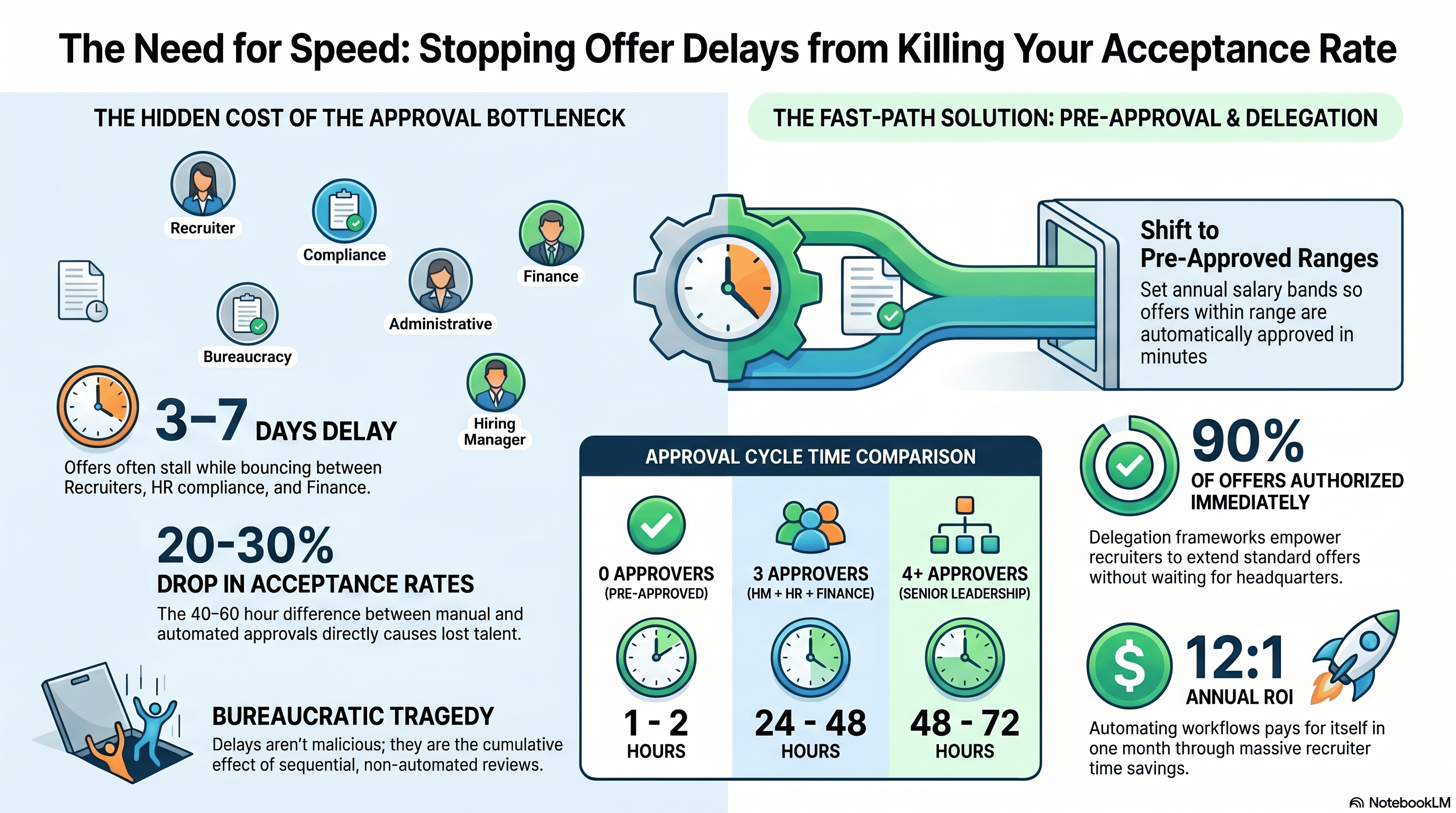
Each step adds 8-24 hours. Three or more steps sequentially = 3-7 day delay.
This is bureaucratic tragedy: nobody is maliciously slowing things down. Everyone has valid reasons (HR needs to ensure compliance, finance needs to track spend). But the cumulative effect is that candidates receive offers days after interviews, when competing offers have already been accepted.
Data on approval delays:
30-person survey of recruiting managers across industries:
- No approval needed (pre-approved range offers): 1-2 hours from interview to offer
- Single approver (hiring manager signs off): 4-6 hours
- Two approvers (hiring manager + HR): 12-24 hours
- Three approvers (hiring manager + HR + Finance): 24-48 hours
- Four+ approvers (including senior leadership): 48-72 hours
Companies with bureaucratic structures (larger organizations, matrix management) average 48-72 hours.
Companies with clear delegation (pre-approved ranges, one approver) average 4-6 hours.
The 40-60 hour difference is the difference between same-day offers and day-3 offers. And that difference is worth 20-30 percentage points in acceptance rate.
Pre-Approved Offer Ranges: Removing Approval Bottlenecks
The most effective way to remove approval delays is pre-approval. Leadership pre-approves offer ranges by role, removing the need for individual offer approvals.
Pre-approval framework:
Leadership (CFO, VP of HR, VP of Operations) meet annually and define offer ranges for each role:
Retail Operations:
- Cashier: $14.00-$16.00/hr
- Sales associate: $14.50-$16.50/hr
- Shift supervisor: $16.00-$19.00/hr
- Store manager: $22,000-$28,000 annually
Warehouse Operations:
- Warehouse associate: $16.00-$18.50/hr
- Forklift operator: $17.50-$20.00/hr
- Shift lead: $19.00-$22.00/hr
- Warehouse manager: $32,000-$42,000 annually
Healthcare Operations:
- CNA: $17.00-$20.00/hr
- LPN: $22.00-$27.00/hr
- RN: $28.00-$35.00/hr
- Clinical manager: $38,000-$48,000 annually
Ranges are set based on:
- Market rate data (salary surveys, competitor benchmarking)
- Internal equity (experienced associates paid more than new associates)
- Budget (ranges fit within approved hiring budget)
Once ranges are set, any individual offer within the range is automatically approved. No additional approval needed.
Offer placement within range:
Within the range, where does each candidate sit?
Placement logic:
- Scorecard/interview score determines placement
- Score 20+: top of range
- Score 15-19: middle of range
- Score 10-14: lower end of range
Example: Warehouse associate job, range is $16-18.50/hr
- Candidate with strong score (20+): $18.50/hr offer
- Candidate with good score (15-19): $17.25/hr offer
- Candidate with acceptable score (10-14): $16.00/hr offer
All three offers are within pre-approved range; all are auto-approved.
Implementation:
- Leadership meets and sets ranges (4-8 hours, happens once annually)
- Ranges are entered into ATS (2-4 hours)
- Offer generation is configured to automatically place candidates within range based on score (2-4 hours, one-time setup)
- From that point forward, offers are generated and auto-approved immediately
Benefits of pre-approved ranges:
- Speed: Offers approved in minutes instead of days
- Consistency: All similar candidates receive similar offers (equitable)
- Autonomy: Recruiters and hiring managers can offer without waiting for approval
- Control: Leadership still controls total compensation (via ranges) without approving every individual offer
Delegation Authority Frameworks: Empowering Local Decision-Making
Pre-approved ranges work for most offers. But some situations fall outside ranges (candidate with unusual background, equity situation, competitive issue).
For these exceptions, a delegation framework defines who can approve what:
Approval authority matrix:
Within range ($): Any recruiter can offer
- Cashier offer $14-16: Recruiter approves (offers immediately)
Within range but bonus: Hiring manager + Recruiter approval
- Warehouse associate, $16-18.50, but candidate negotiated $18.75: Hiring manager must approve (exceeds range by $0.25)
Outside range, small variance (<5%): Hiring manager + HR
- Store manager role, range $22-28k, candidate negotiated $29k: Hiring manager + HR Director must approve (exceeds by 3.6%)
Outside range, large variance (>5%): VP approval
- Executive role, unusual circumstances: VP of Operations must approve
Geographic variance (COLA): Area Manager approval
- High-cost-of-living areas may justify 10-15% above standard range: Area manager can approve adjustments for cost-of-living
This framework achieves several goals:
- Fast path for normal offers: 90%+ of offers are within range and require zero approval (immediate offer)
- Clear path for exceptional offers: Approvers know exactly what they’re reviewing and why
- Empowered teams: Recruiters and hiring managers don’t need to wait for headquarters approval for normal decisions
Typical approval time with delegation framework:
- Within-range offer: immediate (minutes)
- Small variance (5-10%): 2-4 hours (hiring manager can decide quickly)
- Large variance (>10%): 4-8 hours (requires VP discussion)
- Exceptional cases: 8-24 hours (may involve higher leadership)
With this framework, 85-90% of offers are extended immediately. Small variance offers wait a few hours. Only true exceptions wait for extended approval.
Comparison: Without framework, all offers wait for approval chain = 24-72 hours. With framework, 85% approved in minutes.
Technology-Enabled Approval Workflows: Removing Friction
Even with pre-approved ranges, manual approval processes are slow (email chains, wait for manager to check email, HR reviews, back-and-forth on details).
Technology removes friction:
Workflow automation in your ATS:
- Offer generation triggers automatically when scorecard is submitted with score >15:
- System calculates offer terms (salary/wage within range based on score)
- System generates offer document
- If within range, system marks “Auto-approved”
- If outside range, system routes for approval
- Auto-approved offers are immediately sent to candidate
- SMS notification: “Congratulations! Your offer is ready. Click here to review.”
- Email with formal offer document
- Candidate can sign electronically (e-signature)
- Out-of-range offers route automatically to appropriate approver
- Hiring manager dashboard shows “Pending offer approval” with summary
- Manager clicks “approve” or “request modification” (one-click decisions, not email chains)
- If approved, offer is sent
- If requested modification, system asks what’s needed, loops back to HR/Recruiter for update
- Approval history is documented
- Every approval is timestamped and attributed
- Audit trail shows who approved, when, under what authority
- Enables accountability and compliance
Technology stack required:
- ATS with workflow automation (SmartSuite has this built-in)
- Pre-configured offer templates
- E-signature capability
- SMS/email integration
- Dashboard for approvers
Implementation timeline:
- Workflow design: 4-8 hours (define what triggers what, which approvers get which types)
- Template creation: 4 hours (draft offer templates for each role)
- Configuration: 8 hours (set up automation logic in ATS)
- Testing: 8 hours (run test offers through workflow, verify routing)
- Deployment: 2 hours
- Total: 26-32 hours (approximately 1 week for one person)
Cost-benefit:
- Setup cost: ~$4,000 in time (assuming $125/hr labor)
- Ongoing cost: $500-1,000/month for ATS with automation (if not already paying)
- Benefit: 40-50 hour savings per week in recruiter/HR approval time = $5,000-6,000 monthly
- ROI: Breakeven in 1 month, 12:1 annual ROI
Measuring and Monitoring Approval Cycle Time
Approval delays should be tracked daily, not monthly:
Key metrics:
- Time from scorecard to offer sent:
- Measurement: timestamp of scorecard submission vs. timestamp of candidate offer notification
- Baseline: 8-24 hours (current state with manual approvals)
- Target: <2 hours (with pre-approval ranges and automation)
- Percentage of auto-approved offers (within range):
- Measurement: number of offers that required zero approval vs. total offers
- Baseline: 0% (all require approval)
- Target: 85-90% (most offers auto-approved)
- Percentage of approval requests granted:
- Measurement: of offers requesting out-of-range approval, what percentage are approved?
- Baseline: Not measured (no framework exists)
- Target: 95%+ (framework is designed to approve most requests)
- Approval cycle time by approval type:
- Within-range auto-approval: <5 minutes
- Hiring manager approval (5-10% variance): <4 hours
- VP approval (10%+ variance): <12 hours
- Offer acceptance rate vs. approval speed:
- Track: do faster-approved offers have higher acceptance rates?
- Expected correlation: Yes (faster offers = higher acceptance)
- If not correlating, investigate approval process
Dashboard:
Daily dashboard showing:
- Offers sent today: 15
- Auto-approved: 13 (87%)
- Pending approval: 1 (waiting on HM)
- Approved: 1
- Average time-to-approval: 1.2 hours
- Offers accepted today: 12
- Acceptance rate: 80%
Weekly rollup showing trends. Monthly analysis comparing approval speed to acceptance rate.
Optimization based on data:
If approval cycle time is still 8+ hours despite framework, investigate:
- Are managers checking their approval dashboards?
- Are approvers empowered to make decisions?
- Are ranges realistic (too narrow, too many variance requests)?
- Should more offers be in “auto-approve” category?
If auto-approval percentage is only 60%, but target is 85%:
- Are ranges too tight?
- Are hiring managers scoring candidates consistently?
- Do ranges need to be widened?
Data-driven optimization will move you toward 1-2 hour approval cycles and 85%+ auto-approval rates.
Organizational Alignment: Getting Leadership Buy-In for Fast Offers
Pre-approved ranges and delegation frameworks require leadership to relinquish approval control. This is hard for many organizations.
Common objections and responses:
Objection: “We need to review every offer to ensure it’s competitive.”
Response: Pre-approved ranges ARE competitive. They’re set based on market data. Individual offer review doesn’t add competitiveness; it just adds delay. Fast offers at reasonable rates beat slow offers at perfect rates.
Objection: “We can’t trust recruiters to make offer decisions without approval.”
Response: Recruiters aren’t making decisions. Pre-approved ranges make the decisions. Recruiters just execute. It’s like a restaurant franchise with standard menu prices—franchise owner doesn’t need to approve every customer order. The menu prices are already approved.
Objection: “What if we overpay someone because ranges are too broad?”
Response: That’s possible but unlikely. Ranges are set based on internal pay levels (equity band). If a candidate scores 20/25, they get top of range ($18.50). This is fair and transparent. Overpaying outliers is rare with structured scoring.
Objection: “Our approval process ensures compliance and quality control.”
Response: Approval processes verify compliance, which is valid. But that verification should happen on the ranges (one-time), not on individual offers. Have legal/HR review ranges once. Then trust that offers within ranges are compliant.
Getting buy-in:
- Share data: Show that fast offers increase acceptance rates. Calculate the financial impact: “If we reduce approval time from 3 days to same-day, and that increases acceptance rate by 20 percentage points, we hire X more people annually, worth $Y in value.”
- Pilot with one department: Implement pre-approved ranges for one department only. Track results for 2-3 months. Show data to leadership.
- Before: 8-day offer timing, 65% acceptance rate
- After: same-day offer timing, 84% acceptance rate
- Impact: 19 percentage point improvement = X additional hires
- Frame as control enhancement, not reduction: “Pre-approved ranges give us better control because they’re policy-based, not case-by-case. We’re systematizing decisions instead of making them ad-hoc.”
- Address specific concerns: If finance worries about budget, show that pre-approved ranges fit within annual budget (they do, because ranges are set with budget in mind).
Once leadership sees data, objections fade. A manufacturing company skeptical of pre-approved ranges piloted for one department. Results: 82% acceptance rate (vs. 62% previously). Leadership immediately approved expansion to all departments.
References and Further Reading
- Society for Human Resource Management, “Offer Approval Process Benchmarks,” 2023
- Cadient Talent SmartSuite Case Study, “Approval Workflow Automation Impact,” 2024
- Harvard Business Review, “The Cost of Slow Decision-Making in Recruiting,” 2023
- McKinsey, “Agile Recruiting: Decentralized Approval Models,” 2023
- LinkedIn, “Offer Acceptance Rate vs. Approval Speed Correlation,” 2024
- Glassdoor, “Candidate Perception of Offer Response Time,” 2023
- Bureau of Labor Statistics, “Job Offer Timing and Acceptance,” 2023
How Cadient Talent SmartSuite™ Helps
Cadient Talent’s SmartSuite™ platform automates compliance workflows, embeds regulatory guardrails directly into your hiring process, and maintains audit-ready documentation at every stage—so your team can focus on finding great talent while staying protected from costly violations.
