
Why single-source hiring is a bottleneck, and how to build a diversified applicant sourcing strategy
The Single-Source Trap
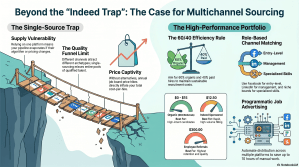
Ask most hiring managers where they source candidates and you’ll hear the same thing: ‘We post on Indeed.’ Maybe they also mention LinkedIn or their career site. But most high-volume hiring operations rely on one primary channel—usually Indeed—for 60-80% of their applicants. This is catastrophic for several reasons.
First, it creates a supply vulnerability. If Indeed changes its algorithm, raises prices, or reduces visibility for your industry, your pipeline evaporates. You’re renting access to a channel you don’t control.
Second, it limits the quality of your funnel. Different channels attract different candidates. Indeed tends to attract candidates who are actively job-searching right now. LinkedIn attracts candidates with career trajectory and professional networks. Niche job boards attract candidates who are genuinely interested in your industry. Social media attracts candidates who consume content on that platform. Employee referrals attract people who know someone at the company. Each channel has a different candidate archetype. By limiting yourself to one, you’re missing entire pools of talent.
Third, it inflates your cost per hire. If all your hiring volume is on one channel, and that channel raises prices (which they do, predictably, every year), your cost-per-hire rises across the board. There’s no leverage. No alternative.
Winning companies diversify their sourcing. They build an intentional multi-channel strategy where different jobs post to different channels, and each channel is measured for ROI. The goal isn’t to use every channel—it’s to use the right channels for the right roles, and to always have alternatives if one channel underperforms.
The Channel Universe: Where Candidates Actually Are
Let’s map out the sourcing channels available for high-volume hiring and what candidates live in each:
- Indeed: 200+ million monthly users. Heavy traffic from job-seekers doing broad searches. Best for: positions you need to fill quickly with large volume. Cost: Pay-per-click ($0.20-$1.50 per click), or organic (free).
- LinkedIn: 900+ million users, 250+ million monthly visitors to career site. Skews toward professionals and passive candidates. Best for: management roles, professional positions, passive recruitment. Cost: Sponsored job posts ($1.80-$3.00 per application), or free via company career page.
- Facebook/Instagram: 3 billion+ users, heavily mobile. Strong targeting for demographics (age, location, interests). Best for: entry-level, hospitality, retail. Cost: $0.50-$2.00 per click, CPM pricing available.
- Niche job boards: Industry-specific (e.g., Culinary Agents for food service, Logistics Job Board, Indeed FlexJobs). Lower volume, but higher quality and intent. Best for: specialized roles. Cost: varies, typically $200-$500/month flat rate or per-posting.
- Google for Jobs: Free, organic, scrapes from your website, Indeed, LinkedIn, and other sources. Appears in Google Search results. Best for: supplementing organic traffic with free visibility. Cost: Free (organic).
- Company career site: Your own domain. High-intent candidates seeking you specifically. Best for: employer brand and organic traffic. Cost: Website hosting + ATS (~$100-500/month).
- Social media (TikTok, Snapchat, YouTube): Emerging for employer branding and recruitment. Best for: Gen Z, entry-level, cultural fit. Cost: Organic (free) or paid ads ($0.50-$3.00 per view).
- Employee referrals: People who know someone at your company. Highest quality, highest retention, highest offer-acceptance. Best for: all roles. Cost: Referral bonus ($100-$500 per successful hire).
- Community partnerships: Schools, community colleges, non-profits, faith-based organizations. Pipeline of candidates actively looking for work. Best for: entry-level, underrepresented demographics. Cost: varies, typically free or small partnership fee.
- Direct outreach: Recruiter sourcing from LinkedIn, community networks, past applicants. Highly personalized. Best for: passive candidates, specialized skills. Cost: Recruiting time (~$30-100/hour).
The best operators don’t pick one. They pick a portfolio.
The Organic vs. Paid Distinction (And Why It Matters)
Every channel has an organic and paid component. Understanding the difference is critical to budgeting and ROI.
Organic sourcing: Your job posting appears for free because the system shows it to candidates. Indeed organic (posting in the main feed), Google for Jobs (free scrape), company career site, LinkedIn organic (posted to your followers), employee referrals, social media organic. Cost: zero paid, but requires either keyword optimization, promotion in-network, or luck.
Paid sourcing: You pay for visibility or clicks. Indeed sponsored, LinkedIn sponsored, Facebook ads, Google ads, niche board premium posting. Cost: $0.50-$3.00 per click, CPM pricing, or flat sponsorship fees.
High-performing multichannel strategies balance organic and paid. Why? Because:
- Paid gets immediate visibility, but isn’t sustainable long-term (cost rises, competition for ad space increases).
- Organic is free but takes time to build (SEO, career site optimization, employee network growth).
- A portfolio with 60% organic, 40% paid is financially sustainable and predictable.
Example breakdown for a 100-hire quarter:
- 30 hires from organic (career site, Google for Jobs, employee referrals, direct outreach) = ~$0 marginal cost
- 70 hires from paid (Indeed, LinkedIn, Facebook ads) = $2,000-3,500 spend
- Cost per hire: $20-35 per hire on paid, $0 on organic
- Blended cost per hire: $14-24
Companies that only use paid sources end up spending $100-150+ per hire when volume increases. Companies with strong organic pipelines stay under $30 per hire even at scale.
Programmatic Job Advertising: The Emerging Standard
A newer approach is gaining traction: programmatic job advertising. Think of it like programmatic display ads, but for jobs. You write one job posting, and it automatically distributes to multiple job boards, social media platforms, and search engines based on rules you set.
Tools that do this: Programmatic job advertising platforms like SmartRecruiter, Workable, and LinkedIn’s Job Distributor can send a single job posting to Indeed, LinkedIn, Facebook, Google for Jobs, niche boards, and your own career site simultaneously.
Benefits:
- You don’t manually post to 10 different platforms (saves 5-10 hours per month)
- You can set rules: ‘Post to niche boards only if we get fewer than 30 applications from Indeed after 3 days’
- You get unified analytics: ‘Where did this hire come from?’
- You can A/B test: Job posting A goes to channels 1, 2, 3. Job posting B goes to 4, 5, 6. See which performs better.
Cost: Typically $500-2,000/month for distribution + analytics, but can save more than that in paid job posting fees and recruiting time.
Programmatic isn’t a replacement for strategic channel selection—you still need to decide which channels matter for your roles. But it’s the execution tool that makes multichannel feasible at scale.
Cost-Per-Hire Analysis by Channel
Here’s what real cost-per-hire looks like across channels, based on industry data:
Channel / Cost Per Click or Flat Fee / Typical Conversion Rate (Application to Hire) / Resulting Cost Per Hire
- Indeed organic (free): $0 / 20-to-1 / $0
- Google for Jobs (free): $0 / 25-to-1 / $0
- Company career site: $100/month ÷ hires per month = varies / 15-to-1 / $5-15 per hire
- Employee referrals: $300 bonus / 1 referral = $300 / 8-to-1 (faster, higher quality) / $300
- LinkedIn organic: $0 / 30-to-1 / $0
- Facebook ads: $1.00/click / 22-to-1 / $22 per hire
- Indeed sponsored: $0.50/click / 25-to-1 / $12.50 per hire
- LinkedIn sponsored: $2.00/click / 35-to-1 / $70 per hire
- Niche job boards: $300-500/month per posting / 15-to-1 / $20-30 per hire
- Direct recruiter sourcing: $50/hour at 3 hires/month / 8-to-1 / $200+ per hire
What jumps out?
- Organic (free) channels have the best cost-per-hire, but require time to build (SEO, career site traffic, employee network).
- Employee referrals have the highest raw cost ($300), but the fastest conversion and best retention, so total cost-of-employment is lowest.
- Indeed and Facebook ads are in the sweet spot: cheap per click, reasonable conversion, high volume potential.
- LinkedIn sponsored is expensive and typically wastes money on retail/hospitality roles (wrong candidate archetype).
- Niche boards work well for specialized roles and have better conversion than general boards.
The implication: your channel mix should be driven by cost and fit, not habit. ‘We’ve always posted on Indeed’ isn’t a strategy.
Attribution Tracking: The Hidden Complexity
Here’s where most companies fail at multichannel sourcing: they can’t attribute hires to channels accurately.
Scenario: A candidate applies on Indeed, gets no response (your fault). They see your Facebook ad later that week, click it, and apply again through your career site. Six weeks later, they’re hired. Where did that hire come from?
Most companies would say ‘career site’ because that’s the last touchpoint. They’d undervalue Facebook ads. But Facebook ads were the re-engagement mechanism.
Proper attribution requires:
- UTM parameters on every link: When you post a job on Indeed, Facebook, LinkedIn, add UTM parameters to the destination URL (the apply link). This tells your ATS which channel the candidate came from. All modern ATS platforms support this.
- ATS data integration: Your ATS should track ‘source of application,’ ‘source of interview,’ and ‘source of hire’ as separate fields. Where did they first apply? Where did they interview? Where were they hired? Sometimes these are different.
- Regular reporting: Monthly, calculate cost-per-application and cost-per-hire by channel. Rank channels by efficiency. Double down on winners, cut losers.
Example report (monthly):
Channel / Applications / Interviews / Hires / Cost Per Application / Cost Per Hire
- Indeed organic: 156 / 39 / 7 / $0 / $0
- Facebook ads: 89 / 31 / 8 / $1.50 / $17
- Career site: 34 / 12 / 2 / $3.00 / $150
- LinkedIn sponsored: 23 / 6 / 1 / $8.50 / $170
- Employee referrals: 5 / 4 / 3 / $60 / $300
What does this tell you? Organic wins. Facebook and Indeed paid are efficient. LinkedIn sponsored is a waste. Referrals are expensive but fast and high-quality.
Decision: Cut LinkedIn sponsored. Reinvest that budget in Facebook ads and Indeed. Double down on employee referral program. This is data-driven sourcing.
Building Your Multichannel Sourcing Strategy
Here’s how to build a sustainable, ROI-focused sourcing strategy:
Step 1: Audit current state. For the last quarter, where did your hires actually come from? Don’t guess. Pull data from your ATS or applicant history. Calculate actual cost-per-hire by channel. This is your baseline.
Step 2: Segment by role type. Different roles perform better on different channels. Entry-level hospitality? Try Facebook ads and organic Indeed. Logistics supervisors? Try niche boards and LinkedIn. Warehouse hourly? Employee referrals and Google for Jobs. Don’t use the same channel for all jobs.
Step 3: Set channel targets. For each role type, decide: What’s the ideal cost-per-hire? What volume do we need? Which channels should we use?
Example:
Role: Retail associate (50 hires needed, target cost $20/hire)
- Primary: Indeed organic (target 30 applications/week, $0 cost)
- Secondary: Facebook ads (target 15 applications/week, $1.50/click = ~$22/hire if conversion is standard)
- Tertiary: Employee referrals (target 3/week, $300 per hire, but faster and better quality)
- Experiment: Google for Jobs optimization (free, target 5 applications/week)
Step 4: Build the execution. Post to your selected channels. Set up UTM tracking. Build workflows for screening. Measure.
Step 5: Optimize monthly. Look at the data. Which channels are overperforming? Double the budget there. Which are underperforming? Cut them. Shift budget between channels based on ROI. This is continuous improvement.
Channel-Specific Optimization Tips
Different channels reward different optimization approaches:
Indeed:
- Write job titles for Indeed’s algorithm, not just your internal naming: ‘Retail Associate’ not ‘Sales Associate, Full-Time’.
- Include salary in the posting (Indeed promotes postings with salary).
- Respond within 24 hours to applications (Indeed tracks this).
- Use “easy apply” (faster conversion).
LinkedIn:
- Post to your company page first (free reach to your network), then sponsor if needed.
- Use industry keywords that passive candidates would search for.
- Avoid expecting LinkedIn to work well for hourly retail roles (wrong audience).
- Use LinkedIn for management, professional, and specialized hiring.
Facebook/Instagram:
- Use compelling imagery and video (stop the scroll).
- Target by location, age, interests (“people interested in retail jobs, 18-35, within 10 miles”).
- Run multiple ad variations and find winners.
- Link directly to easy-apply (don’t require clicking away).
Google for Jobs:
- Publish structured data (schema.org JobPosting markup) on your career site.
- Google will crawl and display your jobs in Google Search.
- Completely free organic traffic if you set it up right.
- Update job postings regularly (Google prioritizes fresh listings).
Employee referrals:
- Make it effortless (referral link in email, one-click nominate).
- Advertise the bonus program internally (employees don’t know it exists if you don’t tell them).
- Offer tiered bonuses: $100 for entry-level, $300 for mid-level, $500 for specialized roles.
- Pay quickly (immediately upon hire start, not after 90 days).
Niche boards:
- Research which niche boards your target candidates use.
- Post when candidates are most active (usually Thursday-Monday).
- Use industry jargon in the posting (these candidates are industry-focused).
The Competitive Advantage of Multichannel Sourcing
Companies that master multichannel sourcing have a structural advantage over single-channel competitors:
- Lower cost per hire: Diversification is literally cheaper. You’re not captive to one platform’s pricing.
- Faster hiring: Candidates come from multiple pipelines simultaneously. Multiple offers, multiple interviews, faster time-to-fill.
- Better candidate quality: Different channels attract different archetypes. By mixing channels, you get diversity in your candidate pool, which statistically leads to better hires.
- Resilience: If one channel underperforms, you have others. Your hiring isn’t derailed by one platform’s algorithm change.
- Talent pool ownership: Over time, organic channels (career site, referrals, community partnerships) become self-sustaining. You’re not dependent on paying platforms.
Companies that don’t do this suffer: they overpay per hire, they’re dependent on Indeed or LinkedIn, their hiring slows during algorithm changes, and they get lower-quality candidates because they’re only tapping one segment of the market.
The competitive gap is 5-7 years away: in 2030, single-channel hiring will look like single-source supply chain management looks now—reckless and outdated. The companies building multichannel sourcing now will have a permanent cost and speed advantage by then.
Start your channel audit this week. Know your current cost-per-hire by channel. You’ll discover you’re overpaying somewhere. Fix it. Diversify. Your recruiting velocity will accelerate, and your cost per hire will drop.
References and Further Reading
- Indeed Hiring Lab. (2024). ‘Job Board Market Share and Application Volume Trends.’ Data on indeed.com’s market dominance and channel diversification.
- LinkedIn Talent Solutions. (2023). ‘Cost Per Hire by Channel: 2023 Data.’ Comparative analysis of LinkedIn, Indeed, Facebook, and niche board ROI.
- Glassdoor Economic Research. (2023). ‘Candidate Journey: Where Job Seekers Search.’ Multiplatform candidate behavior research.
- RetailMeNot Careers. (2023). ‘Retail and Hospitality Hiring: Channel Effectiveness Study.’ Hourly workforce sourcing data.
- SmartRecruiter. (2024). ‘Programmatic Job Advertising Benchmarks.’ Data on automated distribution and cost reduction.
- Workable Insights. (2023). ‘How to Measure and Optimize Recruiting ROI by Channel.’ Attribution and cost-per-hire analysis.
- Bureau of Labor Statistics. (2023). ‘Job Seeker Behavior and Online Platforms.’ Labor market data on where candidates search.
How Cadient Talent SmartSuite™ Helps
Cadient Talent’s SmartSuite™ platform automates compliance workflows, embeds regulatory guardrails directly into your hiring process, and maintains audit-ready documentation at every stage—so your team can focus on finding great talent while staying protected from costly violations.
