
Understanding the pre-offer, post-offer, and employment-stage inquiry framework under 42 USC §12112(d)
Executive Summary
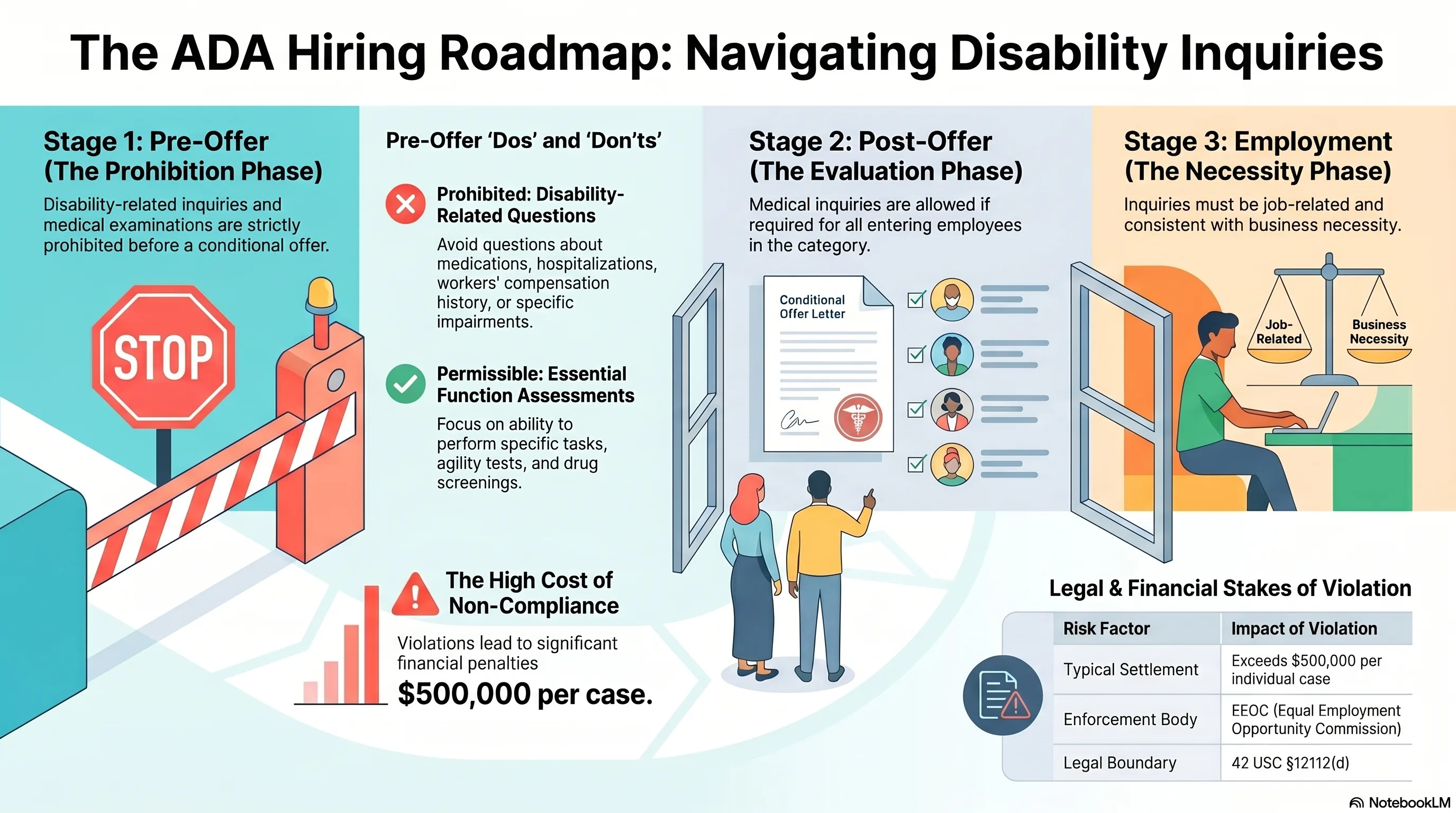
The Americans with Disabilities Act (ADA) prohibits employers from asking disability-related questions or requiring medical examinations until after a conditional job offer has been made. This restriction is codified in 42 USC §12112(d) and is a critical boundary that separates lawful pre-employment assessment from unlawful pre-offer medical inquiry. Yet in practice, this boundary is frequently blurred: recruiters ask “Have you ever been diagnosed with a mental health condition?” Hiring managers inquire about workers’ compensation history. Employers require functional capacity evaluations before the conditional offer. These inquiries violate the ADA even if made with no discriminatory intent. The EEOC has sued employers for millions of dollars over pre-offer disability inquiries, and settlements regularly exceed $500,000 per case. This article provides a comprehensive examination of the three-stage inquiry framework, the definition of disability-related inquiries, permissible pre-offer assessments, the conditional offer dividing line, and practical auditing processes to ensure pre-offer questions comply with the ADA.
The Three-Stage Framework: Pre-Offer, Post-Offer, Post-Employment
42 USC §12112(d) establishes a clear three-stage framework governing medical inquiries and examinations in the recruitment and employment process:
Stage 1: Pre-Offer (Recruitment Through Conditional Offer)
Before a conditional job offer is made, the ADA prohibits disability-related inquiries and medical examinations. Employers may ask questions related to essential job functions and may require job-related tests, but may not ask questions designed to elicit disability information.
Stage 2: Post-Offer (After Conditional Offer But Before Employment Begins)
After a conditional offer has been made, an employer may require medical examinations and ask disability-related questions, provided that all entering employees in the same job category are required to undergo the same examination or questioning, and that all resulting information is maintained separately from the general personnel file.
Stage 3: Employment (After Employee Begins Work)
Once employment begins, medical inquiries and examinations are restricted. An employer may require medical examinations only if they are job-related and consistent with business necessity. Routine periodic exams are permissible if applied to all employees in the same category.
This three-stage framework is not negotiable—it is a statutory requirement that applies to all employers subject to Title I of the ADA (generally, employers with 15 or more employees). The EEOC has emphasized that this framework exists to prevent employers from screening out individuals with disabilities at the pre-offer stage, before the employer has made a commitment to employ them.
Critically, the division between Stage 1 and Stage 2 is the “conditional job offer.” A conditional offer means the employer has decided, in principle, to hire the candidate, subject only to completion of post-offer requirements (background check, medical examination, reference check). The offer must be in writing and must clearly indicate that employment is conditional pending completion of specified requirements. An offer that states “contingent upon passing a medical examination” or “contingent upon results of a background check” is a conditional offer that triggers the Stage 2 period.
Defining Disability-Related Inquiries: EEOC Enforcement Guidance
The EEOC has issued comprehensive enforcement guidance (“Enforcement Guidance on Disability-Related Inquiries and Medical Examinations”) that defines what constitutes a “disability-related inquiry.” This definition is broader than employers often assume.
A disability-related inquiry is any question that is likely to elicit information about a disability. The standard is objective: would a reasonable person understand that the question is intended to solicit disability information, or would the question likely result in the disclosure of disability information even if the employer did not intend that result?
Examples of Clearly Prohibited Pre-Offer Inquiries:
- “Do you have any disabilities?” (explicit)
- “Have you ever been diagnosed with a mental health disorder?” (explicitly about diagnosis)
- “How much sick leave have you used in the past year?” (likely to reveal disability information)
- “Have you ever filed a workers’ compensation claim?” (likely to reveal work-related injury or illness)
- “Do you take any prescription medications?” (likely to reveal medication for disability)
- “Have you ever been treated for anxiety or depression?” (explicitly about mental health)
- “Are you able to lift 50 pounds?” (functional capacity question that must be asked in a non-medical manner)
The last example is important: an employer can ask whether the applicant can perform specific job functions (essential functions), but the manner of asking matters. An employer may ask “The job requires lifting up to 50 pounds. Are you able to do this?” This is a direct job-function question. However, if the employer asks this question only of certain applicants (for example, only those who appear to have a disability), or asks follow-up questions like “Why can’t you lift 50 pounds?” or “What medical condition prevents you from lifting?”, the inquiry becomes disability-related and violates the ADA.
Subtle Disability-Related Inquiries:
Many employers violate the ADA without realizing it by asking questions that are not explicitly about disability but are likely to elicit disability information:
- “Describe your work history gaps.” (May elicit explanation of disability-related leave or unemployment due to disability)
- “Have you been a good employee in the past?” (Vague but can prompt disclosure of disability affecting performance)
- “How many days of work did you miss in your last position?” (Likely to reveal if time missed was due to disability)
- “Are there any reasons you might need accommodations or flexibility in your work schedule?” (Directly requesting disability disclosure)
- “Do you have any known limitations or restrictions?” (Clearly inviting disability disclosure)
These inquiries are not explicitly about medical information or disability, but they are likely to result in disclosure of disability information. Under EEOC guidance, they are prohibited at the pre-offer stage.
The EEOC has brought enforcement actions against employers for using pre-offer inquiries like “Any limitations on your ability to perform the essential functions of the job?” Finding that this question, even though framed neutrally, is a disability-related inquiry because it is likely to elicit disability information.
Permitted Pre-Offer Questions:
In contrast, employers may ask pre-offer questions that are job-related and do not seek disability information:
- “Can you perform the essential functions of this job with or without reasonable accommodation?” (This is permissible because it acknowledges the possibility of accommodation and does not ask about disability)
- “Describe your experience in [skill required for the job].” (Job-related, not disability-related)
- “How would you approach this work situation?” (Behavioral, job-related)
- “Have you worked in this industry before?” (Work history, not disability-related)
- “What attracted you to this position?” (Motivation, not disability-related)
The distinction is important: the employer can ask “Can you perform the essential functions?” and may require a “yes” answer as a condition of employment, but the employer cannot ask “Why might you not be able to perform these functions?” The first question is job-related; the second is disability-related.
Functional Capacity Evaluations and Pre-Offer Job-Related Assessments
A functional capacity evaluation (FCE) is a medical assessment in which a healthcare provider evaluates an individual’s physical and cognitive abilities to determine whether the person can perform specific job functions. FCEs are common in occupational medicine and are often used by employers to determine whether an applicant can safely perform a job.
The critical compliance question: Can an employer require an applicant to undergo an FCE before making a conditional job offer?
The answer is no—with narrow exceptions. Under 42 USC §12112(d), a functional capacity evaluation is a medical examination, and medical examinations are prohibited before a conditional offer is made. Requiring an applicant to undergo an FCE pre-offer violates the ADA.
The exceptions are limited:
- Safety-sensitive positions (commercial driver’s license holders, pilots, law enforcement) may require functional assessments if they are job-related and consistent with business necessity, and if they are applied uniformly to all applicants.
- Jobs with inherent safety requirements may require demonstrated ability to perform specific physical functions (e.g., a firefighter position may require demonstration of ability to carry equipment and climb ladders), provided the assessment is performed as a job test rather than a medical examination.
The distinction between a “job test” and a “medical examination” is critical and sometimes blurry. A job test is an assessment of whether the applicant can perform an essential job function, conducted in the normal work environment or a simulated environment. A medical examination is an assessment by a healthcare professional using medical methods and protocols.
For example:
- Requiring an applicant to walk a 50-foot course while carrying a 30-pound weight (simulating job performance) is a job test and is permissible pre-offer.
- Requiring an applicant to undergo a medical evaluation assessing cardiovascular fitness, joint mobility, and muscle strength (the functional assessment component of an FCE) is a medical examination and is prohibited pre-offer.
In practice, many employers violate this distinction by requiring applicants to undergo occupational medicine evaluations pre-offer, arguing that the evaluation is “job-related.” The EEOC has successfully challenged this practice, finding that even job-related evaluations are medical examinations when conducted by healthcare professionals using medical protocols.
Best practice is to structure pre-offer assessments as job demonstrations (perform the actual work or a simulation) rather than as medical evaluations. Post-offer, the employer may require comprehensive medical examinations to ensure the applicant can safely perform the job.
The Conditional Offer: Timing and Documentation
The dividing line between Stage 1 (pre-offer) and Stage 2 (post-offer) is the conditional job offer. Understanding what constitutes a conditional offer is essential because the timing of the offer determines whether subsequent medical inquiries are permissible.
A conditional job offer must meet two criteria:
- It must be a genuine offer: The employer has decided, in principle, to hire the candidate. The offer must not be a preliminary expression of interest (“We’re interested in you,” “You seem qualified”), but a formal commitment (“We are offering you employment in the position of [title]…”).
- It must clearly specify conditions: The offer must state what post-offer requirements must be completed before employment begins. Common conditions include background check, drug screening, medical examination, reference verification, and degree verification.
A conditional offer is typically documented in writing, though ADA case law does not explicitly require written offers. However, best practice is to make conditional offers in writing and to clearly label them as “conditional offers of employment.” This documentation protects the employer by providing clear evidence of when the post-offer stage began.
Timing Issues:
A common compliance error is treating the medical examination as occurring simultaneously with or before the conditional offer. For example:
- An employer says, “We’d like to offer you the job, but you need to pass a medical exam first.” This can be ambiguous—did the conditional offer precede the medical exam request, or are they simultaneous?
- An employer sends a written conditional offer and a medical examination request in the same email, without clearly sequencing them. This can create confusion about timing.
Best practice is to:
- Send the conditional offer in a separate communication from the medical examination request.
- In the conditional offer, clearly specify that a medical examination will be required before employment begins.
- After the conditional offer has been accepted (or sent, if the employer does not require explicit acceptance), then request the medical examination.
- Document the date of the conditional offer and the date of the medical examination request.
This sequencing eliminates ambiguity about timing and demonstrates that the medical examination was required only after the offer was made.
Multiple Applicants and Sequential Offers:
When an employer is interviewing multiple applicants for a single position, medical inquiries may be permitted for one applicant but not another, depending on the timing of offers. For example:
- Applicant A is offered the job on Monday and required to undergo a medical exam on Tuesday (permissible).
- Applicant B is still in the interview process on Monday; the employer may not require applicant B to undergo a medical exam until a conditional offer is made to applicant B.
The employer must track the offer timing for each applicant separately. A common error is using a standardized process that applies medical examinations to all candidates in a finalist pool before making a formal offer—this violates the ADA.
Drug Testing and Genetic Information: Statutory Exceptions
The ADA contains specific exceptions to the prohibition on pre-offer medical inquiries:
Drug Testing:
42 USC §12114 provides that an employer may require applicants and employees to submit to drug tests at any point in the recruitment or employment process. Drug testing is not considered a “medical examination” under the ADA, and therefore the pre-offer prohibition does not apply. However, this exception applies only to tests for illegal drugs; testing for lawful medications (even if those medications are used to treat disabilities) is not permitted pre-offer under this exception.
The statutory language specifically states: “A test to detect the illegal use of drugs is not considered a medical examination.” The EEOC has clarified that this exception applies only to:
- Urine drug screens for illegal controlled substances
- Blood tests for illegal drugs
- Hair tests for illegal drugs
The exception does not apply to:
- Alcohol testing pre-offer (alcohol is not an illegal drug, so testing is subject to the general pre-offer prohibition)
- Prescription drug testing pre-offer (even if screening for prescription opioids)
- Testing for the presence of metabolites of marijuana where state law permits medical marijuana use
Genetic Information:
The Genetic Information Nondiscrimination Act (GINA, 42 USC §2000ff) prohibits employers from requesting or requiring genetic information about applicants or employees. GINA defines “genetic information” broadly to include genetic tests, family medical history, genetic counseling, and fetal genetic information. The prohibition applies to all points in the employment relationship, not just pre-offer.
GINA’s protections are separate from and broader than the ADA’s medical examination restrictions. An employer may not request family medical history even post-offer if the request is framed in a way that seeks genetic information. For example, a post-offer medical history form that asks “Has anyone in your family been diagnosed with heart disease or diabetes?” violates GINA even though it occurs post-offer.
Best practice is to instruct medical providers (occupational health clinics, physicians) to exclude questions about family medical history from post-offer medical evaluations. The employer should focus the post-offer medical exam on the applicant’s own medical conditions that are relevant to job performance, not on family history or genetic predisposition.
Practical Pre-Offer Question Audit Process
Ensuring ADA compliance in pre-offer inquiries requires systematic review of all questions asked during recruitment. The following process helps identify and eliminate non-compliant questions:
- Audit Job Descriptions and Application Forms: Review the job description, online application, and any screening questionnaires to identify questions that are asked of all applicants. For each question, ask: “Is this question likely to elicit disability information?” If the answer is yes, the question violates the ADA and must be eliminated or modified.
- Review Behavioral Interview Questions: Interview guides and behavioral questions should be reviewed to ensure they do not inquire about disability. Questions like “Describe a challenge you overcame” or “Tell us about a time you struggled” are broad and not inherently disability-related, but follow-up questions that specifically probe for disability information (“What medical condition caused that challenge?”) violate the ADA.
- Examine Pre-Screening Assessments: Cognitive tests, aptitude tests, and job simulations are generally permissible pre-offer. However, if the employer uses functional capacity evaluations, physical fitness tests, or medical screening questionnaires pre-offer, these are likely to violate the ADA. These should be moved to the post-offer stage.
- Review Medical History Forms: If the employer requires medical history forms or background information from healthcare providers pre-offer, this violates the ADA. Medical inquiries are prohibited pre-offer. Any medical forms should be required only post-offer.
- Examine Reference Check Procedures: If the employer asks references about an applicant’s medical history, disability status, or ability to work due to health conditions, this indirectly elicits disability information and violates the ADA. Reference checks should focus on work performance and job-related qualifications, not health or disability.
- Check Background Check Providers: Third-party background check companies should not be instructed to report on health or disability information. If background check reports include workers’ compensation history or medical-related terminations, the employer should request that background check providers exclude this information, as it is likely to reveal disability status.
- Document Findings and Create a Compliance Plan: Document the audit findings, identify non-compliant practices, and create a corrective action plan. Non-compliant questions should be eliminated, and alternative job-related questions should be developed. Staff should be retrained on compliant inquiry practices.
This audit should be conducted annually or when interview guides or application forms are updated.
Common Pre-Offer Compliance Errors and Litigation Patterns
EEOC enforcement cases and private ADA litigation reveal recurring patterns of pre-offer disability inquiry violations:
Incorporating Workers’ Compensation History in Pre-Offer Screening: Employers frequently ask applicants about workers’ compensation claims or injury history prior to making offers. This is prohibited because workers’ compensation claims typically involve disclosure of disability. The EEOC has sued employers for asking questions like “Have you filed any workers’ compensation claims in the past five years?” at the application stage. Settlement amounts have exceeded $500,000 in some cases.
Required Medical Forms Before Conditional Offer: Employers requiring applicants to complete medical questionnaires or history forms before a conditional offer is made violates the ADA. One notable case involved an employer requiring all applicants to complete a comprehensive medical history form at the interview stage; the EEOC successfully sued for violation, and the employer paid substantial damages.
Physician Sign-Off Before Conditional Offer: Requiring physician clearance or medical certification that the applicant is “fit for duty” before making a conditional offer violates the ADA. This is particularly common in industries with safety-sensitive positions (healthcare, transportation, law enforcement). While post-offer medical evaluations are permissible, pre-offer physician clearance is not.
Functional Capacity Evaluations at the Interview Stage: Requiring applicants to undergo functional capacity evaluations (conducted by occupational medicine providers) pre-offer violates the ADA. These evaluations are medical examinations and are prohibited pre-offer. However, employers often use them pre-offer because the jobs involve physical demands. The EEOC has successfully challenged this practice.
Vague “Ability to Perform” Inquiries: Asking applicants whether they have “any limitations on your ability to perform this job” or “any conditions that might affect your work” is a disability-related inquiry, even though it is not explicitly about medical information. Follow-up questions that probe for details about limitations or conditions are clearly prohibited.
Healthcare Industry Compliance Issues: Healthcare employers are particularly vulnerable to pre-offer medical inquiry violations because the industry commonly uses occupational health screening. However, the ADA prohibits pre-offer medical screening even in healthcare. One large healthcare system settled an ADA case for millions of dollars due to requiring all applicants to undergo pre-offer physical examinations and substance abuse screening.
These enforcement patterns demonstrate that the pre-offer prohibition is rigorously enforced by the EEOC and that employers face substantial liability for violations, even when the violations are not intentional.
How Cadient Talent SmartSuite Helps
Cadient Talent’s SmartSuite platform embeds ADA compliance into the applicant tracking system, preventing prohibited pre-offer inquiries and ensuring that medical inquiries and examinations occur only post-offer. The system maintains a compliant question bank for interviews and application forms, flagging any user-created questions that appear to be disability-related. SmartSuite tracks the timing of conditional offers and automatically blocks any request to conduct medical examinations or require medical documentation until a conditional offer has been documented in the system. The platform provides clear workflow guidance for recruiters distinguishing permissible pre-offer assessments (job-related tests, behavioral questions) from prohibited medical inquiries. When medical examinations are scheduled post-offer, SmartSuite ensures that all job applicants receiving conditional offers in the same job category are required to undergo the same examination, maintaining consistency and supporting compliance with the ADA’s equal-treatment requirement. By automating the pre-offer/post-offer distinction and maintaining audit trails of all inquiry timing, SmartSuite reduces ADA litigation risk and demonstrates good-faith compliance to the EEOC.
References and Further Reading
- 42 USC §12112(d): Medical examinations and inquiries under the ADA
- EEOC Enforcement Guidance on Disability-Related Inquiries and Medical Examinations of Employees Under the ADA
- 29 CFR §1630.13: Prohibited inquiries and examinations
- EEOC v. Medical Transportation Specialists (11th Cir. 2018): Pre-offer medical inquiry violation and damages
- Leonel v. American Airlines (N.D. Cal. 2012): Functional capacity evaluation as prohibited pre-offer medical examination
- 42 USC §2000ff (GINA): Genetic Information Nondiscrimination Act and family medical history restrictions
- 42 USC §12114: Drug testing exception to medical examination prohibition
- EEOC Compliance Manual Section 902: ADA obligations in recruitment and hiring
- DOJ ADA Title I Technical Assistance: Guidance on pre-offer and post-offer inquiry procedures
How Cadient Talent SmartSuite™ Helps
Cadient Talent’s SmartSuite™ platform automates compliance workflows, embeds regulatory guardrails directly into your hiring process, and maintains audit-ready documentation at every stage—so your team can focus on finding great talent while staying protected from costly violations.
