
The Speed-Quality Balance in High-Volume Hiring
The Speed-Quality Tradeoff
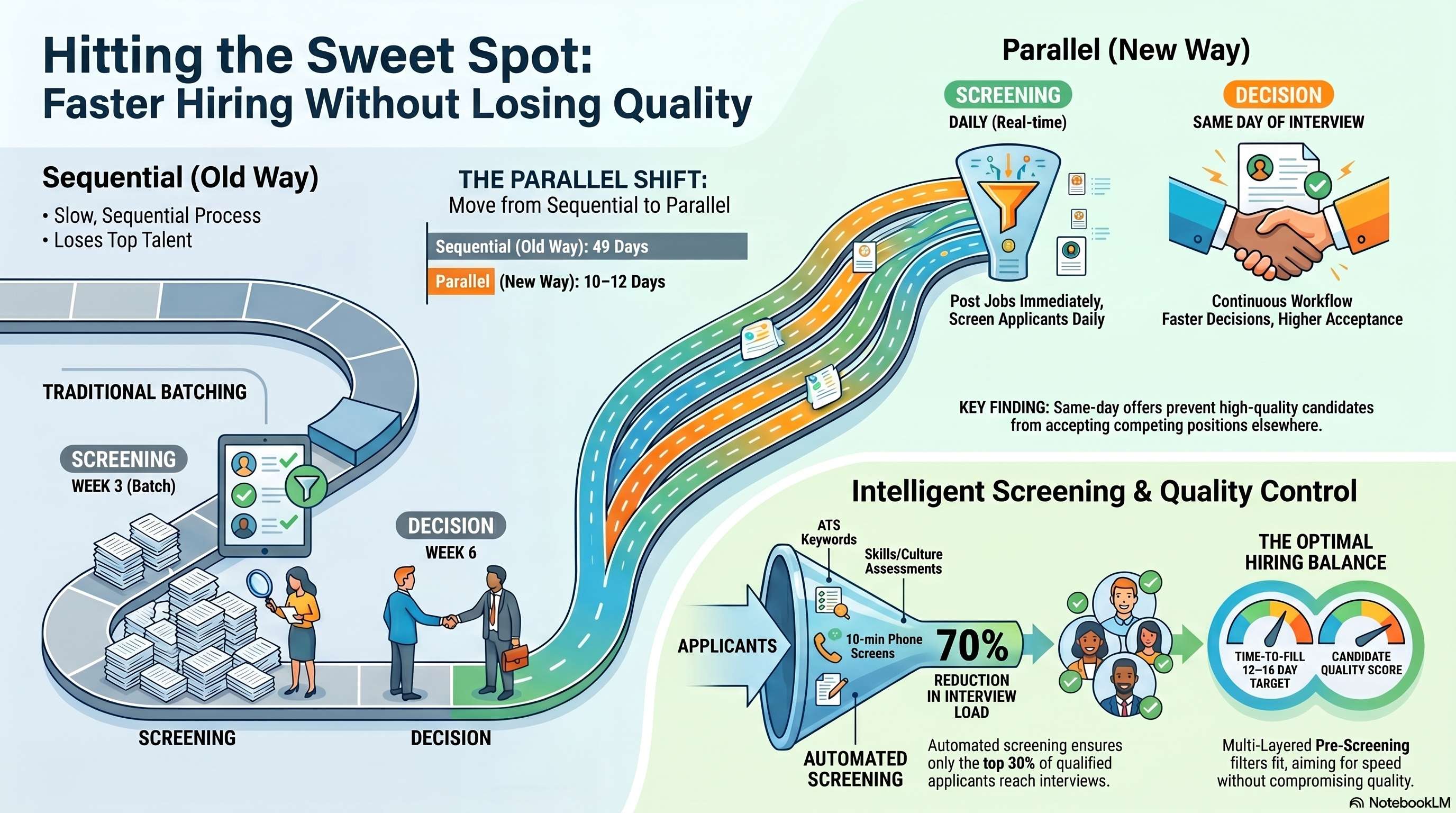
Slow hiring (30+ days) means high-quality candidates accept other offers and positions stay vacant, hurting operations. Fast hiring (5 days) risks quality—insufficient screening, poor fit. Optimal balance: 12-16 day time-to-fill with 80%+ quality score.
Mechanism: Faster hiring requires parallel processing (multiple candidates in parallel interview stage, not sequential); immediate availability (not batching applications), and streamlined decision-making (fast approvals). Speed without reducing quality requires: better upfront screening (fewer unqualified candidates), structured assessment (quick, accurate evaluation), and clear decision criteria (quick yes/no decisions).
Parallel Processing
Sequential: Job posts → Applications come in over 2 weeks → Batch screening at week 3 → Interviews week 4-5 → Decision week 6 → Hire week 7. Total: 49 days.
Parallel: Job posts → Applications come in → Screening done daily → Interviews ongoing (as soon as qualified candidates ready) → Decision same day of final interview → Offer same day. Total: 10-12 days.
Implementation: (1) Post immediately (don’t wait for multiple postings); (2) Screen daily (don’t batch); (3) Continuous interviewing (don’t wait for cohort); (4) Fast decision-making (approval by EOD).
Cost: Minimal. Benefit: Reduces time-to-fill by 60-70%, improves candidate experience (faster feedback), increases offer acceptance (candidate not waiting).
Pre-Screening and Automation
Reduce unqualified candidates through better upfront screening: (1) ATS screening—resume scanned for keywords automatically, unqualified rejected; (2) Phone screen—brief 10-min call with candidates, assessing basic fit; (3) Skills assessment—online test (typing, customer service, problem-solving) completed before interview; (4) Culture fit assessment—online questionnaire identifying alignment.
Benefit: Only 30-40% of applicants advance to full interview (vs. 60-70% without screening), reducing interview time-to-hire. If 100 applicants and you interview all vs. 30 qualified, interview load drops 70%, time-to-fill drops 40%.
Accuracy: Screening must be accurate (not rejecting qualified candidates). Validation: Test screening tool against hired candidates; does it predict performance?
Conclusion
Speed and quality aren’t enemies. Smart process design, parallel processing, and automation enable both. Target: 12-16 day time-to-fill, 80%+ quality score.
References and Further Reading
- McKinsey: Speed-Quality in Hiring (2024)
- Workable: Time-to-Fill Analysis (2023)
How Cadient Talent SmartSuite™ Helps
Cadient Talent’s SmartSuite™ platform automates compliance workflows, embeds regulatory guardrails directly into your hiring process, and maintains audit-ready documentation at every stage—so your team can focus on finding great talent while staying protected from costly violations.
