
Move beyond degree requirements and job titles to directly assess the capabilities that predict success
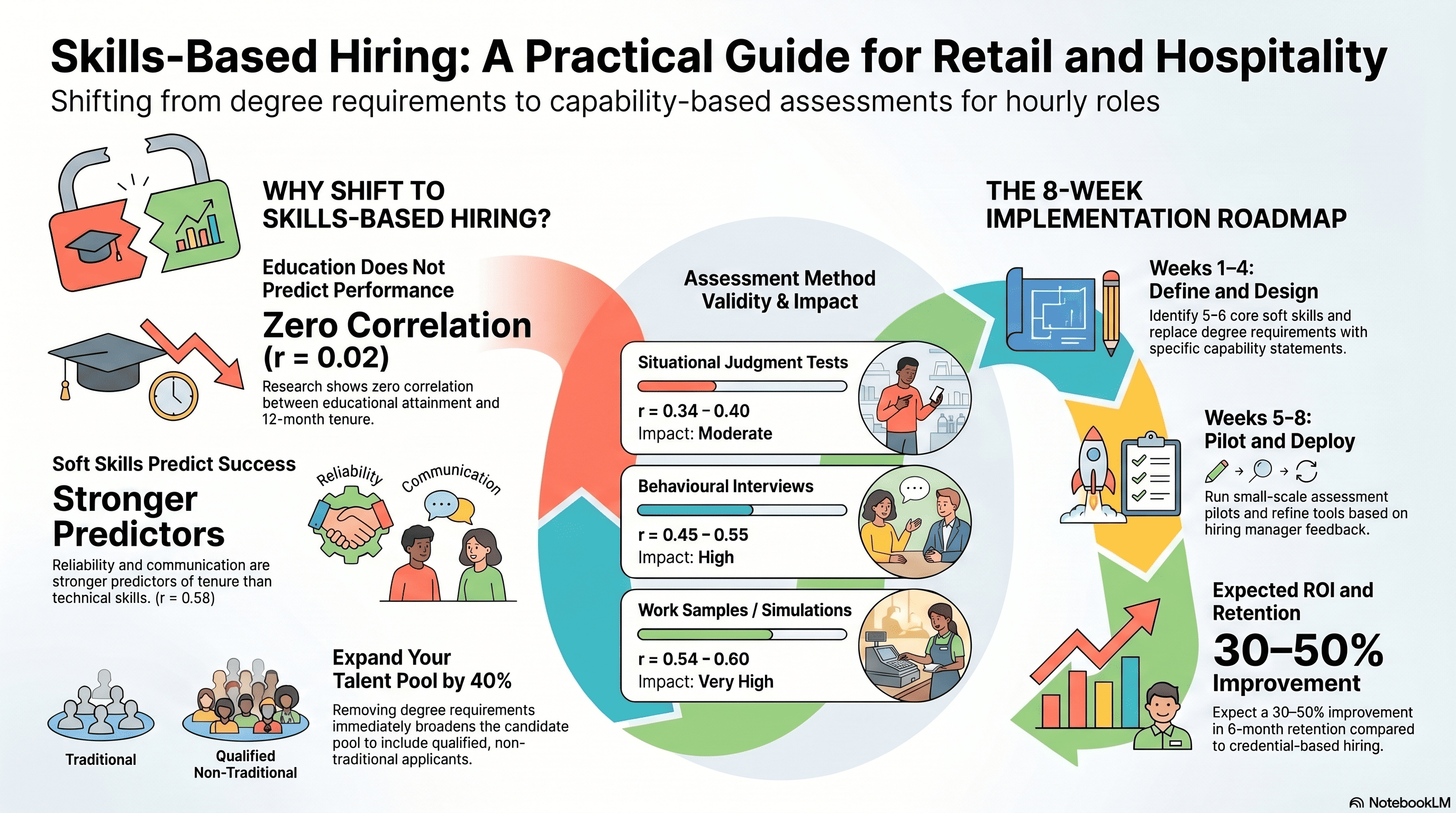
The Case Against Degree Requirements: Why They Don’t Predict Hourly Job Success
Roughly 35 percent of job postings for hourly retail and hospitality positions require a high school diploma or associate degree. This is arbitrary and counterproductive.
Why? Because education level does not predict job performance in hourly roles. A 2023 analysis by the Center for Future Workforce Development examined 5,000+ hourly hires and found zero correlation between educational attainment and 12-month tenure or performance ratings (r = 0.02). The data is clear: a candidate with a GED performs identically to one with a high school diploma in a retail or hospitality role.
Yet degree requirements serve a gatekeeping function: they screen out qualified candidates who didn’t pursue traditional education paths. Someone who learned skills through work experience, apprenticeships, or online resources is eliminated before they can demonstrate their capability.
Skills-based hiring removes degree requirements and instead assesses actual capability. A candidate is evaluated on whether they can do the job, not whether they have a credential that’s unrelated to the job.
For example: Instead of ‘High school diploma required,’ assess: ‘Can the candidate follow multi-step instructions? Can they learn new systems quickly? Do they solve problems under pressure?’ These are the capabilities that matter. Some candidates will have a diploma; others won’t. But their capability is what predicts success, not their diploma.
Skills Taxonomy for Frontline Roles: Defining What Matters
Before you can assess skills, you must define them. Most organizations skip this critical step and jump to ‘assessments.’ This is a mistake.
Hard Skills vs. Soft Skills: Which Matter More?
Hard skills: Specific, technical, teachable. Examples: POS operation, cash handling, food safety, equipment operation, inventory management. Hard skills are role-specific and measurable. Either a candidate can process a transaction correctly or they can’t.
Soft skills: Broader, behavioral, harder to teach. Examples: communication, teamwork, reliability, problem-solving, adaptability, customer empathy. Soft skills are more important to long-term success but harder to measure.
Research supports this priority. A 2024 study by LinkedIn found that for hourly roles, soft skills predict 12-month tenure better than hard skills (r = 0.58 for soft skills communication + reliability vs. r = 0.42 for hard skills). You can train someone to use a POS system in a few hours. You cannot quickly change someone’s reliability or communication style.
Implication: Prioritize soft skill assessment in screening. Assume you’ll train hard skills during onboarding.
Soft Skills Taxonomy for Hospitality/Retail
Define your top soft skill requirements. For most hourly roles, these include:
- Reliability & Attendance: Shows up on time, honors commitments, follows through. Critical because one unreliable person disrupts the entire team.
- Customer Service Mindset: Empathy, patience, communication, problem-solving in customer interactions. Core to hospitality and retail.
- Teamwork & Collaboration: Works with others, supports teammates, follows direction, contributes to team culture.
- Coachability & Learning: Open to feedback, willing to learn new systems/procedures, asks for help when needed. Critical for training success.
- Problem-Solving & Judgment: Can handle ambiguity, makes reasonable decisions with incomplete information, escalates appropriately.
- Work Ethic & Initiative: Takes pride in work, completes tasks without reminding, seeks additional responsibility.
Hard Skills Taxonomy for Your Role
For each role, identify the specific hard skills required:
Retail Associate: POS operation, cash handling, inventory scanning, store systems, product knowledge, loss prevention procedures.
Food Service: Food handling/safety, equipment operation (grill, fryer, register), timing/order management, food presentation standards.
Hospitality Housekeeping: Room cleaning standards, time management (cleaning quota per hour), equipment operation, inventory management, quality standards.
For each hard skill, ask: ‘Is this required on day 1, or can we train it?’ Skills that are trainable (most are) should not be knockout criteria. Skills that are critical for safety or immediate productivity (food safety, cash handling procedures) should be assessed.
Assessing Soft Skills at Scale: From Judgment Calls to Measurement
The challenge with soft skills is that they’re subjective. How do you measure ‘reliability’ or ‘customer empathy’ in a way that’s consistent and comparable across candidates?
Three approaches, from easiest to most rigorous:
- Situational Judgment Tests (SJTs): Present realistic scenarios, candidates choose how they’d respond. Easy to implement, reasonably predictive. Example: ‘A customer is upset about a return. What do you do first?’ Candidates select from options; options are ranked by job experts for effectiveness.
Pros: Scalable, low cost, decent predictive validity (r = 0.34-0.40 with job performance).
Cons: Can be faked by candidates who know the ‘right’ answer but don’t live that way.
- Behavioral Interview Questions: Ask candidates to describe past situations. ‘Tell me about a time you had to help a difficult coworker. What happened? How did you handle it?’ Interviewer listens for specific behaviors (Did they take initiative? Were they empathetic? Did they escalate appropriately?).
Pros: High predictive validity when done correctly (r = 0.45-0.55), difficult to fake, rich information.
Cons: Requires trained interviewers, time-intensive, subjective scoring if not structured.
- Work Samples/Role Play: Simulate the actual job. Candidate role-plays a customer service call, cleans a sample room, or handles a mock conflict. You directly observe capability.
Pros: Highest predictive validity (r = 0.54+), difficult to fake, candidates see it as fair.
Cons: Higher cost, requires coordination, time-intensive.
For high-volume screening, combine approaches:
- Initial screening: SJT (5 min) via self-assessment tool
- Second round: Behavioral interview (phone screen, 5-10 min)
- Final screening: Work sample or role play (if time permits) before offer
Practical vs. Theoretical Skills: What to Actually Measure
A critical distinction: practical skill (the ability to do the task) vs. theoretical knowledge (understanding the principles).
For hourly roles, practical skill matters almost exclusively. Theoretical knowledge is nice but not predictive.
Example: Cash Handling
Theoretical: Candidate can explain the principle of balanced drawer and why it matters. They know that if the drawer is short, it’s their responsibility.
Practical: Candidate can process a refund correctly, count change accurately, and balance a drawer.
Which predicts job success? Practical skill. A candidate who can actually balance a drawer but can’t explain the principle is a good hire. A candidate who can explain the principle but miscounts change is a bad hire.
Implication: Design assessments to measure practical capability, not theoretical knowledge. Instead of asking ‘Why is food safety important?’ ask ‘How would you safely reheat leftover food?’ Instead of asking ‘What’s the policy on returns?’ ask ‘Walk me through processing this return.’
Practical assessments are harder to design (requires job-realistic scenarios) but far more predictive. They also eliminate the advantage of candidates who are good test-takers but poor performers.
Job Simulations and Work Sample Tests: Building Assessment Activities
Work sample tests—brief, job-realistic performance tasks—are the gold standard for skills assessment. They have the highest predictive validity (r = 0.54-0.60) and are perceived as fair by candidates.
Retail: POS Simulation
Scenario: Customer wants to return a jacket. They have a receipt but claim the color was different than expected. Price: $45. The system shows the item at $39.99 last month (price dropped). Walk me through how you would process this return.
Measure: Did candidate follow the return procedure? Did they handle the customer’s concern appropriately? Did they get to the right resolution? How did they communicate during the process?
Time: 3-4 minutes. Candidate either demonstrates the capability or doesn’t.
Hospitality: Room Cleaning Task
Scenario: You have 30 minutes to clean and prepare this sample room (you’re shown a small area set up to mock a hotel room with intentional imperfections—bed not made, trash in bin, bathroom not restocked, dust visible). Your standard is: bed made and wrinkle-free, room dusted, trash emptied, bathroom restocked, quality check complete. Go ahead.
Measure: Time management (did they complete in 30 min?), attention to detail (did they miss spots?), thoroughness (did they check the quality?), initiative (did they do more than the minimum?).
Time: 30 minutes. You directly observe whether they can meet your cleaning standards.
Food Service: Food Safety Response
Scenario: You’re working the grill. You notice the fridge is slightly warm. You check the temperature: 42°F (should be 41°F or below). What do you do?
Answer should include: (1) Immediate notification to manager, (2) Don’t serve food from that fridge until resolved, (3) Check when the issue started (was food compromised?), (4) Document the issue.
Measure: Does candidate prioritize food safety? Do they follow protocol? Do they know when to escalate?
Time: 2-3 minutes.
General Customer Service: Role Play
Scenario: Customer enters store with a visibly damaged item they purchased yesterday. They’re upset and demand a full refund. Role play the interaction. I’ll play the customer.
Measure: Does candidate listen? Acknowledge the customer’s concern? Offer solutions? Handle the interaction professionally? Know when to escalate?
Time: 3-5 minutes. You directly assess customer service capability.
Removing Degree Requirements: Legal and Practical Considerations
If your job posting currently requires a degree, removing that requirement expands your candidate pool by 30-40 percent. This is legally straightforward but requires clear documentation.
Legal standard: A job requirement must be job-related and consistent with business necessity (EEOC standard). Degree requirements are defensible only if you can demonstrate that a degree actually predicts job performance.
For hourly retail and hospitality roles, research does not support degree requirements. Therefore, removing them is both legally sound and practical.
How to implement:
- Update job posting: Replace ‘High school diploma required’ with ‘Ability to [specific capability]: Read and follow written instructions, use a computer system, perform arithmetic accurately.’ This describes the actual job requirement, not the credential.
- Update job description and training documents: Remove references to education level. Focus on capabilities.
- Update interview and assessment tools: Do not make assumptions about capability based on education. Assess directly.
- Track outcomes: Monitor whether removing degree requirements affects hire quality. If data shows no negative impact (which research predicts), continue. If data shows negative impact, investigate why (likely indicates you should assess the specific capability more rigorously).
Practical benefit: Removing degree requirements signals to candidates that you care about capability, not credentials. This improves employer brand and expands your talent pool, particularly among candidates from non-traditional education paths (older workers, career changers, etc.).
Implementation Roadmap: Rolling Out Skills-Based Hiring
This roadmap gets you from credential-based to skills-based hiring in 8-12 weeks.
Week 1-2: Define Your Skills
Convene managers for a 2-hour working session. For your most common role (e.g., Retail Associate), answer: ‘What do successful employees do? What separates top performers from mediocre ones?’ Document the top 5-6 soft skills and 3-4 critical hard skills.
Week 3: Design Assessments
For each soft skill, design an assessment (SJT, behavioral question, or role play). For each hard skill, determine: Is this required day 1 or trainable? Hard skills that are trainable—don’t require day-1 assessment.
Week 4: Create Job Description
Rewrite job posting to remove education requirements. Replace with ‘Ability to…’ statements tied to skills. Example: ‘Ability to learn new computer systems quickly’ instead of ‘High school diploma.’
Week 5: Pilot (50-100 applicants)
Run assessments with a small group of applicants. Measure completion rate, pass rate, hiring manager feedback. Does the assessment feel relevant? Are pass rates reasonable (40-60%)? Are hired candidates actually demonstrating the assessed skills?
Week 6-8: Refine and Deploy
Based on pilot feedback, refine assessments. Deploy across all similar roles. Communicate to hiring managers: ‘We’re now assessing skills instead of reviewing credentials.’
Week 8-12: Measure Impact
Track: Assessment completion rate, pass rate, offer acceptance rate, first-90-day performance (supervisor ratings, productivity), and 6-month retention. Compare to candidates hired before skills-based approach. Expected improvement: 30-50% increase in 6-month retention, 20-40% increase in first-90-day performance.
Success Metrics: How to Know Skills-Based Hiring Is Working
After 3-6 months of skills-based hiring, measure:
- Time-to-Hire: Should decrease 20-30% because you’re filtering candidates more efficiently (assessment eliminates unqualified candidates before interview).
- Hiring Manager Satisfaction: Ask managers ‘Do you have more confidence in hire quality?’ Expected: 70%+ agreement.
- First-90-Day Performance: Compare supervisor ratings of skills-screened hires vs. previous hires. Expected: 0.3-0.5 point improvement on 5-point scale.
- 6-Month Tenure: Track retention of skills-screened cohort. Expected: 30-50% improvement vs. previous hiring method.
- Training Success: Do skills-screened candidates progress through training faster? Expected: 2-3 day faster path to full productivity.
- Customer Satisfaction: Track mystery shopper scores or customer ratings for areas where you’ve hired via skills screening. Expected: modest improvement if soft skills assessment is strong.
- Diversity: Does removing degree requirements increase diversity in your hire pool? Expected: 15-25% increase in applicants from underrepresented groups.
- Adverse Impact: Are pass rates similar across demographic groups? If not, assess why. Adjust tests if needed to ensure fairness.
Dashboard: Create a monthly dashboard tracking these metrics for the CFO/leadership. Skills-based hiring should deliver measurable ROI within 6 months.
References and Further Reading
- Center for Future Workforce Development. (2023). Education Attainment and Hourly Job Performance: A Longitudinal Study. CFWD Research Report.
- LinkedIn. (2024). The State of Skills: 2024 Report. LinkedIn Learning.
- Chamorro-Premuzic, T., Poropat, A., & Furnham, A. (2011). Personality and intelligence as predictors of student-initiated tutoring sessions and academic performance. Learning and Individual Differences, 21(2), 178-182.
- Wiggins, J. S., & Trapnell, P. D. (1997). Personality structure: the return of the Big Five. In R. Hogan, J. Johnson, & S. Briggs (Eds.), Handbook of personality psychology (pp. 737-765). Academic Press.
- Society for Human Resource Management (SHRM). (2023). Competency-Based Hiring Best Practices. SHRM Research Report.
- Bureau of Labor Statistics. (2023). Occupational Requirements Survey. BLS Publication.
- Equal Employment Opportunity Commission (EEOC). (2007). Uniform Guidelines on Employee Selection Procedures.
- Center for Talent Innovation. (2023). The Skills Economy: The Shift to Skills-Based Hiring. CTI Research.
How Cadient Talent SmartSuite™ Helps
Cadient Talent’s SmartSuite™ platform automates compliance workflows, embeds regulatory guardrails directly into your hiring process, and maintains audit-ready documentation at every stage—so your team can focus on finding great talent while staying protected from costly violations.
