
Eliminate disparate treatment risk by standardizing questions, evaluation, and documentation
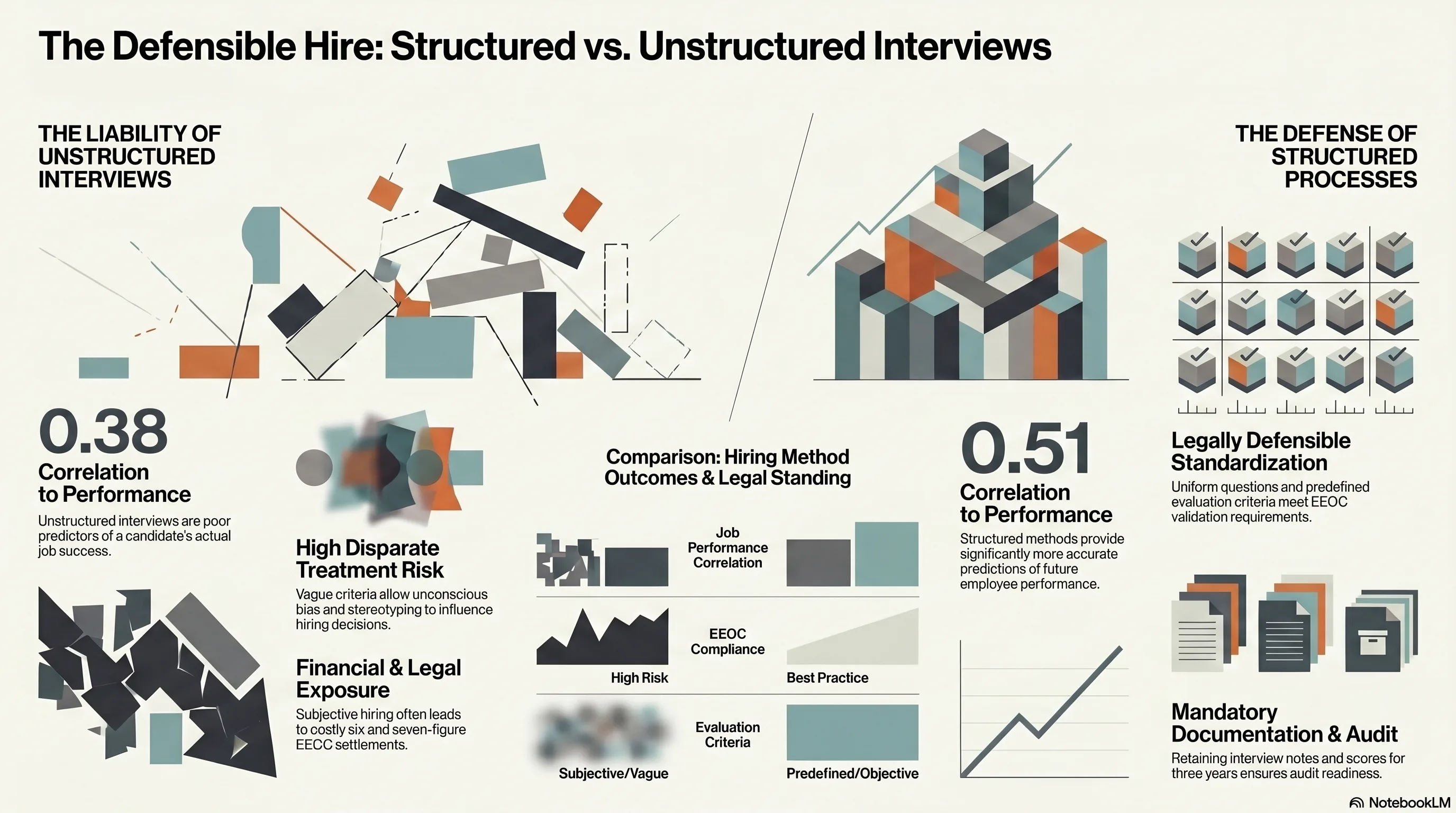
The Legal Risk of Unstructured Interviews
The unstructured interview—where different candidates are asked different questions based on interviewer whim, where evaluation criteria are not predefined, and where subjective impressions drive hiring decisions—is a legal liability. Courts and the EEOC have consistently found that unstructured interviews create disparate treatment risk because they allow unconscious bias, stereotyping, and discrimination to influence hiring decisions.
The EEOC’s Uniform Guidelines on Employee Selection Procedures (29 CFR §1607) explicitly state that interview procedures should be validated for reliability and non-discrimination. The guidelines note that unvalidated selection procedures—particularly those relying on subjective judgment—have the highest litigation risk.
Empirical research supports this. Dr. Frank Schmidt’s meta-analytic research found that unstructured interviews have only 0.38 correlation with job performance, while structured interviews have 0.51 correlation. More importantly, unstructured interviews show higher racial disparities in ratings. When interviewers have discretion to ask different questions and apply vague criteria, they unconsciously apply different standards to candidates of different races, genders, or other protected statuses.
The disparate treatment pathway is straightforward: Candidate A (White male) is asked about leadership experience and shown favorable interpretation of examples. Candidate B (Hispanic female) is asked about specific technical qualifications and shown strict evaluation of credentials. The company’s post-hoc explanation of why Candidate A was hired is “better interpersonal fit,” a subjective criterion that is difficult to defend in litigation. When applicant flow data shows that the company systematically rates candidates from certain demographic groups lower, the question of discrimination becomes unavoidable.
The financial stakes are substantial. EEOC litigation over disparate treatment in hiring decisions regularly results in six and seven-figure settlements, and discovery requirements force disclosure of all hiring decisions, necessitating review of decades of interview notes and hiring decisions. Structured interviews reduce this risk dramatically because they create a documented, legally defensible selection process.
The Business Case and Legal Framework for Structured Interviews
Structured interviews are not just compliance measures; they improve hiring quality. Companies using structured interviews report better hiring decisions, reduced turnover, improved performance prediction, and faster hiring cycles. The EEOC and Department of Labor both recommend structured interviews as best practice.
The legal framework supporting structured interviews is built on several precedents:
McDonnell Douglas Corp. v. Green, 411 U.S. 792 (1973), established that employers must articulate the criteria used in hiring decisions. Vague criteria like “best overall fit” or “strongest candidate” without predefined standards are difficult to defend.
Griggs v. Duke Power Co., 401 U.S. 424 (1971), established that selection procedures must be job-related and validated. Unstructured subjective impressions in interviews fail this test.
Alabama v. Pugh, 438 U.S. 567 (1978), held that selection criteria must be consistently applied. Different questions for different candidates suggest inconsistent application.
Uniform Guidelines on Employee Selection Procedures (29 CFR §1607) recommend that employers develop validated selection procedures and retain evidence of validation. Structured interviews with documented job analysis are easier to validate.
The EEOC’s Compliance Manual notes that interviews should be standardized, with the same core questions asked of all candidates for the same job, same scoring procedures, and documented evaluation.
Title VII of the Civil Rights Act prohibits discrimination in hiring based on protected characteristics (race, color, religion, sex, national origin). The ADEA prohibits age discrimination. The ADA prohibits disability discrimination. Section 501 of the Rehabilitation Act applies to federal contractors. All of these statutes are enforced more vigorously when selection procedures are subjective and undocumented.
Developing Legally Defensible Interview Questions
The starting point for structured interviews is developing questions that are job-related, consistently applied, and non-discriminatory.
Job analysis foundation: Before developing interview questions, conduct a job analysis identifying the essential functions and required competencies for the position. This job analysis becomes the documented foundation showing that interview questions are job-related, not discriminatory screening. A job analysis for an accountant might identify: accuracy in mathematical calculation, ability to interpret complex regulations, proficiency with accounting software, and communication of financial information to non-technical stakeholders. Questions are then developed to assess these specific competencies.
Permissible question categories:
Job-specific technical or functional knowledge: “Describe your experience implementing generally accepted accounting principles (GAAP) in financial reporting.” “What is your experience with [specific software system]?” “Walk me through how you would approach a complex data analysis problem.”
Job-specific behavioral/situational questions: “Describe a time you had to analyze complex financial data under a tight deadline. What approach did you use?” “Tell me about a time you had to communicate complex technical information to a non-technical stakeholder. How did you approach it?” These assess actual job-relevant behaviors.
Professional background and experience: “Tell me about your experience in financial analysis.” “What attracted you to this type of role?” “How does your background prepare you for this position?” These assess qualifications directly.
Motivation and fit for role/organization: “What attracts you to this position and company?” “What are your career goals and how does this position align with them?” “What motivates you in your work?” These assess alignment but must be applied consistently.
Prohibited or risky question categories:
Religion: “What is your religious background?” “Do your religious beliefs conflict with working on [date]?” (Exception: Employers may ask about scheduling availability; this addresses the business need, not belief.)
National origin or accent: “Where is your accent from?” “What language do you speak at home?” “Are you a U.S. citizen?” (Exception: Employers may ask about right to work; this addresses legal requirement, not origin.)
Disability or health: “Do you have any disabilities?” “Have you had any health problems?” “How many days were you absent last year due to illness?” (Exception: After conditional offer, employers may ask disability-related questions as part of medical examination.)
Family status: “Are you married?” “Do you have children?” “How will you manage childcare?” “Is your spouse able to relocate?” (These suggest bias against women and parents.)
Age or date of graduation: “When did you graduate from high school?” “What is your age?” “How many years have you been in the workforce?” (These screen for age protected by ADEA.)
Arrest history (in Ban-the-Box jurisdictions): “Have you ever been arrested?” (Criminal conviction inquiries only permitted post-offer under BTB laws.)
Social media or personal conduct: “Do you have social media accounts?” “Tell me about your social life.” (These are often pretexts for learning protected characteristics.)
Question development best practice: Develop a question bank of 8-12 core behavioral/situational questions that all candidates for a position will be asked. Supplement with 2-3 role-specific technical questions. For some positions (e.g., highly technical roles), technical screening may occur before the interview. Ensure that the questions assess job-related competencies identified in the job analysis, not personal preference.
Pilot testing: Before deploying questions organization-wide, pilot them with a diverse group of interviewers and candidates. Identify whether any questions are ambiguous, overly challenging, or appear to correlate with protected characteristics.
Establishing Standardized Evaluation Criteria and Scoring
Unstructured interviews fail because interviewers ask different questions and apply different standards. Structured interviews succeed because all candidates are evaluated on the same criteria using the same scale.
Rating scale development: Establish a rating scale (typically 1-5 or 1-7) with clear behavioral anchors for each level. A sample scale for a “Problem-Solving” competency might be:
5 = Exceptional: Candidate described a sophisticated approach to a complex problem, identified multiple solutions, evaluated trade-offs, and selected optimal approach with clear rationale.
4 = Strong: Candidate described a systematic approach to a moderately complex problem, identified multiple relevant considerations, and selected a sound approach.
3 = Meets Expectations: Candidate described an adequate approach to a straightforward problem with some relevant considerations.
2 = Below Expectations: Candidate’s approach was simplistic or missed relevant considerations.
1 = Deficient: Candidate could not articulate a clear approach or showed poor problem-solving.
The behavioral anchors prevent interviewers from applying different standards. An answer that one interviewer might rate a 5 cannot be rated a 2 by another interviewer; the behavioral anchors force consistency.
Predefined competencies: Identify 4-6 competencies relevant to the position (e.g., Technical Proficiency, Problem-Solving, Communication, Teamwork, Client Service Orientation, Attention to Detail). Each interview question should assess one or more competencies. This ensures that evaluation is focused on job-relevant factors.
Evaluation immediately after interview: Interviewers should complete their rating form immediately after the interview, before memory fades and before discussing the candidate with other interviewers. Delay introduces error and allows implicit bias to creep in.
Aggregation of multiple raters: If multiple people interview the same candidate, their ratings should be aggregated (average or consensus meeting). This reduces the impact of any single interviewer’s bias. If one interviewer consistently rates women lower than men across multiple candidates, this pattern is discoverable and visible. Single-rater decisions are less defensible.
Documentation of scoring basis: Interviewers should briefly note which comments or examples support their rating. “Candidate answered problem-solving question well: described considering multiple approaches, evaluated trade-offs, explained final selection—Strong (4).” This documentation proves the score is based on job-related factors, not protected characteristics.
Score-based comparison: Candidates are compared on total score or competency-specific scores, not on interviewer “gut feeling.” The candidate with the highest total score (or strongest competency match for critical skills) is the recommended hire, and this recommendation can be supported with objective scoring data.
Prohibited Questions and How to Redirect
Despite training, interviewers sometimes ask prohibited questions, either from unfamiliarity with law or from unconscious bias leading them to dig for information about protected characteristics.
Common prohibited questions and redirects:
Prohibited: “Where are you from originally?” or “That’s an interesting accent; where are you from?”
Business need: Understanding right-to-work status or language skills required for job
Redirected question: “Tell me about your experience in [relevant field].” If language skills are required, ask: “This position requires fluency in [language]; are you fluent in [language]?”
Prohibited: “Are you married? Do you have children?”
Business need: Understanding availability or commitment
Redirected question: “This position requires [specific schedule]. Are you able to meet this schedule?” “Are you available to travel [X% of the time] for this role?”
Prohibited: “When did you graduate from high school?”
Business need: Understanding experience level
Redirected question: “Tell me about your education and how it prepared you for this role.” “How many years of experience do you have in [field]?”
Prohibited: “Have you ever been arrested?”
Business need: Understanding background (in appropriate jurisdictions/post-offer only)
Redirected question: (In Ban-the-Box jurisdictions, defer criminal history questions to post-offer stage. “Do you have any felony convictions in the past [X years]?” only post-offer.)
Prohibited: “Do you have any disabilities?”
Business need: Identifying accommodation needs
Redirected question: “This role requires [specific physical/mental functions]. Are you able to perform these functions? If accommodations are needed, we are committed to the interactive process to identify them.”
Prohibited: “What religious holidays do you observe?”
Business need: Understanding scheduling conflicts or religious accommodation needs
Redirected question: “This position requires [specific schedule]. Are you able to work this schedule, or would you need any adjustments to accommodate your needs?”
Training should emphasize that redirects accomplish the legitimate business purpose without asking prohibited questions. The company’s need to understand scheduling availability can be met by asking about availability; it cannot be met by asking marital status.
ADA Accommodation in the Interview Process
Title I of the ADA requires that employers provide reasonable accommodations to qualified candidates with disabilities in the interview process, not just once hired.
Common accommodations in interviews:
Physical accessibility: Interviews conducted in accessible facilities, with accessible parking, elevators, and interview rooms.
Sign language interpretation or CART (Communication Access Realtime Translation): For deaf or hard-of-hearing candidates.
Screen reader software or adjusted screen magnification: For blind or low-vision candidates interviewing via video.
Additional time for candidates with cognitive or information-processing disabilities: A candidate with a learning disability may request 50% additional time for a written assessment.
Alternative format for written materials: Large print, electronic format, or audio format for written assessments.
Personal care assistant attendance: Allowing a candidate with a physical disability to bring a care assistant.
Notification procedures: Candidates should be informed in the job posting and initial outreach that accommodations are available upon request. “If you need an accommodation to participate in this interview process, please contact [name, phone, email].” Do not wait for candidates to request; proactively offer.
Interactive process: Upon a candidate’s request for accommodation, engage in an interactive process to identify the specific need and the effective accommodation. “I understand you use a wheelchair. Let me walk you through our facility and show you the accessible entrance and accessible interview rooms. Is there anything else we can do to ensure you’re comfortable?”
Timing: Implement accommodations without delay. Denying accommodation or delaying it until after the interview is discrimination.
Confidentiality: Accommodation requests are medical information and must be kept confidential. The hiring manager should know that an accommodation is being provided, but not the disability that prompted it, if possible.
Documentation: Document the accommodation request, the accommodation provided, and confirmation from the candidate that it was adequate. This documentation becomes important if the candidate is not hired and suggests that the accommodation was not sufficient; you need evidence that a genuine accommodation was attempted.
Religious Accommodation in Interview Scheduling
Title VII requires that employers provide religious accommodations in hiring to the extent they do not cause undue hardship.
Common religious scheduling conflicts:
Sabbath or religious days of observance: Some religions require avoidance of work on specific days (Saturdays for Seventh-day Adventists, Fridays for some Muslim observances, certain days for Orthodox Jews).
Religious holiday observances: Candidates may request interviews on dates other than specified dates because of religious observances.
Prayer times: Some candidates may request interview breaks for required daily prayers.
Dress or grooming: Candidates may request to wear religious dress or head coverings in interviews.
Proactive accommodation: Inform candidates in job postings or initial outreach: “If you have religious observances that affect your interview availability, please let us know and we will work to accommodate.” This signals openness and often prevents formal requests later.
Request receipt and response: When a candidate requests religious accommodation, respond promptly. “I understand that the scheduled interview time conflicts with your Sabbath observance. Let me check on alternative dates.” Promptly offer alternatives (e.g., a different day/time slot).
Undue hardship analysis: An employer may deny religious accommodation only if it causes undue hardship—significant cost or operational disruption. Merely rescheduling an interview to a different time is not undue hardship. Allowing a candidate to wear religious dress to an interview is not undue hardship. Only in rare cases (e.g., an interview for a position requiring work on specific dates and the candidate cannot work those dates due to religious observance) might undue hardship exist.
Documentation: Document the accommodation request, the accommodation provided, and confirmation from the candidate that it is adequate.
Practical Implementation and Ongoing Management
Structured interview programs require initial development and ongoing management to be effective.
Development timeline: (1) Conduct job analysis for key positions (1-2 weeks). (2) Develop interview questions and competency frameworks (2-3 weeks). (3) Develop rating scales with behavioral anchors (1 week). (4) Draft interviewer training materials (1 week). (5) Pilot interview questions with diverse group and refine (2 weeks). (6) Roll out structured interview process (1 week). Total time: 6-10 weeks for initial launch.
Interviewer training: All interviewers should receive training covering: (1) Job analysis and position-specific competencies; (2) Interview questions and how they assess competencies; (3) Rating scales and behavioral anchors; (4) Prohibited questions and redirects; (5) Implicit bias and how to recognize and mitigate it; (6) Accommodation responsibilities; (7) Documentation requirements. Training should be conducted live (not just online slide review) to allow Q&A. Annual refresher training is recommended.
Interview coordination: Designate someone (usually HR or a recruiting coordinator) to: (1) Schedule interviews, sending calendar invites with location, parking, accessibility information; (2) Provide interview materials (job description, competency framework, rating form) to interviewers; (3) Collect completed rating forms immediately after interviews; (4) Track accommodation requests and confirmations; (5) Aggregate scores across multiple interviewers; (6) Ensure hiring decisions are made based on objective scores, not subjective impressions.
Quality assurance: (1) Monthly audit a sample of rating forms (10-15% of all interviews) to ensure: scores are completed, behavioral evidence is documented, scores align with competency frameworks, and any prohibited questions or issues are identified. (2) Quarterly analysis of rating patterns: do certain interviewers consistently rate women/minorities lower? Do certain interview questions correlate with protected characteristics? Are any competencies not being adequately assessed? (3) Annual applicant flow analysis: for each position category, track what percentage of candidates from each race/ethnicity/gender advance past the interview stage and what percentage are hired. Are there disparities suggesting bias? (4) Periodic refresher training based on quality assurance findings.
Technology support: Applicant tracking systems (ATS) should capture: interview date/time, interviewer name, competencies assessed, individual competency scores, comments, and overall rating. SmartSuite and similar systems automate this tracking and provide analytics on interview patterns and outcomes.
Documentation retention: Retain interview rating forms, notes, and final hiring decision documentation for at least one year (Title VII requirement) and preferably three years (sound legal practice). These documents become critical evidence if the candidate later files a charge claiming discrimination.
Best Practice Implementation Checklist
- Conduct formal job analysis for each position that will use structured interviews, identifying essential functions and required competencies.
- Develop 8-12 core behavioral/situational interview questions that all candidates for a position will be asked, plus 2-3 role-specific technical questions.
- Develop a competency framework identifying 4-6 core competencies for each position and which questions assess which competencies.
- Create rating scales (1-5 or 1-7) with detailed behavioral anchors for each competency, ensuring clear definitions of each rating level.
- Draft interviewer guidelines documenting: permitted questions, prohibited questions, how to redirect prohibited topics, and accommodations to provide.
- Create and deliver interviewer training covering job analysis, interview questions, competencies, rating scales, prohibited questions, implicit bias, and accommodation responsibilities.
- Pilot interview questions with diverse group of interviewers and candidates, refining based on feedback to ensure questions are clear, job-relevant, and not inadvertently biased.
- Develop a standardized interview process: same questions for all candidates in same role, same order, same time limit, with multiple raters where possible.
- Implement a standardized rating form to be completed by all interviewers immediately after each interview, with space for behavioral evidence supporting ratings.
- Establish a process for candidates to request accommodations (physical accessibility, sign language interpretation, additional time, religious accommodation, etc.) and a commitment to providing them.
- Implement quality assurance audits: monthly review of sample rating forms, quarterly analysis of rater patterns and disparities, annual applicant flow analysis.
- Use applicant tracking system to track interview outcomes, scores, and hiring decisions, enabling analysis of patterns and disparities.
- Conduct annual training refresher for all interviewers, incorporating lessons learned from quality assurance audits.
- Retain all interview documentation (rating forms, notes, hiring decisions) for at least three years.
References and Further Reading
- Title VII of the Civil Rights Act of 1964, 42 U.S.C. §2000e et seq.
- Age Discrimination in Employment Act (ADEA), 29 U.S.C. §621 et seq.
- Title I of the Americans with Disabilities Act (ADA), 42 U.S.C. §12101 et seq.
- Title VII Religious Accommodation Requirements, 42 U.S.C. §2000e(j)
- EEOC Uniform Guidelines on Employee Selection Procedures, 29 CFR §1607
- EEOC Compliance Manual, Chapter 3: Hiring
- McDonnell Douglas Corp. v. Green, 411 U.S. 792 (1973)
- Griggs v. Duke Power Co., 401 U.S. 424 (1971)
- Alabama v. Pugh, 438 U.S. 567 (1978)
- Schmidt, F. L., & Hunter, J. E. (1998). The validity and utility of selection methods in personnel psychology: Practical and theoretical implications of 85 years of research findings. Psychological Bulletin, 124(2), 262–274.
- Society for Human Resource Management, 2022 Structured Interview Best Practices
How Cadient Talent SmartSuite™ Helps
Cadient Talent’s SmartSuite™ platform automates compliance workflows, embeds regulatory guardrails directly into your hiring process, and maintains audit-ready documentation at every stage—so your team can focus on finding great talent while staying protected from costly violations.
