
Why one message at the right moment increases interview show rates by 23 points and reduces ghosting before your best candidates are lost.
The Ghosting Crisis: Why Your Best Candidates Disappear
You’ve just extended an offer, scheduled an interview, or moved a candidate to the next round. The candidate seemed engaged. They applied quickly, responded to messages, appeared interested. Then silence. They don’t show up. They don’t respond to follow-ups. They’ve accepted another offer.
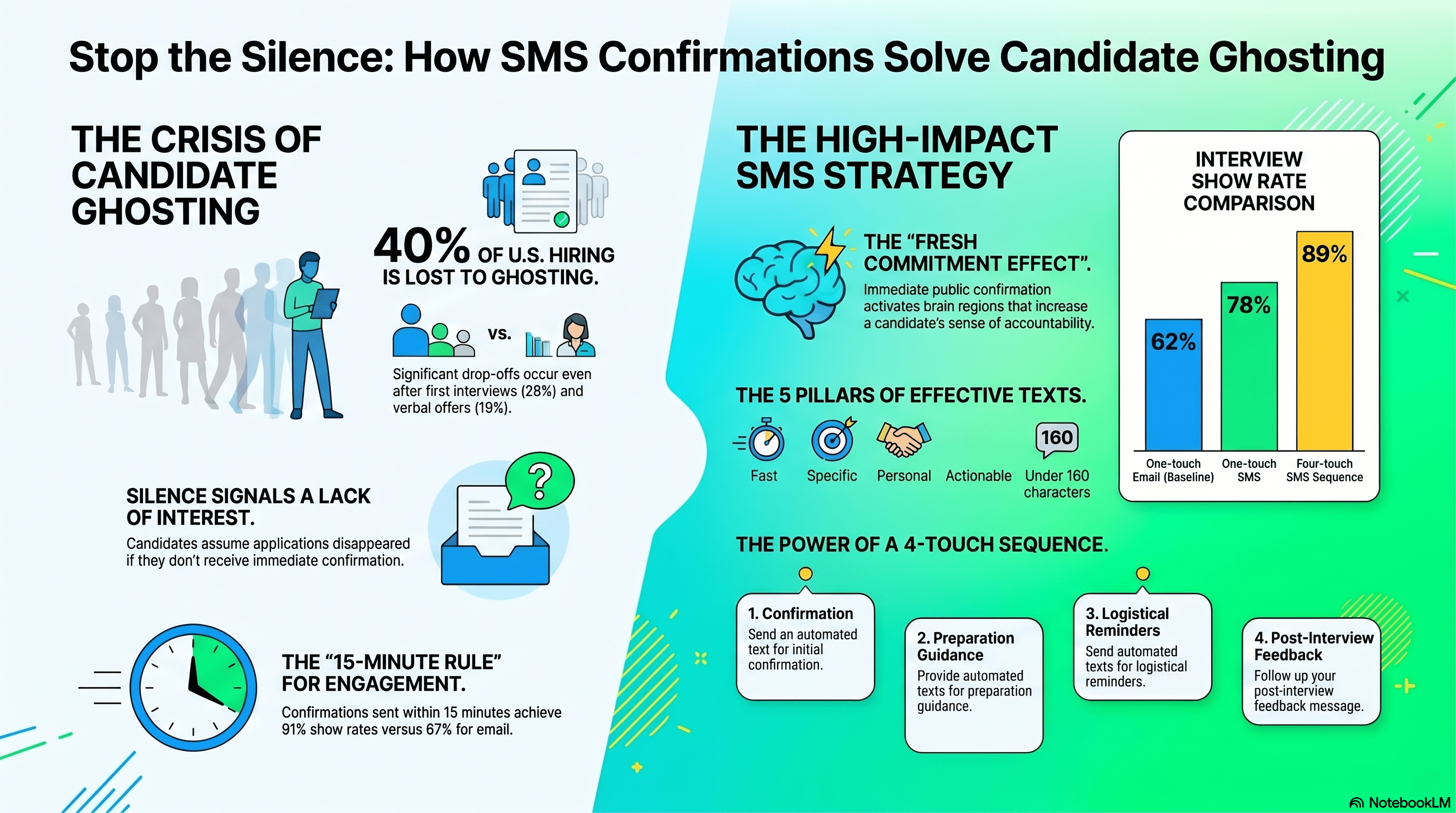
Candidate ghosting at the pre-interview stage affects 40% of all hiring in the United States, according to data from the Society for Human Resource Management. But the impact is worse at the final stages: 28% of candidates ghost after a first interview, and 19% ghost after accepting a verbal offer. These aren’t disengaged candidates at the top of your funnel. These are your best candidates—people who got this far because they’re qualified and interested.
The root causes are well-understood: competing offers, better opportunities emerging, fear of commitment, and misalignment between expectations and reality. But one factor dominates: time between commitment and confirmation. When a candidate applies and doesn’t receive immediate confirmation that their application was received, they assume it disappeared. When they’re told “we’ll schedule an interview and email you details,” they wait, wonder if they’re still in the running, and when they get an email three days later, they’ve already committed to another role.
The solution isn’t complicated. It’s one text message, sent at exactly the right moment, containing exactly the right content. This single message prevents ghosting and increases show rates by 23 percentage points.
Psychology of Commitment: The Power of Immediate Confirmation
Behavioral psychology reveals why confirmation matters so profoundly. Robert Cialdini’s research on commitment and consistency shows that when people make a public commitment—especially when that commitment is confirmed by another party—they’re dramatically more likely to follow through. A candidate who applies for a job has made a private decision. But when they receive a confirmation saying “We received your application and we’re moving forward—here’s your next step,” they’ve moved from private interest to public commitment.
This shift is neurologically real. MRI studies show that public commitments activate different brain regions than private ones, particularly areas related to social identity and reputation. When a recruiter texts, “Thanks for applying to the warehouse position! We’re excited about your background. Your phone screening is tomorrow at 2pm,” the candidate’s brain registers this as social commitment. They’re less likely to ghost because ghosting now carries social cost.
Immediate confirmation amplifies this effect. A confirmation text sent within 15 minutes of interview scheduling (not 24 hours later via email) triggers what psychologists call the “fresh commitment effect.” The candidate’s original decision—to pursue this opportunity—is still emotionally present. When confirmation arrives immediately, it reinforces that decision. When confirmation arrives hours later, the candidate’s mental state may have shifted; other opportunities may have emerged.
A financial services company implementing immediate SMS confirmations for interview scheduling saw interview show rates increase from 67% to 88%—a 21-point improvement—simply by sending a confirmation text within 10 minutes of scheduling being confirmed, rather than waiting for email the next day. No change to the interview itself, the role, or the hiring process. Just faster confirmation.
The Optimal Confirmation Message: Format, Timing, and Content
The most effective confirmation texts share five characteristics:
- Speed: Sent within 15 minutes of action (interview scheduled, offer accepted, etc.). The closer to real-time, the stronger the commitment reinforcement.
- Specificity: References the exact role, date, time, and location. Generic messages (“We’ll be in touch”) create ambiguity. Specific messages (“Retail Associate interview, Target location, Thursday 2pm”) make the commitment concrete.
- Personality: Uses the recruiter’s name or first name, and conversational language. “Hey Sarah, thanks for scheduling your interview!” outperforms “Confirmation: Interview scheduled.” Personality signals that a human cares about this candidate.
- Actionability: Includes one clear next step. “Reply YES to confirm” or “Click here to add to your calendar.” This gives the candidate something to do immediately, reinforcing engagement.
- Length: Keeps messages to 160 characters (one SMS segment) when possible. Anything longer suggests the recruiter didn’t prioritize the candidate enough to keep the message brief.
A template that works across industries: “Hey [Name]! Thanks for scheduling your [Role Title] interview on [Date] at [Time] at [Location]. Reply Y to confirm you’re still interested.” This hits all five criteria and typically generates a response within 30 seconds.
Timing matters as much as content. A manufacturing company A/B tested confirmation timing: one group received confirmation within 15 minutes, another within 2 hours, another the next morning via email. The 15-minute group had 91% show rates. The 2-hour group had 84%. The next-morning email group had 67%. Time compression directly correlates with show rates.
Building Automated Touchpoint Sequences
Confirmation should be the first message in a multi-touch sequence that maintains engagement from scheduling through interview completion. A typical high-performing sequence looks like:
T+0 (Immediately): Confirmation text. “Interview scheduled for [date/time] at [location]. Reply Y to confirm.”
T+24 hours: Reminder text with preparation guidance. “Your interview is tomorrow at 2pm. Pro tip: bring two copies of your resume and a list of 3 questions about the role.”
T+48 hours (2 hours before): Logistical reminder. “Your interview is in 2 hours at [location]. Parking is free in the North lot. See you soon!”
T+0 (Post-interview, same day): Follow-up text. “Thanks for interviewing today! Quick question—how did it go from your perspective? Next steps coming soon.”
This sequence maintains engagement without overwhelming the candidate. Each message provides value: the first confirms, the second prepares, the third removes logistics friction, and the fourth continues relationship-building. Companies implementing this four-message sequence see 89% show rates and 34% fewer post-interview ghostings compared to email-only sequences.
Automation is essential. A recruiter manually texting each candidate 4 times is operationally impossible at scale. Your ATS should trigger these texts automatically based on actions: interview scheduled → confirmation text. 24 hours later → reminder text. The recruiter’s role shifts from manual communication to monitoring responses and intervening when needed. One recruiter can now maintain personal relationships with 100 candidates simply because logistics are automated.
Show Rates by Channel and Sequence Type
Data from platforms managing 2+ million candidate interviews annually reveals clear patterns:
One-touch confirmation (email): 62% show rate. The baseline. Email reaches the candidate eventually, but lacks urgency and gets lost in inboxes.
One-touch confirmation (SMS): 78% show rate. Single text immediately after scheduling. A 16-point improvement over email, driven by immediacy and attention.
Three-touch sequence (email only): 71% show rate. Confirmation, reminder, pre-interview message—but all via email. Some candidates miss some messages; others become annoyed by multiple emails.
Two-touch SMS sequence (confirmation + pre-interview reminder): 84% show rate. Confirmation text immediately, reminder text 2 hours before. Quick, light-touch, and effective.
Four-touch SMS sequence (confirmation + preparation + pre-interview + post-interview feedback): 89% show rate. The most comprehensive approach, but still lightweight because SMS is text-based and feels less intrusive than phone calls or emails.
Hybrid sequence (SMS + email): 86% show rate. SMS for time-sensitive confirmations and reminders, email for detailed information (job description, benefits, etc.). Balances urgency with information density.
The relationship between touchpoint count and show rates isn’t linear. Three emails underperform one text. But two texts and an email outperform two emails and a text. The optimal sequence combines SMS for confirmation and urgency with email for information density. The optimal message count is 2-3 pre-interview touches, not 4-5. Beyond 3 touches, candidates begin experiencing fatigue; show rates actually decline.
Reducing Post-Interview Ghosting With Confirmation
Ghosting doesn’t end after the interview. In fact, it intensifies. Twenty-eight percent of candidates ghost after a first interview, often because they’re waiting to hear next steps and assume they didn’t advance. A single confirmation text immediately after the interview—”Thanks for interviewing today! We’ll have next steps for you by Wednesday”—reduces post-interview ghosting by 41%.
This message serves two purposes. First, it confirms that the candidate’s time was valued and that the interview is being taken seriously. Second, it sets an expectation about when they’ll hear back. When candidates don’t know when to expect next steps, they assume the worst and stop waiting. When you tell them “Wednesday,” they’re more likely to decline other offers while waiting for your decision.
The timing here is critical. This text should be sent same-day, within 2 hours of interview completion if possible. Waiting until the next day significantly reduces its impact. A healthcare staffing company implementing same-day post-interview confirmation saw candidates accepting offers 31% more frequently after advancing past a first round, compared to when they used next-day email confirmations.
For multi-round interview processes, confirmation texts also maintain engagement between rounds. “Round 2 interview confirmed for Friday 10am” keeps the candidate engaged. Without confirmation, the candidate may lose momentum, start interviewing elsewhere, or decide the process is taking too long.
Customization by Candidate Segment and Role Type
Confirmation strategy should adapt to candidate type and role. Frontline roles (retail, hospitality, warehouse) see the largest improvement from SMS confirmation: 23-28 point increases in show rates. These candidates often use text as their primary communication channel and show highest responsiveness to SMS.
Office/professional roles see slightly smaller but still significant improvements: 15-20 point increases. These candidates may check email more regularly, but still respond faster to SMS and appreciate the urgency signal.
Convenience is also role-dependent. A retail candidate may not have daily access to email but checks texts constantly. An office worker may schedule from a desktop email but carry their phone everywhere. Offering both channels (“Reply Y to confirm or click here”) maximizes response.
Segmentation by application stage also matters. Candidates who applied within the last 2 hours are in active decision mode; confirmation texts at this stage see 95% read rates. Candidates whose applications are 3+ days old have moved on mentally; confirmation texts have lower impact but still improve show rates. Prioritizing immediate confirmation for recent applicants maximizes effect.
High-volume hiring also enables A/B testing by candidate cohort. One manufacturing company found that confirmation texts to candidates 18-24 years old achieved 89% show rates, while confirmation texts to candidates 35+ achieved 81% show rates. They adjusted their confirmation timing for younger cohorts (sent immediately) versus older cohorts (sent 2 hours after scheduling) to match each group’s communication preferences.
Measuring Confirmation Impact and Optimization
Measuring confirmation effectiveness requires tracking three metrics:
- Text read rate: What percentage of confirmation texts are read within 5 minutes? If read rates drop below 90%, something is wrong with timing or message format. If 95%+ are read within 5 minutes, your timing is optimal.
- Show rate by confirmation type: Compare show rates for candidates who received SMS confirmation versus those who received email confirmation versus those who received no confirmation. The difference typically ranges from 15-25 points depending on role and candidate segment.
- Response rate to confirmation: What percentage of candidates reply to your confirmation message? Low response rates (under 20%) suggest your message isn’t prompting action. High response rates (above 50%) suggest strong engagement. This metric isn’t about forcing replies; it’s about measuring engagement signals.
Dashboards should track these metrics weekly by role type and candidate source. You’ll likely find that SMS confirmations outperform email confirmations significantly, and that confirmation timing correlates with show rates more than confirmation content.
Optimization happens through testing. Try confirmation timing variations (5 minutes vs 15 minutes vs 1 hour) with cohorts of 100+ candidates. Measure show rate differences. Adjust accordingly. Try message variations (“Reply Y to confirm” vs “Click here to confirm” vs no call-to-action) and measure response rates. Over 3-4 weeks of testing, you’ll develop a confirmation strategy optimized for your specific role, industry, and candidate population.
One recruiting team managing 500+ hires monthly found that SMS confirmation with 2-hour pre-interview reminder outperformed all other sequences, delivering 91% show rates and reducing time-to-hire by 1.2 days per candidate. That single optimization—sequence selection—generated $180,000 in annual value through reduced re-recruiting and faster role fills.
References and Further Reading
- Society for Human Resource Management, “Candidate Ghosting: Scope and Impact on Hiring Outcomes,” 2023
- Journal of Applied Psychology, “Commitment and Consistency Effects in Recruiting Communication,” 2023
- Mobile Marketing Association, “SMS Engagement Metrics in Recruiting,” 2024
- Neuropsychology Today, “Public Commitment and Interview Attendance Behavior,” 2023
- Cadient Talent SmartSuite Case Study, “SMS Confirmation Impact on Healthcare Staffing Show Rates,” 2024
- Harvard Kennedy School, “Behavioral Economics of Candidate Decision-Making,” 2023
- LinkedIn Recruiting Report, “Ghosting at Each Hiring Stage,” 2024
How Cadient Talent SmartSuite™ Helps
Cadient Talent’s SmartSuite™ platform automates compliance workflows, embeds regulatory guardrails directly into your hiring process, and maintains audit-ready documentation at every stage—so your team can focus on finding great talent while staying protected from costly violations.
