
Meeting obligations to engage in interactive process with applicants requesting accommodations to perform essential job functions
Executive Summary
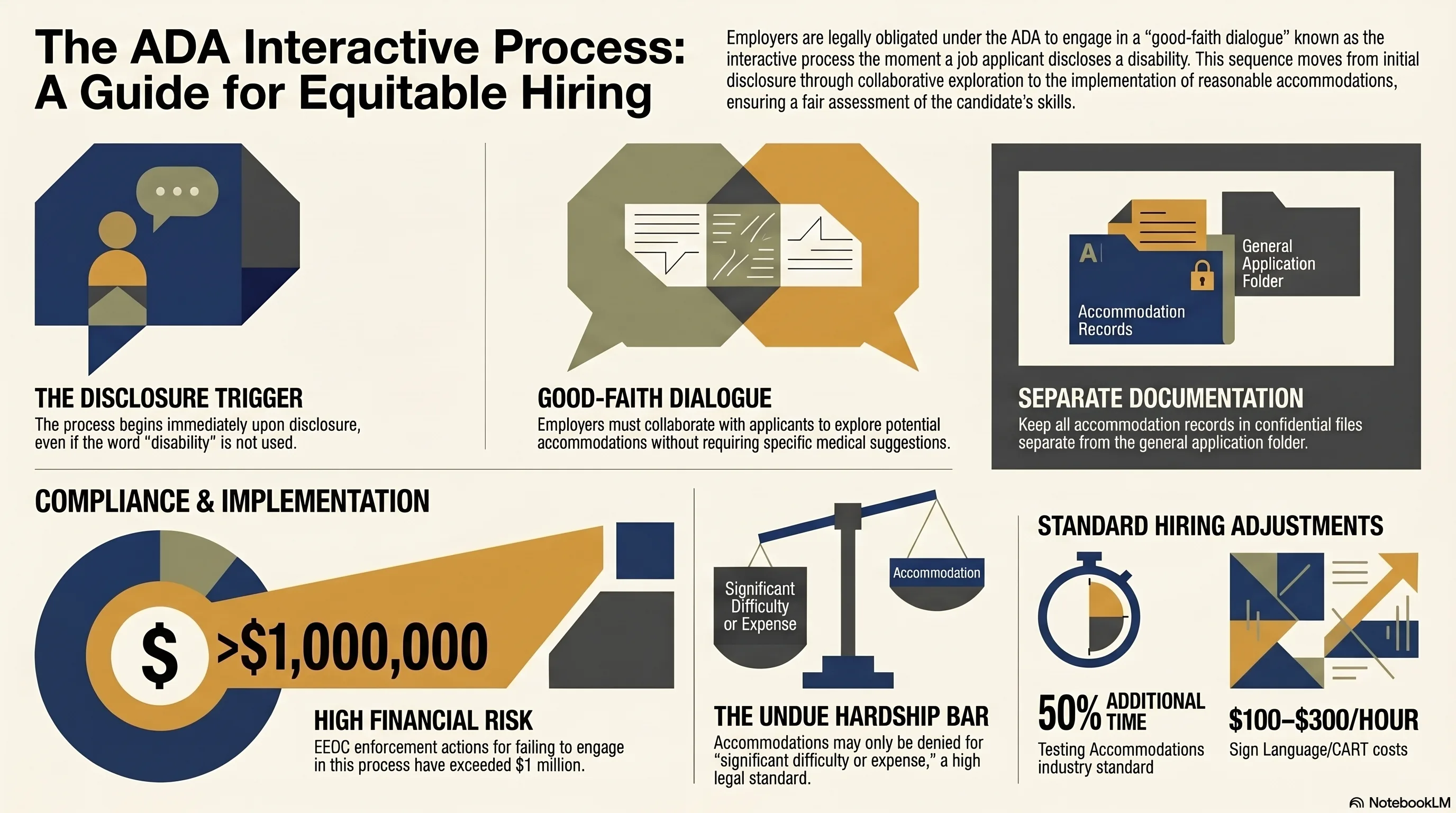
When a job applicant discloses a disability and requests accommodations to perform essential job functions, the employer is obligated to engage in an “interactive process” to determine whether reasonable accommodations can be provided. This obligation—derived from 42 USC §12111(9) and EEOC guidance—is separate from the employer’s obligation to accommodate employees. The interactive process requires that the employer engage in good-faith dialogue with the applicant, explore potential accommodations, and make a determination about whether accommodations are reasonable or would create undue hardship. Failing to engage in this process, or engaging in a process that is perfunctory or dismissive, violates the ADA. Yet many recruiters are unaware that this obligation exists during hiring—they mistakenly believe accommodation obligations begin only after the employee is hired. This misunderstanding results in applicants with disabilities being rejected without genuine accommodation consideration. The EEOC has brought enforcement actions against employers for failing to engage in the interactive process during hiring, and settlements have exceeded $1 million in some cases. This article examines the interactive process framework, accommodation examples in the hiring context, the undue hardship defense, documentation requirements, technology-enabled accommodations, and practical workflow for HR teams.
The Interactive Process: Legal Obligation and Framework
The ADA’s requirement that employers provide “reasonable accommodation” to qualified individuals with disabilities is implemented through the interactive process. While the ADA statute does not explicitly use the term “interactive process,” the EEOC and courts have recognized that engaging in an interactive process is an essential element of the obligation to provide reasonable accommodation.
The interactive process involves:
- Identifying the essential functions of the job: What must the employee do to perform the job? What are the non-essential functions? This requires reviewing the job description and understanding the actual work performed.
- Understanding the applicant’s disability and limitations: What are the specific functional limitations caused by the disability? How do these limitations affect the ability to perform essential functions? The employer should NOT ask the applicant to disclose the disability diagnosis itself, but should ask about the functional limitations.
- Exploring potential accommodations: What changes to the job, the work environment, or the hiring process could enable the applicant to perform essential functions or to equal access to the application process?
- Determining feasibility: Are the proposed accommodations reasonable? Would they impose undue hardship? Are there alternative accommodations that would be less burdensome?
- Implementing agreed-upon accommodations: Once an accommodation is agreed to, the employer should ensure it is provided and that it actually enables the applicant to participate in the hiring process or perform the job.
The interactive process is not a formal procedure with required documents or signatures (though documenting the process is best practice). Rather, it is a dialogue—typically beginning with a conversation or email exchange—in which the employer and applicant work together to identify and implement accommodations.
Critically, the applicant is not required to suggest specific accommodations. Many applicants do not know what accommodations are feasible or standard in a particular industry. The employer has an obligation to engage in the process even if the applicant initially states that accommodation is needed without specifying what type of accommodation.
The interactive process applies during hiring (when an applicant requests accommodations to apply for a job or to interview) and continues throughout employment. For this article, we focus on the hiring stage—but the framework is identical in both contexts.
Triggering the Interactive Process: Disclosure and Requests
The interactive process is triggered when an applicant discloses a disability (or the employer learns that an applicant may have a disability) and requests accommodations. The disclosure need not use the word “disability” or “accommodation.” For example:
- “I have a visual impairment and would need materials provided in large print for the interview”
- “I use a wheelchair and need the interview to be in an accessible location”
- “I’m deaf and would need a sign language interpreter for the interview”
- “I have anxiety and would benefit from having a quiet space for the interview”
- “I have dyslexia and would need written test instructions explained verbally”
All of these statements trigger an accommodation obligation, even though they don’t use the word “accommodation” explicitly.
Disclosure can occur at various points in the hiring process:
- During the application: An applicant may mention in a cover letter or application that accommodations are needed
- During initial phone screening: An applicant may mention a disability when contacted to schedule an interview
- During the interview: An applicant may disclose a disability when asked about their ability to perform job functions
- After the interview: An applicant may request accommodations if they did not disclose earlier
The employer’s obligation arises the moment disclosure occurs, regardless of when in the hiring process it happens. An employer cannot defer engaging in the interactive process until later stages of hiring.
Responding to Disclosure:
When an applicant discloses a disability and requests accommodations, the employer should:
- Take the disclosure seriously and respond promptly (ideally within 1–2 business days)
- Thank the applicant for disclosing
- Explain that the employer is committed to providing accommodations
- Ask clarifying questions to understand the specific needs (e.g., “Can you tell me more about what type of accommodation would be helpful?”)
- Indicate that the employer will explore options and follow up with specific accommodations
Common Errors in Responding to Disclosure:
- Immediately saying “no” without exploring options (“We can’t do that” is premature)
- Asking for medical documentation (not generally necessary at the applicant stage; the employer can ask follow-up questions about functional needs)
- Assuming what the applicant needs without asking (“I assume you want a video interview” might be incorrect)
- Offering only one accommodation without exploring alternatives
- Delaying response for an extended period (creates the appearance that the employer is not taking the request seriously)
Best practice is to respond to accommodation requests within 1–2 business days, even if the response is simply “Thank you for letting us know. I’m exploring options and will follow up by [date].” This demonstrates responsiveness and commitment to the interactive process.
Common Accommodation Examples in the Hiring Context
Reasonable accommodations in hiring take many forms. The following are common examples:
- Modified Interview Formats: Applicant may request a phone interview instead of in-person (due to mobility limitations or anxiety), a video interview instead of phone (for a deaf applicant who communicates via video relay), or additional break time during interviews. These are generally reasonable unless the employer can demonstrate undue hardship.
- Accessible Interview Location: An applicant may need an interview in a location with accessible parking, elevator access, and accessible restrooms. The employer should ensure the interview space meets these requirements.
- Sign Language Interpreter or CART Captioning: Deaf applicants frequently need sign language interpreters or Communication Access Realtime Translation (CART) captioners during interviews. These services are standard accommodations and cost $100–300 per hour. Undue hardship is rarely established for this accommodation.
- Extended Time for Testing: Applicants with cognitive disabilities (dyslexia, ADHD, autism) may request additional time to complete written assessments or skills tests. Providing 50% extra time is a standard accommodation. Providing unlimited time is rarely necessary.
- Clarification of Verbal Instructions: An applicant may request that verbal interview or test instructions be provided in written form, or that complex instructions be explained in simpler language. This is a standard, low-cost accommodation.
- Allowing Assistive Technology: An applicant may use a screen reader, speech-to-text software, or other assistive technology during assessments or interviews. The employer should allow this technology unless the purpose of the assessment would be defeated (e.g., a typing speed test would be invalid if the applicant uses speech-to-text).
- Accessible Materials: An applicant may request that written materials be provided in large print, Braille, audio format, or electronic format that is compatible with screen readers. Providing materials in alternative formats is generally reasonable.
- Service Animal Accommodation: An applicant with a service animal should be allowed to bring the animal to interviews or other hiring-related locations. Service animals are not pets; they are medical devices and are permitted under the ADA.
- Flexibility with Attendance or Timing: An applicant may request that an interview be scheduled at a time when they are more alert (e.g., morning instead of evening for someone with a condition affecting energy), or may request additional breaks. These are generally reasonable unless they significantly interfere with the hiring process.
- Modified Application Format: An applicant may request that the online application be completed via phone with an HR representative, or may request a paper application instead of online. Providing an alternative application method is a reasonable accommodation.
- Permission for Support Person: An applicant may request that a family member, friend, or disability advocate be present during the interview to provide emotional support or to help with note-taking. While the employer can require that the applicant be the one answering questions, prohibiting a support person present is generally not reasonable.
- Task Modification During Job Assessments: During a job simulation or skills assessment, an applicant may request modification of the task. For example, a job applicant who is blind may request that a written test be read aloud, or that a visual task be described verbally. The accommodation should not defeat the purpose of assessing the essential skill, but reasonable modifications are generally required.
The Undue Hardship Defense: When Accommodations Are Not Required
The ADA’s accommodation obligation is not absolute. Employers may deny an accommodation if providing it would cause “undue hardship.” 42 USC §12111(10) defines undue hardship as an “action requiring significant difficulty or expense” in relation to the employer’s resources and operations.
In determining undue hardship, the following factors are considered:
- Nature and cost of the accommodation: What is the specific cost of providing the accommodation? A $500 interpreter service might be reasonable for a large employer but could constitute undue hardship for a very small employer.
- Overall financial resources: What are the employer’s total financial resources? Costs must be analyzed relative to the employer’s overall budget and resources.
- Type of operations: How do the operations of the employer affect the feasibility of accommodation? A manufacturing company with shift work may face greater hardship in accommodating certain scheduling requests than an office-based company.
- Impact on operations: How would the accommodation affect the employer’s operations and ability to serve clients or the public?
In practice, undue hardship is a high bar. Most common accommodations (interpreter services, modified schedules, accessible locations, alternative testing formats) do not constitute undue hardship for most employers. The EEOC frequently challenges employer claims of undue hardship, arguing that the employer has not genuinely explored the cost and feasibility of accommodations.
Common Hardship Claims That Are Often Rejected:
- “This is too expensive.” Unless the cost is extraordinary (tens of thousands of dollars) relative to the employer’s size and resources, cost alone does not establish undue hardship. A $300 interpreter service is not undue hardship for an employer with multiple locations and thousands of employees.
- “This is not standard practice.” The fact that the employer has never provided an accommodation before does not establish hardship. The question is whether the accommodation is feasible, not whether it is typical.
- “This would take too much time.” Accommodations that require time investment (modifying materials, scheduling interpreter services) are generally reasonable unless they would substantially delay or interfere with hiring timelines.
- “This would be a distraction.” The employer cannot deny accommodations because they might make others uncomfortable. For example, “The team might be distracted by a sign language interpreter” is not a legitimate hardship argument.
Common Hardship Claims That Are Sometimes Accepted:
- Fundamental alteration of the job: If an accommodation would fundamentally change the nature of the job or eliminate essential functions, it may constitute undue hardship. For example, requiring a truck driver position to provide a modified vehicle that does not require driving could be undue hardship.
- Extraordinary cost: For a very small employer (fewer than 5 employees), an accommodation costing $5,000–10,000 might be undue hardship. However, this depends on the employer’s resources.
- Safety concerns: If an accommodation would create a significant safety risk that cannot be mitigated, it may be denied. For example, requiring a blind person to work as a crane operator without any accommodation might be denied based on safety concerns.
When considering undue hardship, employers should:
- Actually calculate costs: Don’t assume an accommodation is expensive; determine the specific cost
- Evaluate alternatives: Can a different accommodation be provided that would be less costly or burdensome?
- Consider business necessity: Is the concern truly about hardship, or about preference or tradition?
- Document the analysis: If the employer denies an accommodation based on hardship, document the reasoning
In the hiring context, claiming undue hardship is particularly difficult because hiring accommodations (interpreter services, modified interviews, extended time for testing) are typically low-cost.
Documentation of the Interactive Process
Best practice is to document the interactive process, creating a record of the accommodation request, the employer’s response, options explored, and the accommodation ultimately provided. This documentation serves several purposes:
- Demonstrates good-faith engagement: If the applicant later alleges that the employer did not engage in the interactive process, documentation proves that the employer took the request seriously
- Prevents miscommunication: Written summaries of conversations ensure that both parties have the same understanding of what was agreed
- Provides continuity: If an accommodation spans from hiring through employment, documentation ensures that the accommodation is implemented consistently
- Supports mitigation: If an ADA lawsuit is filed, documentation showing that the employer engaged in good-faith process and made genuine efforts to accommodate can support a defense or reduce damages
A Recommended Documentation Process:
- Initial Request Email: When the applicant requests accommodations (verbally or in writing), send a follow-up email summarizing the request: “Thank you for letting me know that you would benefit from a sign language interpreter for your interview. I want to confirm that you’re requesting an interpreter, and I will arrange one for you. The interview is scheduled for [date/time]. Please confirm that an interpreter will work for you.”
- Accommodation Confirmation Email: Once accommodations are arranged, send a confirmation: “I’ve arranged a sign language interpreter for your interview on [date/time]. The interpreter will arrive at [location] at [time]. Please let me know if you have any other needs.”
- Post-Interview Note: After the interview, add a note to the applicant’s file documenting that the accommodation was provided: “Accommodation provided: Sign language interpreter arranged and present for [date] interview.”
- Retention: Keep all documentation (emails, notes, confirmation of services provided) for at least the same period as hiring records (typically 1 year).
What NOT to Document:
Employers should avoid documenting details about the applicant’s disability, medical history, or diagnosis. The focus should be on functional needs and accommodations, not medical information. For example:
- Good documentation: “Applicant requested sign language interpreter for interview”
- Poor documentation: “Applicant disclosed deafness and requested interpreter”
The employer can note what the applicant disclosed, but the focus should be on what was needed to enable participation.
Confidentiality:
Accommodation documentation should be kept separate from the general application file and should be treated as confidential medical information. If the applicant is not hired, the accommodation request should still be documented (to show that the applicant was given fair consideration) but the file should be retained separately.
Technology-Based Accommodations and Video Interviewing Platforms
Modern hiring frequently uses video interview platforms (Zoom, Webex, Microsoft Teams, specialized interview platforms like HireVue or Spark Hire). These platforms can create barriers for applicants with disabilities if not used carefully.
Common Video Platform Accessibility Issues:
- No captioning: Deaf applicants cannot follow video conversations. Solutions include enabling automatic captions or scheduling CART captioner.
- No alt text for shared content: If the interviewer shares a document or image on screen, blind applicants using screen readers cannot see it. Solution: interviewer describes content verbally.
- Inability to adjust text size or contrast: Applicants with low vision may not be able to read content. Solution: use platform’s built-in accessibility features, or provide materials in advance in accessible format.
- Requirement to use video: Some platforms require that video camera be on. For applicants with certain disabilities (anxiety, cognitive disabilities triggered by self-observation), this is burdensome. Solution: allow audio-only participation or provide alternative interview format.
Best Practice for Video Interviews:
- Test accessibility features: Before scheduling a video interview, ensure the platform has accessibility features (captions, screen reader compatibility, keyboard navigation)
- Provide platform orientation: Give applicants advance information about the platform and any technical requirements
- Allow participants: If the interview is scheduled via platform, be flexible about allowing applicants to have a support person on the call (in a non-participant role)
- Offer alternatives: For applicants who disclose that video interviews are problematic, offer a phone interview or in-person interview
- Enable captions by default: Automatic captions should be enabled for all video interviews (they benefit deaf applicants and also benefit applicants in noisy environments or with hearing difficulties)
- Test with assistive technology: Use a screen reader to test whether the interview platform is compatible
Technology-Enabled Accommodations:
Beyond video platforms, emerging technologies can support applicants with disabilities:
- Speech-to-text software: Allows applicants with motor or cognitive disabilities to respond verbally in assessments
- Screen readers and text-to-speech: Enables blind applicants to participate in assessments
- Live captioning services: CART captioners provide real-time transcription of spoken words
- Digital accessibility platforms: Some companies use platforms that automatically detect accessibility barriers and suggest accommodations
Employers should be open to applicants using assistive technology during hiring assessments, provided that the accommodation doesn’t defeat the purpose of the assessment. For example, allowing speech-to-text during a typing test would be inappropriate, but allowing it for a problem-solving assessment would be reasonable.
Practical Workflow for HR Teams: Accommodation Request to Hiring Decision
Implementing the interactive process requires clear procedures and training for HR teams. The following workflow integrates accommodation requests into the hiring process:
- Training: Train all recruiters and hiring managers on the interactive process, common accommodations, and the legal obligation to engage seriously with accommodation requests. Training should include examples and should emphasize that engaging in the interactive process is both a legal obligation and a good hiring practice (accommodations allow the employer to fairly evaluate qualified candidates who might otherwise be screened out).
- Accommodation Request Intake: When an applicant requests accommodations (via email, phone, or in-person), take the request seriously and document it. Send a confirmation email thanking the applicant and indicating that the employer will explore options.
- Information Gathering: Ask clarifying questions to understand the applicant’s needs. Do not ask for a medical diagnosis, but do ask about functional limitations and what the applicant believes would be helpful.
- Exploration and Assessment: Consult with the hiring team to identify potential accommodations. Consider cost, feasibility, and whether alternatives exist. Document the options considered.
- Proposal and Agreement: Propose one or more accommodations and ask for the applicant’s feedback. Discuss any concerns or alternative options.
- Implementation: Once accommodations are agreed to, arrange and implement them. Communicate logistics to the applicant (time, location, or other details).
- Follow-Up: After the hiring stage (interview, assessment, etc.), check with the applicant to ensure the accommodation was effective and that no additional needs arose.
- Documentation and Retention: Document all steps of the process and retain records for at least 1 year (or longer if required by law or company policy).
A Sample Accommodation Request Workflow:
Applicant discloses disability via email: “I use a wheelchair and would need the interview to be in an accessible location.” → HR responds within 1 business day: “Thank you for letting us know. Our interview location has accessible parking and elevator access. Is this suitable for you?” → Applicant confirms → HR sends confirmation email with location details and accessibility features → Interview conducted → HR documents that accommodation was provided and notes any feedback from the applicant → File retained.
Common Errors in the Interactive Process and How to Avoid Them
Years of EEOC enforcement actions reveal recurring errors that employers make in handling accommodation requests:
Assuming What the Applicant Needs: An employer learns an applicant is deaf and assumes they will need a sign language interpreter, without asking. The applicant might prefer CART captioning, or may be comfortable reading subtitles. Best practice: Ask the applicant what type of accommodation they prefer.
Delaying Response: An applicant requests accommodations a week before the scheduled interview, and HR does nothing. By the time the interview occurs, accommodations are not arranged. This demonstrates lack of engagement in the interactive process. Best practice: Respond to accommodation requests within 1–2 business days, even if just to indicate that options are being explored.
Denying Without Exploration: An applicant requests an accommodation, and the employer says “no” without genuinely exploring feasibility or cost. For example: “We can’t provide an interpreter; that’s too expensive.” Without knowing the actual cost ($300 for the interview) relative to the employer’s budget, this denies the request prematurely. Best practice: Always explore cost and feasibility before denying.
Asking for Medical Documentation: During hiring, the employer asks the applicant for a letter from their doctor confirming the disability. This is generally excessive at the application stage; the employer can ask follow-up questions about functional needs without requiring medical documentation. Best practice: Ask the applicant “What type of accommodation would help you participate fully in the interview?” rather than requesting medical records.
Offering Only One Option: The employer identifies one accommodation option and presents it as take-it-or-leave-it. Applicants might have preferences or might identify a better option. Best practice: Explore multiple options with the applicant and discuss pros and cons.
Feeding Accommodations Into Hiring Decisions: After providing an accommodation, the employer gives the applicant lower interview ratings because the accommodations “showed” the applicant has limitations. This violates the ADA—accommodations should not be factored into hiring decisions. Accommodations are provided specifically to level the playing field so that the applicant is evaluated on qualifications, not on disability. Best practice: Evaluate applicants based on their responses and qualifications, not on the fact that they requested accommodations.
Failing to Document: The employer provides accommodations verbally but does not document the request or the accommodation provided. If the applicant later complains that they did not receive promised accommodations, there is no record to support the employer’s account. Best practice: Always follow up conversations with a confirming email.
These errors typically result from lack of awareness or training, not intentional discrimination. Training and clear procedures can prevent most of these errors.
How Cadient Talent SmartSuite Helps
Cadient Talent’s SmartSuite platform embeds the interactive accommodation process directly into the hiring workflow. When an applicant discloses a disability or requests accommodations through the application system, SmartSuite automatically triggers an accommodation request intake process. The system prompts recruiters with a structured interview guide to gather information about functional needs and to explore potential accommodations. SmartSuite provides a library of common accommodations in the hiring context (interpreter services, modified interview formats, extended time for testing, accessible materials) and allows recruiters to propose and track accommodations. The platform documents all steps of the interactive process—request, options explored, accommodation agreed to, implementation confirmation—creating an irrefutable record of good-faith engagement. SmartSuite automatically separates accommodation information from the general hiring file, keeping it confidential and organized. Hiring managers see clear guidance indicating that accommodations should not factor into interview evaluations, ensuring that applicants are assessed fairly. By integrating the interactive process into the workflow, SmartSuite ensures that no accommodation requests are overlooked, that responses are timely, and that documentation supports ADA compliance and demonstrates commitment to equal employment opportunity.
References and Further Reading
- 42 USC §12111(9): Definition of qualified individual with disability
- 42 USC §12111(10): Definition of undue hardship
- EEOC Guidance on the Interactive Process for Reasonable Accommodation
- 29 CFR §1630.2(o)(1)(v): Interactive process requirement under ADA regulations
- EEOC v. Heil Trailer International Corp. (6th Cir. 2005): Interactive process obligation and damages for failure to engage
- EEOC v. Exxon Chemical Co. (9th Cir. 2012): Employer’s obligation to engage in interactive process even if accommodation request is vague
- ADA Amendments Act of 2008: Broadened definition of disability to require interactive process for wider range of conditions
- Title I Technical Assistance Manual: Guidance on accommodation and undue hardship determinations
- EEOC Compliance Manual Section 902: ADA obligations in hiring and accommodation
How Cadient Talent SmartSuite™ Helps
Cadient Talent’s SmartSuite™ platform automates compliance workflows, embeds regulatory guardrails directly into your hiring process, and maintains audit-ready documentation at every stage—so your team can focus on finding great talent while staying protected from costly violations.
