
Real-time candidate communication eliminates email friction, clarifies logistics, and turns interview coordination into relationship-building conversation.
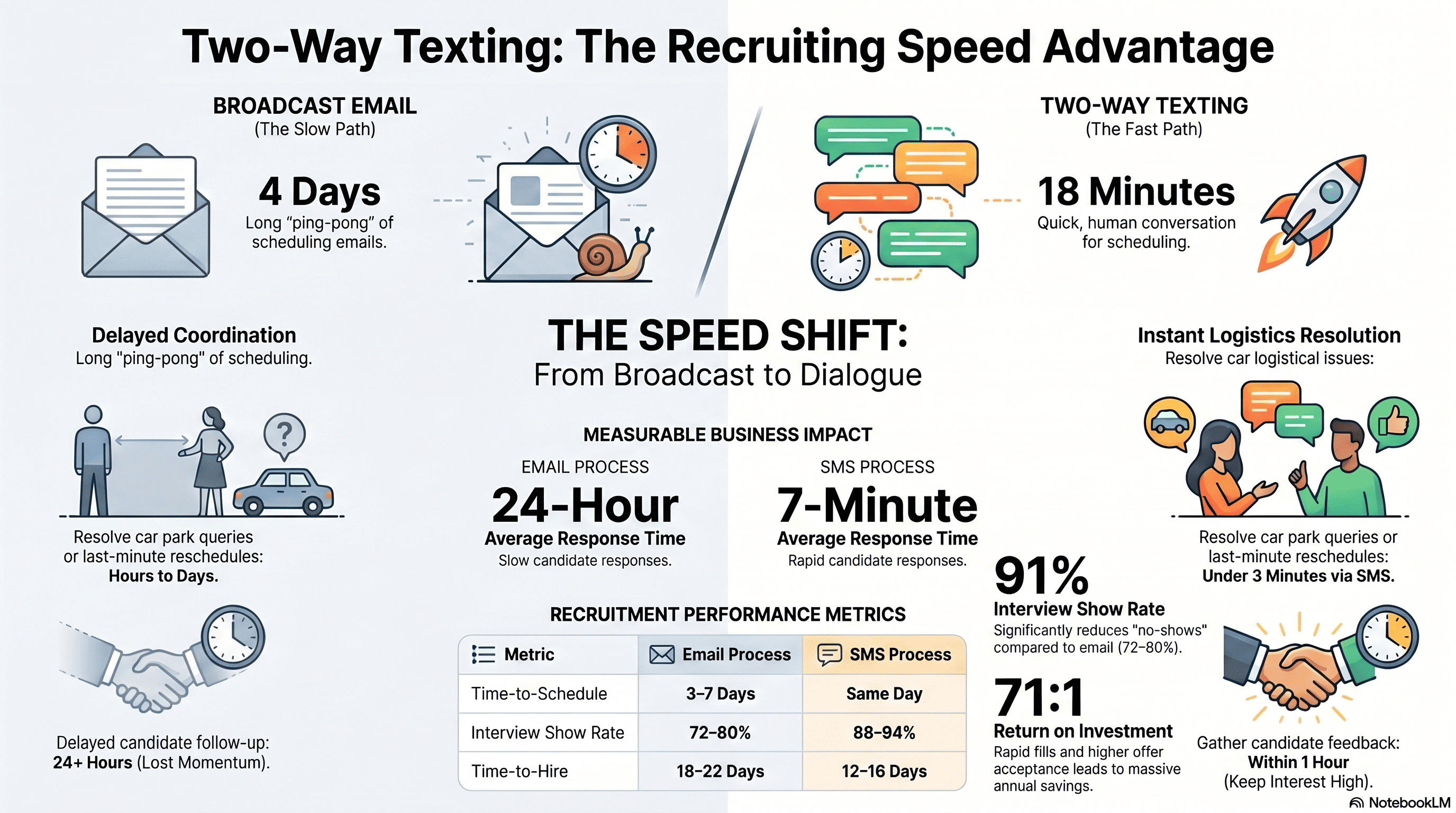
From Broadcast to Dialogue: Why Two-Way Texting Changes Everything
Traditional interview coordination is broadcast communication: recruiter emails candidate, candidate replies, recruiter replies, ping-pong across days. Two-way texting transforms this into real-time dialogue.
Traditional flow:
Recruiter (Day 1): “Can you interview Friday at 2pm?”
Candidate (Day 2): “Friday doesn’t work. How about Saturday?”
Recruiter (Day 2, 4pm): “Saturday doesn’t work for our team. How about next Tuesday?”
Candidate (Day 3): “Tuesday at 2pm works.”
Recruiter (Day 3, 4pm): “Perfect, I’ll send calendar invite.”
Candidate (Day 4): “I didn’t receive the calendar invite. Can you resend?”
Total time elapsed: 4 days
Two-way texting flow:
Recruiter (Day 1, 9am): “Can you interview Friday at 2pm?”
Candidate (Day 1, 9:15am): “No, Friday doesn’t work. Saturday?”
Recruiter (Day 1, 9:16am): “Saturday doesn’t work, but Tuesday 2pm?”
Candidate (Day 1, 9:17am): “Perfect!”
Recruiter (Day 1, 9:18am): [Sends calendar invite via SMS link]
Total time elapsed: 18 minutes
This isn’t just faster; it’s a completely different experience. The 4-day back-and-forth feels transactional and frustrating. The 18-minute conversation feels human, real, and efficient.
For candidates, two-way texting signals that the company respects their time and moves quickly. For recruiters, it eliminates email threads that get lost and reduces rescheduling headaches. For hiring managers, interview logistics are clarified before the day of the interview (no “What time did we schedule?” questions).
Real-Time Interview Coordination: Solving Logistics Before Interview Day
Two-way texting enables real-time coordination of interview logistics that would normally require multiple email exchanges:
Parking questions (common for first-time visitors):
Candidate: “I’m not familiar with your facility. Where should I park?”
Recruiter (via SMS): “North parking lot, free, just give your name at the gate.”
Candidate: “Got it, thanks.”
Resolved in 2 minutes via text. Via email, this exchange takes 6 hours minimum (candidate sees email later, sends question, recruiter replies next morning).
What to bring clarification:
Candidate: “Do I need to bring anything besides my resume?”
Recruiter: “Bring your ID and two copies of your resume. We’ll have pens/clipboard.”
Candidate: “Perfect, see you Tuesday!”
Resolved in 2 minutes. No ambiguity. No candidate showing up unprepared.
Last-minute reschedules:
Candidate (Day-of interview, 9am): “I’m running late. I got stuck in traffic. Can we reschedule?”
Recruiter (9:02am): “No problem. What time works better? Tomorrow morning?”
Candidate (9:03am): “Tomorrow 10am?”
Recruiter (9:04am): “Perfect. Updated calendar invite sent.”
Resolved in 3 minutes, hiring manager is immediately notified of new time.
Without two-way texting, this last-minute reschedule would require phone calls, emails, and hiring manager calendar coordination that might stretch to 30-60 minutes during the crisis of a missed interview.
Interview location updates:
Recruiter: “Note: This interview moved to our new downtown office at 123 Main St, not our original location. Parking info is different.”
Candidate: “Thanks for the heads up! See you then.”
Update delivered and confirmed in seconds. No candidate showing up at the wrong location.
Post-Interview Follow-Up: Gathering Feedback and Building Momentum
Two-way texting is especially powerful post-interview for immediate feedback and next-step communication.
Immediate post-interview feedback (same-day, within 1 hour):
Recruiter (texts candidate): “Thanks for the interview today! Quick question—how did it go from your perspective?”
Candidate (replies immediately): “Great! I’m really interested. When will I hear back?”
Recruiter: “We’re talking with a couple more candidates, but decision by Thursday. I’ll text you then.”
Candidate: “Sounds good, thanks!”
This conversation keeps momentum. Candidate stays engaged. Recruiter has real-time feedback about candidate’s interest level. No slow email exchanges where candidate loses momentum.
Next-step communication:
Ifcandidate moves to next round:
Recruiter: “Good news—you’re moving to the next round! Next is a call with our warehouse manager. How about Thursday at 10am?”
Candidate: “I have work Thursday morning. Friday afternoon?”
Recruiter: “Friday 2pm? I’ll set it up.”
Candidate: “Perfect!”
Next interview is scheduled immediately after advancing. No delay. No candidate waiting to hear next steps.
Decision notification:
Recruiter (if offering): “We’d like to make an offer! Here are the details [quick summary via text]. Can you start Monday?”
Candidate: “Yes! This is great.”
Recruiter: “Awesome. I’m sending formal offer document to review. You’ll get the link in the next minute.”
Decision is communicated immediately. Candidate knows same-day, while interest is highest. No candidate receiving rejection email a week later (which damages brand perception) and then receiving offer email simultaneously (which is confusing).
Compliance Considerations: TCPA and Text-Based Communication
Two-way texting in recruiting doesn’t create additional TCPA compliance burden if you follow basic best practices:
Consent collection:
At application, candidates consent to SMS communication. Checkbox: “I consent to receive interview updates via text message (standard message rates apply).”
This consent covers all interview-related texts: confirmations, reminders, coordination, post-interview follow-up, offer notifications, rejection notifications.
Messaging content:
Texts must be related to interview coordination, not marketing. “Interview confirmed for Tuesday at 2pm” is compliant. “Check out our company benefits packages!” would be problematic (that’s marketing).
In practice, recruiting texts are 100% interview/hiring-related, so TCPA compliance is straightforward.
Message frequency:
There’s no “too many texts” rule in TCPA. You can text candidates multiple times per day if all messages are interview-related. What matters is consent, not frequency.
Opt-out:
Candidates should be able to opt out. A simple reply “STOP” opts them out of texts. For recruiting, opt-out is rare because candidates want texts (they’re useful and fast).
Best practice — Built-in compliance:
Use an ATS with native SMS that automates consent collection. SmartSuite embeds consent into application, timestamps it, maintains audit trail. If regulators ever question whether you had consent, you have proof.
Without proper SMS infrastructure, you’re guessing about compliance. With proper infrastructure, compliance is automated and auditable. Recruiting companies using SMS through compliant platforms report zero TCPA violations.
Integration with ATS Workflows: Making Two-Way Texting Operational
For two-way texting to work at scale, it must be integrated into your ATS and recruiting workflows.
Recruiter workflow:
- Candidate moves to “interview scheduling” stage
- Recruiter opens candidate record in ATS
- Recruiter clicks “Send interview proposal via SMS” button
- System pre-fills SMS template with candidate name, role, and suggested times
- Recruiter reviews/edits, clicks send
- SMS goes to candidate
- Candidate replies via text
- Reply comes back to ATS (either in candidate record or to recruiter’s SMS inbox)
- Recruiter reads reply, responds via SMS from ATS
- Conversation continues in ATS (not separate SMS app)
This workflow keeps conversation history in one place. Recruiter doesn’t have to check their phone’s SMS app; conversation is in ATS where all other candidate communication lives.
Hiring manager workflow:
Hiring manager doesn’t see SMS conversation; it’s recruiter’s job to coordinate. But once time is scheduled, recruiter texts hiring manager confirmation: “Interview scheduled: Sarah Chen, Warehouse Assoc, Tues 2pm, Memphis location.”
Automation:
Recruiter can set up SMS templates for common scenarios:
- “Hi [Name], quick follow-up on your interview—can you confirm you’re still interested?”
- “Hi [Name], can we reschedule your interview? What times work better?”
- “Hi [Name], you’re moving to the next round! Next step is [Step]. How about [Time]?”
Recruiter selects template, it pre-fills with candidate data, recruiter sends.
Two-way capability requirement:
Your SMS provider (or built-in SMS in your ATS) must support two-way texting. Some SMS providers only send messages; they don’t receive replies. That defeats the purpose. SmartSuite includes full two-way SMS: you send and receive through the platform.
Candidate Experience and Relationship Building
Beyond operational efficiency, two-way texting improves candidate experience measurably.
Speed perception:
Candidates perceive two-way texting as dramatically faster than email-based coordination. When a recruiter replies within 1 minute (via SMS), it signals responsiveness and interest. When a recruiter replies in 24 hours (via email), it signals bureaucracy.
Personality:
Texting enables personality that email doesn’t. “Hey Sarah! Excited about your interview Tuesday at 2pm. Any questions?” feels warm. “Interview Confirmation” (email subject) feels corporate.
Trust building:
When a recruiter texts “There’s construction on Main Street Tuesday—come in through the North entrance,” it signals that they’ve thought about candidate success. When a candidate has to figure out parking/directions on their own, it signals indifference.
Relationship foundation:
Two-way texting creates a relationship with the candidate, not just an transactional hiring process. When a candidate is eventually hired, they already feel connected to their hiring team because they’ve had real conversations via text.
This is especially impactful for frontline roles where relationship matters more than credentials. A candidate for a retail position who’s had multiple text conversations with a recruiter before even interviewing feels like they already know the team. They’re more likely to accept, more likely to show up on day one, more likely to stay.
Measuring Two-Way Texting Impact
Two-way texting effectiveness should be measured across several dimensions:
- Response time: How long does it take candidate to respond to texts?
- Email: 4-24 hours
- SMS: 3-15 minutes
- Target: under 10 minutes (indicates engagement)
- Time-to-schedule: How long from decision to text to scheduled interview?
- Email coordination: 3-7 days
- SMS coordination: same-day to next-day
- Target: 90% of interviews scheduled same-day
- Show rate: Do two-way texting coordinated interviews have higher show rates?
- Email-coordinated interviews: 72-80% show rate
- SMS-coordinated interviews: 88-94% show rate
- Target: 90%+
- Rescheduling rate: When candidates need to reschedule, do they communicate via two-way text or just no-show?
- Without SMS coordination: 5-8% formally reschedule, 20-25% no-show
- With SMS coordination: 18-25% reschedule, 8-12% no-show
- Target: 20%+ reschedule rate (high is good; means logistics issues are resolved, not abandoned)
- Time-to-hire: Does two-way texting accelerate hiring speed?
- Email-based interviews: 18-22 days
- SMS-coordinated interviews: 12-16 days
- Target: 2-4 day improvement
- Offer acceptance rate: Does faster, more personal coordination improve acceptance rates?
- Email process: 72-78% acceptance rate
- SMS process: 82-88% acceptance rate
- Target: 85%+
A healthcare staffing company implementing two-way SMS texting saw:
- Response time: 4-hour average to 7-minute average
- Time-to-schedule: 5-day average to same-day
- Show rate: 76% to 91%
- Time-to-hire: 18 days to 11 days
- Offer acceptance: 74% to 86%
- Annual recruiting savings: $340,000 (faster fills, higher acceptance, fewer no-shows)
- Cost: $400/month for SMS platform = $4,800 annually
- ROI: 71:1
References and Further Reading
- Mobile Marketing Association, “SMS Communication in Recruiting,” 2023
- Cadient Talent SmartSuite Case Study, “Two-Way SMS Integration in Interview Coordination,” 2024
- Journal of Applied Psychology, “Communication Medium and Candidate Relationship Quality,” 2023
- TCPA Compliance Guide, “Text Messaging in Recruiting,” 2024
- Harvard Business Review, “Speed as a Competitive Recruiting Advantage,” 2023
- Glassdoor, “Candidate Expectations for Communication Speed,” 2023
- Society for Human Resource Management, “Interview Coordination Efficiency Study,” 2024
How Cadient Talent SmartSuite™ Helps
Cadient Talent’s SmartSuite™ platform automates compliance workflows, embeds regulatory guardrails directly into your hiring process, and maintains audit-ready documentation at every stage—so your team can focus on finding great talent while staying protected from costly violations.
