
 Identity verification, credential fraud detection, and red flags that signal dishonest applicants
The Hidden Cost of Fraudulent Hires: Why This Matters
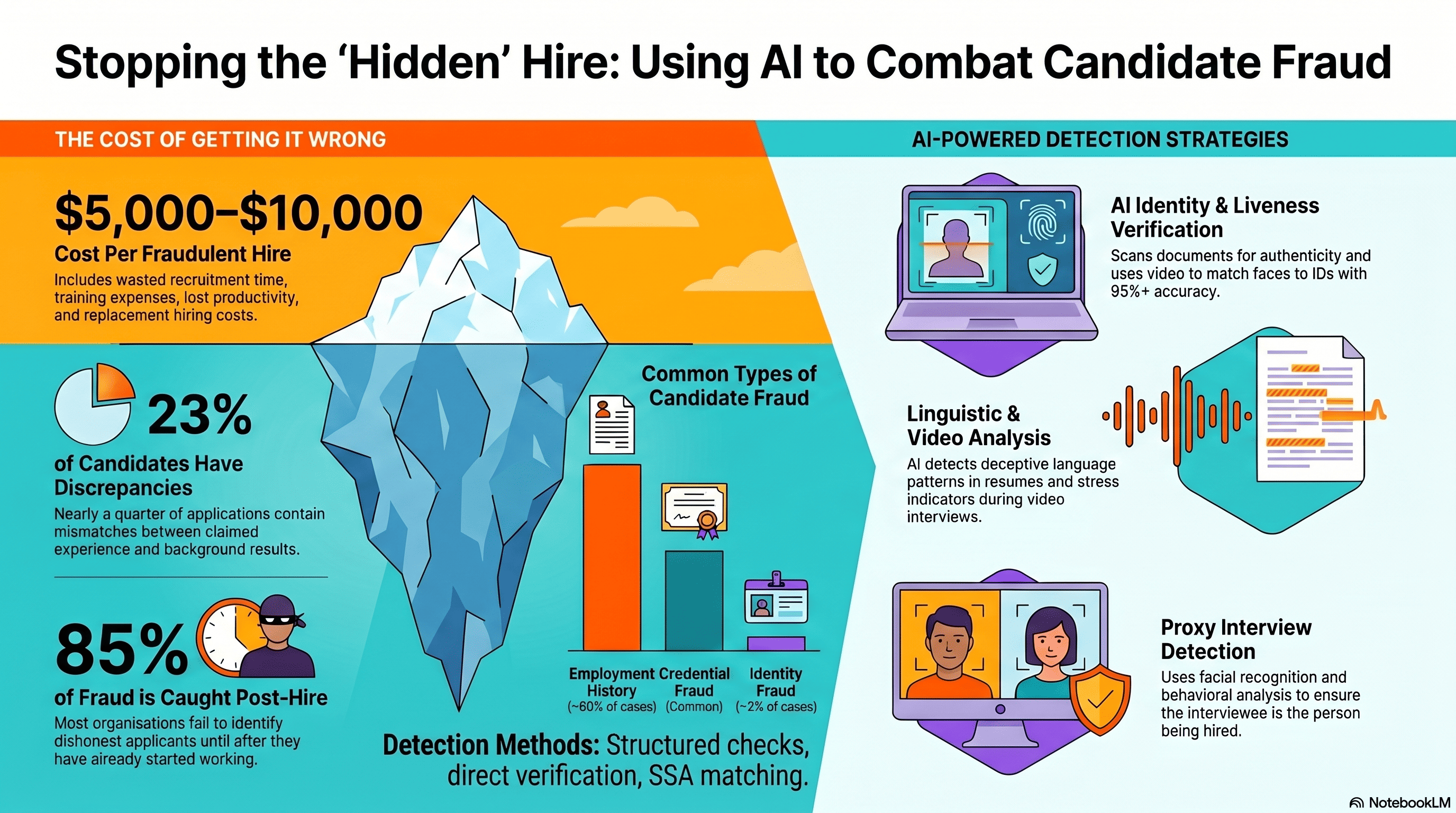
Credential fraud—candidates misrepresenting their background, identity, or qualifications—costs employers significantly. A 2023 Background Check, Inc. study of 10,000 background check investigations found:
- 23 percent of candidates had discrepancies between their application and background check results
- In 41 percent of those cases, the discrepancy was significant enough to change the hiring decision (‘worked there 2 years’ vs. ‘worked there 6 months’; ‘supervisor’ vs. ‘associate’)
- Only 15 percent of employers caught the fraud before the candidate started; 85 percent discovered it after hire
The cost per fraudulent hire:
- Recruiting time wasted: 20 hours × $22/hour = $440
- Onboarding/training: 40 hours × $22/hour = $880 (in salary/benefits cost)
- Lost productivity from false expectations: $2,000-5,000 (new employee isn’t performing at claimed level, team productivity drops)
- Manager time investigating discrepancies: 10 hours × $40/hour = $400
- Potential theft/misconduct: Many fraudulent candidates have histories of dishonesty; risk increases
- Replacement hiring if person is terminated: $1,500-3,000
Total cost per fraudulent hire: $5,000-10,000.
For a 500-hire-per-year operation with 5% fraud rate (25 fraudulent hires): $125,000-250,000 in annual fraud cost.
This is a massive, preventable loss.
Types of Fraud: Identity, Credential, and Employment History
Credential fraud takes several forms. Understanding them helps you design detection systems.
Identity Fraud
Candidate uses a false name, fake Social Security number, or someone else’s identity. This is the rarest form (~2% of cases) but the most serious (criminal liability, homeland security implications).
Detection: Run background check that includes Social Security number verification and address verification. Legitimate background check vendors (Sterling, Checkr, Accurate, ADP) verify Social Security numbers against SSA database and flag mismatches immediately.
Red flag: Candidate is eager to work but vague about identification documents. When asked for ID and Social Security number verification, they become evasive or delayed.
Employment History Fraud
Candidate exaggerates dates, job titles, or responsibilities. Most common type (~60% of credential fraud). Examples:
- Claimed ‘Shift Supervisor’ but actually was ‘Associate’
- Claimed ‘Worked 3 years’ but actually 18 months (may have left due to poor performance)
- Claimed ‘Managed team of 5’ but actually was peer to 5 people
- Claims supervisor experience but has none
- Claimed full-time position that was actually part-time
Detection: Background check investigator calls previous employers and asks specific questions. However, many employers are reluctant to provide detailed information (liability concerns). Better detection: Structured reference checks during screening (before offer) and work samples during interviewing (assess whether claimed skills are real).
Credential Fraud
Candidate claims education, certification, or credential they don’t have. Examples:
- Claims college degree or GED they don’t have
- Claims food handler card, driver’s license, or security clearance they don’t have
- Claims relevant certifications (equipment operation, etc.)
Detection: Verify credentials directly. For education: Contact registrar at claimed school (most provide degree verification). For certifications: Check issuing body (food handler card: state health department; driver’s license: DMV; security clearance: federal database if applicable). For licenses: Check professional licensing board.
Red flag: Candidate is vague about when/where they obtained credential. When asked for details (‘Which school? What year?’), answers are evasive.
Reference Fraud
Candidate provides fake references. They claim they have a reference from ‘Supervisor John Smith’ at previous company, but ‘Supervisor John Smith’ is actually a friend role-playing. Or the reference is real but has been coached to lie.
Detection: (1) Call the phone number provided and ask clarifying questions (‘Tell me about a specific project you worked with [Candidate] on’). Real references provide specific details; fake references are vague. (2) Verify the reference through official company channels (call company main number and ask for extension, don’t use number provided by candidate). (3) Use AI-powered reference checking that detects vocal patterns associated with deception and inconsistencies in stories.
AI-Powered Fraud Detection: Emerging Tools and Techniques
New AI tools help identify candidates likely to be fraudulent, allowing you to prioritize verification.
Linguistic Analysis of Applications/Resumes
AI tools analyze the language in applications, resumes, and cover letters to detect patterns associated with deception or fabrication. Red flags:
- Excessive formality or jargon inconsistent with role (cashier’s resume uses “operationalized value-chain optimization”)
- Suspiciously perfect grammar and structure (consistent with AI generation, as discussed in Article 5)
- Vague descriptions vs. specific details (Fraudsters: “Responsible for customer interactions”; Honest: “Processed 150+ daily customer transactions, handled complaints, managed returns”)
- Inconsistencies within resume (CV says ‘fluent in Spanish’ but cover letter never mentions it; if true, why not highlight?
Vendors: Pymetrics, HireVue, and newer entrants use language analysis to flag suspicious applications.
Limitation: This is correlational, not definitive. Some honest candidates write vaguely; some fraudsters are good liars.
Background Check Integration and Cross-Verification
AI platforms (Accurate Background, Checkr, Sterling) cross-reference background check results with application data. They flag discrepancies:
- Application says ‘worked 5 years at Acme Retail’; background check shows 18 months → Flagged
- Application says ‘Supervisor’; background check shows ‘Associate’ → Flagged
- Application lists employment at company that doesn’t exist → Flagged
- Address history doesn’t match claimed location history → Flagged
AI assigns a fraud risk score (1-100, where 100 = highest fraud likelihood). You can then prioritize deeper verification for high-risk candidates.
Video Interview Analysis
AI video analysis tools (used by platforms like HireVue) detect behavioral and vocal patterns associated with deception. Research shows:
- Eye contact patterns: Fraudsters look away more when discussing qualifications
- Response latency: Fraudsters take longer to respond to qualification-specific questions (they’re fabricating)
- Vocal stress: Voice stress analysis can detect anxiety/deception when discussing claimed experience
- Inconsistencies: If candidate tells same story twice with different details, AI flags the inconsistency
Vendors: Cogito, HireVue, Unveil AI offer video analysis for fraud detection.
Limitation: Video analysis for fraud detection is controversial. Some jurisdictions (Illinois, others) require consent. Accuracy is 70-85%, not perfect. Use as one signal among many, not definitive proof.
Identity Verification Tools
AI-powered identity verification (Shuftipro, IDology, Socure) use document verification, liveness detection, and database matching:
- Document verification: Candidate uploads ID (driver’s license, passport, etc.). AI scans document for authenticity (font, holograms, security features).
- Liveness detection: Candidate records a video showing their face. AI confirms the person in video matches the ID document.
- Database matching: AI checks ID against government databases (DMV, passport, Social Security).
Accuracy: 95%+ for detecting fake IDs, forged documents, and identity mismatches.
Cost: $2-8 per verification. For hourly hiring, this is affordable.
Limitation: Confirms identity, not character or capability. Someone with valid ID can still be fraudulent about experience.
Red Flags in Applications: Early Detection Before Verification
Before spending money on AI verification tools, train hiring managers to spot red flags in applications.
- Vague Employment History: Candidate lists ‘Worked in retail’ without company names, dates, or specific responsibilities. When job history is this sparse, they may be hiding gaps or fabrication.
- Unexplained Gaps: Long unexplained gaps in work history (6+ months with no explanation). Fraudsters often hide periods of unemployment or termination due to dishonesty.
- Exaggerated Titles: Job title is suspiciously impressive relative to job level. E.g., ‘Director of Operations’ at a small local business, or ‘VP of Sales’ at a store with 5 employees. Ask: Does this title make sense for this company?
- Inconsistent Contact Information: Candidate has worked in [City A] for claimed 5 years but all contact numbers are from [City B]. Ask: Why are you still based there if you’ve been working here?
- Frequent Job Hopping: Changed jobs every 3-6 months (unless there’s a clear reason like temporary roles). Frequent movers may be fleeing past dishonesty or poor performance.
- Unverifiable References: Reference contact information is personal cell phone only (not company number). Or references are vague (‘My manager; call me for number’).
- Over-Qualification Inconsistent with Role: Resume claims MBA and 10 years management experience for hourly retail role. Why is this person overqualified? Are they misrepresenting role, or will they leave immediately?
- Language Inconsistencies: Resume is perfect English; candidate struggles to speak English during phone screening. Or vice versa (resume is poor writing; interview is eloquent). Suggests someone else wrote the resume.
- Missing Information: Candidate refuses to provide Social Security number, date of birth, or other standard background info. Legitimate candidates typically provide this without hesitation.
- Pressure to Hire Fast: Candidate is unusually eager (‘I can start tomorrow,’ ‘I need a job immediately’) and discourages thorough vetting. Fraudsters often want to start before background check is complete.
Proxy Interview Detection: AI Identifying When Someone Else Took the Interview
A new fraud type emerged post-COVID: proxy interviews. A candidate arranges for someone else to take the interview on their behalf. The substitute interviews well; the actual candidate is hired but lacks the skills demonstrated.
Detection is difficult because the interview performance is real—someone skilled just completed it. However, AI-powered tools can identify proxy interviews:
- Facial Recognition: During video interview, AI analyzes facial features and compares to ID. If the person in the interview doesn’t match the ID, it flags it.
Tools: IDology, Socure, and some HireVue implementations use facial recognition to confirm interview participant matches application.
- Behavioral Analysis: Fraudsters typically coach their proxy with prepared answers. When asked unexpected follow-up questions, the proxy struggles. AI detects this pattern (smooth prepared answers + sudden stumbling on follow-ups = suspicious).
- Consistency Checks: Interview is video recorded. After hire, compare interview video to employee photo/video taken during onboarding. If the person who interviewed doesn’t match the person who showed up, that’s a proxy interview.
- Reference Cross-Check: During reference check, ask: ‘Tell me about their interview experience at your company. Were you involved?’ If reference says ‘We didn’t interview them’ but your records show an interview, that’s a red flag.
Preventive measures:
- Require ID verification before interview (photo ID match to video)
- Record all interviews and compare to candidate at onboarding
- For high-risk roles, use facial recognition to confirm interview participant matches ID
- During reference calls, ask about the interview process (‘What was your impression of how they interviewed?’)
Forensic detection: If you suspect proxy interview after hiring, compare video of interview to video/photos of employee. If they don’t match, you have grounds for termination for fraud.
Background Check Strategy: Timing and Scope
Background checks are the primary fraud detection tool, but timing and scope matter.
When to Run Checks: Pre-Offer vs. Post-Offer
Pre-Offer Background Check (Recommended for hourly): Run background check on final candidates (those you’re about to make an offer to). Cost is higher (~$35-75 per check) but you avoid hiring fraudsters.
Pro: You know before offering. Cons: Longer hiring timeline, higher upfront cost.
Post-Offer Background Check (Common but risky): Make offer contingent on background check. Candidate starts once check clears.
Pro: Lower upfront cost, faster hiring. Con: You’ve already invested interview time; if they fail, you’ve lost that investment. If they pass but are fraudulent, they’ve already started.
Recommendation: For high-risk roles (supervisory, cash handling, roles with customer access), run pre-offer checks. For lower-risk hourly roles, post-offer checks are acceptable but still run them.
What to Check: The Scope
Standard background check includes: Criminal history, employment history verification, education verification.
Enhanced checks add: Driving record (if role requires driving), sex offender registry, international background (if applicable), medical/drug screening.
For hourly retail/hospitality roles, standard + driving record is typically sufficient.
Evaluating Results: What’s Disqualifying?
Criminal history: Be careful. Many jurisdictions prohibit blanket disqualification for criminal history. You must evaluate: (1) Nature of conviction (theft = more relevant than DUI for retail role), (2) Time elapsed (conviction 15 years ago is less relevant than 1 year ago), (3) Job relevance (murder conviction more relevant for security role than for warehouse role).
Employment history discrepancies: If application says ‘5 years’ and background check shows ’18 months,’ investigate. Ask candidate to explain. They might have counted differently (includes temporary roles, etc.). If they deliberately lied, that’s fraud—disqualify.
Education discrepancies: If you require a degree and background check shows they don’t have it, disqualify (you set the requirement). If degree wasn’t actually required, don’t penalize.
Missing employment dates: Some candidates intentionally omit jobs they were fired from. If background check reveals employment not listed on application, investigate. Candidate should explain.
Vendor Selection
Choose background check vendors that: (1) Use AI to cross-reference and flag discrepancies, (2) Provide clear reporting, (3) Offer adjudication support (help you interpret results), (4) Ensure FCRA compliance (Fair Credit Reporting Act), (5) Offer reasonable turnaround (2-3 business days).
Top vendors: Sterling, Checkr, Accurate, ADP, HireRight. Cost ranges $25-75 per check depending on scope.
Post-Hire Verification: Catching Fraud After Hire
Despite best efforts, some fraudsters slip through. Implement post-hire verification to catch fraud early:
- First-Day Document Review: During onboarding, request copies of ID, Social Security card, work authorization, and any claimed certifications. Verify these match what was claimed in application.
- I-9 Verification: Within 3 days of hire (required by law), complete I-9 form. Verify documents match identity. Some employers discover fraud at I-9 stage.
- Reference Calls During Training: Contact references during the first week of employment (not before hire). Ask: ‘How is [Candidate] doing in their new role?’ This sometimes prompts honest feedback about capability level. If reference says ‘I’m not sure what they told you, but they didn’t actually manage anyone,’ you have evidence of fraud.
- Skills Assessment During Training: During training, assess whether candidate has claimed skills. If they claimed ‘POS expert’ but struggle with basic transactions, that’s evidence of fraud. Document this.
- Supervisor Check-Ins: First week supervisor check-in should include: ‘How does their actual capability match what they claimed?’ If supervisor says ‘They claimed 2 years experience but are learning from scratch,’ that’s fraud.
- 30-Day Review: At 30-day mark, conduct performance review. If it’s clear the candidate inflated their background, you have grounds for termination. Most employees are at-will, so you can terminate for dishonesty without cause.
Documentation: Keep records of discrepancies discovered (email to candidate, supervisors’ notes, training assessments). This protects you if candidate claims wrongful termination.
Building a Fraud Detection Program: Implementation Roadmap
Phase 1: Establish Baseline (Weeks 1-4)
Audit your current hiring process: Do you run background checks? If so, what scope? Do you verify education/certifications? Do you check references? Document current fraud detection approach.
Analyze your recent hires: Pull 50 recent hires and conduct post-hoc background checks. Compare results to application data. How many discrepancies exist? This gives you a fraud baseline.
Phase 2: Train Hiring Managers (Week 2, ongoing)
Teach hiring managers to spot red flags (vague employment history, unexplained gaps, exaggerated titles). Share examples of fraud caught in your organization.
Communicate new policy: All offers contingent on background check. Candidates who refuse check are disqualified.
Phase 3: Implement Pre-Offer Screening (Week 3-4)
For roles where you suspect fraud risk (supervisory, cash handling, customer-facing), add background check stage before final interview.
Sequence: (1) Application, (2) Assessment, (3) Interview, (4) Background check, (5) Offer.
Cost: ~$40 per final candidate × 100 candidates/month = $4,000/month. But this prevents $250,000+ in annual fraud cost.
Phase 4: Deploy AI Tools (Month 2)
Choose 1-2 AI tools to test: (1) Linguistic analysis of applications (flag suspicious resumes), (2) AI-powered background check vendor with fraud scoring.
Pilot with 500 applicants. Measure: How many candidates are flagged as high fraud risk? Of those flagged, how many fail background checks? Assess ROI.
Phase 5: Measure and Optimize (Month 3+)
Track: Number of fraud cases caught in background checks, time to discovery, cost savings. Monitor: Have fraud cases decreased? Are hiring managers better at spotting red flags? Are interviews more focused on verifying claims?
Set target: <2% fraud rate among hires (industry average is ~5%).
References and Further Reading
- Background Check, Inc. (2023). Credential Fraud in Hiring: Scope, Cost, and Detection. Background Check Report.
- SHRM. (2023). Background Screening and Fraud Detection Best Practices. SHRM Research Report.
- NAPBS (National Association of Professional Background Screeners). (2023). Background Screening Industry Report. NAPBS Publication.
- Society for Industrial and Organizational Psychology (SIOP). (2023). Selection Best Practices and Fraud Prevention. SIOP Guidelines.
- Federal Trade Commission (FTC). (2024). Fair Credit Reporting Act (FCRA) Compliance. FTC Guidance.
- LinkedIn. (2024). Resume Fraud and Credential Verification. LinkedIn Insights.
- Deloitte. (2024). Fraud Prevention in High-Volume Hiring. Deloitte Research Report.
- HR.com. (2023). The Cost and Prevention of Candidate Fraud in Recruitment. HR.com Survey.
How Cadient Talent SmartSuite™ Helps
Cadient Talent’s SmartSuite™ platform automates compliance workflows, embeds regulatory guardrails directly into your hiring process, and maintains audit-ready documentation at every stage—so your team can focus on finding great talent while staying protected from costly violations.
