
How pay transparency is now table stakes for recruitment, and why salary data makes or breaks your application rate
The Case for Radical Transparency
It’s 2026. A candidate sees two job postings for the same role at two different companies. One lists the salary. One doesn’t. Which one gets clicked?
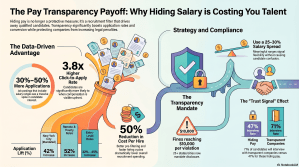
The research is unambiguous: the posting with salary gets 30-50% more applications. But most companies—especially in retail and hospitality—still hide compensation, hoping candidates will apply first and negotiate later. This is outdated thinking that’s now costing them dearly.
The shift toward pay transparency is driven by multiple forces: legal requirements (California, New York, Washington, and 25+ other states/cities now mandate pay disclosure), job seeker expectations (Gen Z and younger millennials see hidden pay as a red flag), platform defaults (LinkedIn now highlights salary ranges, Indeed has pay estimation tools), and competitive dynamics (companies that post pay attract better candidates faster).
But the deeper reason is economic. In a tight labor market, transparency is a selection filter. Candidates who know the pay upfront are self-selecting for fit. They apply only if the compensation meets their expectations. Yes, you get fewer total applications. But the applications you get are qualified—in terms of both fit and salary expectations. This dramatically improves your hire quality and offer-acceptance rate.
Companies hiding pay aren’t protecting themselves. They’re filtering out candidates who would have been excellent matches, and they’re wasting time interviewing candidates who reject the offer because the pay is lower than they expected. Radical transparency is not generosity. It’s recruiting efficiency.
The Research: Pay Transparency Impact on Applications
Several large studies have quantified the impact of pay transparency:
Glassdoor Economic Research (2023) analyzed 500,000 job postings and applications across all industries. Their findings:
- Postings with salary ranges received 30% more applications than those without
- The effect was stronger for entry-level and hourly roles (32-45% lift) than for salaried roles (15-20% lift)
- Applications with visible pay converted to interviews at a 12% higher rate
- Candidates who saw the salary upfront had offer-acceptance rates 8 percentage points higher than those who didn’t
LinkedIn Talent Solutions (2024) analyzed 2 million job postings on their platform. Results:
- Salary transparency increased application completion rate by 38%
- For remote and hourly roles, the lift was 52%
- Candidates were 3.8x more likely to click ‘apply’ if salary was visible
- Postings with salary range were 3x more likely to result in interviews being scheduled
Occupational Safety and Health Administration (OSHA) research on four states with transparency laws found:
- California (salary law effective 2023): 35-40% average lift in applications
- New York City (salary transparency law): 42% average lift
- Washington State (salary transparency law): 38% average lift
- Colorado (salary transparency law, earliest adopter): 45% average lift
The pattern is clear: transparency increases quantity and quality of applications simultaneously. You get more applications AND better matches.
Legal Requirements: The Transparency Mandate
Let’s be clear about the legal landscape. As of 2026, the following jurisdictions require salary disclosure in job postings:
States with statewide laws: California, Colorado, Connecticut, Delaware, Illinois, Maryland, Michigan, Minnesota, Missouri, Nevada, New Hampshire, New Jersey, New Mexico, New York, Ohio, Rhode Island, Vermont, Washington, and others. The list grows quarterly.
Major cities with local laws: New York City, Los Angeles, San Francisco, Chicago, Boston, and 30+ others.
Federal contractors: If you do any work for the federal government, Executive Order 14026 requires salary transparency in job postings as of 2024.
What transparency means legally varies slightly by jurisdiction, but the standard is: the salary range for the role, or if a range isn’t determined, the minimum salary or acceptable range. For hourly roles, the hourly wage or range. These can be updated periodically, but must be current.
Fines for non-compliance range from $500-$10,000+ per violation. Multiple applications and postings = multiple violations. If you post 50 jobs in California without salary ranges, that’s 50 violations × $5,000 = $250,000 in potential fines.
More importantly, failure to comply opens you to litigation. Candidates have standing to sue for violations. Class-action lawsuits on pay transparency issues are already underway in multiple states.
The practical implication: you must post salary. There’s no loophole, no ‘salary negotiable’ escape hatch. Post the range. The question is not ‘Should we?’ but ‘How do we set the range correctly?’
Setting the Right Salary Range
The fear most companies have is simple: ‘If we post a salary, we’ll have to pay that. Candidates will demand it.’ This misunderstands how salary ranges work.
A salary range is not a commitment. It’s an expected range. If your posting says ‘$18-22 per hour,’ that means you expect to hire someone at some point within that range based on experience, skills, and market conditions. You don’t pay everyone at the top of the range. You don’t have to hire someone insisting on the top.
Here’s how professional companies set ranges:
- Research the market rate: Use tools like Glassdoor, LinkedIn Salary, PayScale, Bureau of Labor Statistics, or industry surveys to understand what similar roles pay in your geography. For a retail associate in Denver, the market rate might be $17-21 per hour (entry-level) to $20-25 (experienced).
- Determine your position in the market: Do you want to lead on pay, match the market, or follow? If labor is tight, leading ($19-25) attracts better candidates faster. If labor is abundant, you can match market ($18-22) or follow ($16-20). Choose intentionally.
- Set the range accordingly: If market is $17-21 and you want to lead, set your range at $19-24. If you want to match, set $17-21. If you want to follow (not recommended), set $15-19.
- Make the range meaningful: A range that’s too narrow ($18-19) isn’t really a range—it signals you have little flexibility. A range that’s too wide ($15-25) signals confusion. Best practice is a 25-30% spread. If minimum is $18, maximum should be $22-24.
- Be honest about progression: If the posting is for an entry-level retail associate, the range should reflect that. Don’t post $18-24 if you only hire new associates at $18. Set realistic ranges. For entry-level: $18-20. For experienced: $20-24.
- Review quarterly: Market rates change. Adjust your ranges seasonally (retail might shift before Black Friday, hospitality before summer). Annual reviews minimum, quarterly if you’re in a tight market.
Done right, salary ranges do two things: they filter for genuine candidates (people who want the job at the posted range) and they signal confidence and transparency to the market.
The Trust Signal: Why Transparency Builds Employer Brand
There’s a psychological dimension to pay transparency beyond economics. Transparency is a trust signal.
When a candidate sees hidden pay, they infer: ‘This company doesn’t want to be transparent. They’re trying to get away with something. They might lowball me.’ Whether true or not, the perception is negative.
When a candidate sees posted pay, they infer: ‘This company is confident about their compensation. They’re not trying to game me. I can trust them.’ The psychological effect is powerful.
Glassdoor research (2023) found that candidates saw companies that posted salaries as ‘more trustworthy’ and ‘more professional’ than those that didn’t. When asked ‘Would you interview with this company?’, 71% said yes for transparent companies, 47% for non-transparent.
This translates to employer brand. Companies that post pay attract people who respect transparency. They attract mature, professional candidates who want straightforward dealing. They repel candidates who are looking for a ‘hidden gem’ negotiation angle. Over time, your candidate pool self-selects for cultural fit: people who value honesty and directness.
Further, transparent companies have lower offer-rejection rates (candidates aren’t surprised by the number), lower first-day quitting (no pay shock), and higher first-year retention (expectations were set correctly). The trust compounds.
Application Rate Lift: Real Numbers from Real Companies
Here’s how three multi-location retailers quantified the impact of adding pay to job postings:
Company A (150-location casual dining): Baseline for retail associate posting: 80 applications per week across all locations, 6% conversion to hire. Added salary range ($18-20/hour) to all postings. Result: 115 applications per week (+44%), 9% conversion to hire (difference due to better pre-filtering). Same hiring team, same locations, same timeframe. Cost per application fell from $8 to $5. Cost per hire fell from $133 to $67.
Company B (300-location quick service): Baseline for shift lead posting: 40 applications per week, 8% conversion. Added salary range ($22-26/hour). Result: 58 applications per week (+45%), 11% conversion. Cost per hire fell from $250 to $145.
Company C (200-location retail): Baseline for sales associate posting: 50 applications/week across channels, 12% conversion. Posted salary ($17-21/hour). Result: 72 applications per week (+44%), 15% conversion (big jump because salary pre-filtered for fit). Cost per hire fell from $167 to $96.
The pattern: +40-50% applications, 20-35% improvement in conversion rate, 30-50% reduction in cost per hire. This is a massive efficiency gain for the cost of being transparent.
What’s happening: you’re getting more applications because candidates see it’s worth their time. You’re getting better conversion because candidates who apply are genuinely interested (not just exploring options). You’re getting lower cost per hire because you’re filling roles faster with less waste.
This is not anecdotal. This is consistent and measurable.
The Competitive Advantage in Hourly Hiring
The impact of pay transparency is especially pronounced in hourly and entry-level hiring, which is where Cadient Talent focuses.
Why? Because hourly workers are price-sensitive and information-seeking. They need the job to cover bills. They’re comparing offers from multiple employers simultaneously. They don’t negotiate offers—they either accept or reject. If the pay is too low, they decline and move on.
For an entry-level retail or logistics position, pay is often the top decision factor. Location, hours, and schedule matter, but pay is the deal-breaker. A candidate comparing three retail jobs will choose the one with the highest pay if everything else is equal. By hiding pay, you’re saying: ‘Please spend 20 minutes applying and interviewing without knowing if we can afford you.’ Most don’t bother.
Companies that post pay in competitive hourly markets get a structural advantage:
- Faster hiring (more qualified applications per week)
- Lower cost per hire (better pre-filtering reduces interview waste)
- Higher offer-acceptance rates (candidates aren’t surprised by pay)
- Better retention (expectations set correctly)
- Better cultural fit (transparent companies attract transparent people)
This advantage compounds. If you hire 20% faster, with 20% lower cost per hire, and 10% better retention, you’re operating with fundamentally lower recruiting burden over time. Your competitors are scrambling. You’re building predictability.
How to Format and Present Salary in Job Postings
The mechanics of posting salary matter more than companies realize.
Format the range clearly: Use a format that’s scannable. Avoid burying the salary in paragraph 5. Put it in the first paragraph or in a dedicated compensation section. Examples:
‘Hourly Rate: $18-$20 per hour, depending on experience and shift type’
‘Salary: $45,000-$52,000 per year, based on experience and performance’
‘Compensation: $22/hour starting (entry-level) to $26/hour (experienced associates with 2+ years)’
Be specific about variables: If pay varies by shift, location, or experience level, say so. ‘Starting pay is $18/hour. With 2+ years experience, $20/hour. Weekend/night shifts add $1/hour premium.’ This is transparent AND allows flexibility.
Include benefits in the picture: Base pay is important, but total compensation matters. If you offer health insurance, 401(k), discounts, or other benefits, mention them. ‘Hourly rate: $18-20, plus health insurance after 60 days, 10% employee discount, and 401(k) matching.’ This is more compelling than pay alone.
Use salary estimators appropriately: If you’re posting on Indeed, LinkedIn, or other platforms with built-in salary tools, use their salary estimator feature. LinkedIn and Indeed use machine learning to predict what candidates expect. Let the algorithm suggest a range (usually accurate), then adjust based on your local market.
Format for mobile: Most candidates view job postings on phone. Make sure the salary is visible above the fold (no scrolling required). Use a dedicated line or highlighted section. Don’t hide it in dense paragraphs.
Update proactively: If you post a salary range in January and it’s now March, has the market moved? Consider quarterly reviews of your ranges, especially in tight labor markets. Outdated ranges look like outdated postings.
Consistency: Use the same format across all postings. ‘Hourly Rate: $X-Y’ for all retail roles. ‘Salary: $X-Y plus benefits’ for all salaried. Consistency makes it easier for candidates to compare and apply.
Objections Answered: What About Negotiation?
The most common objection to posted pay is: ‘Won’t this eliminate our ability to negotiate?’
Answering this requires reframing what ‘negotiation’ means for hourly roles.
For salaried professional roles, negotiation is normal and expected. A candidate might say, ‘I have 5 years experience. I’d like to start at $55,000.’ There’s room for discussion.
For hourly roles, ‘negotiation’ is often a fiction. A cashier with 6 months experience doesn’t negotiate; they accept $18/hour or decline. There’s no negotiation happening. You post $18, they accept or decline. Transparency just makes this explicit.
For experienced hourly roles or shift leads, there’s slightly more negotiation room. You post $22-26 for shift leads. A candidate with 5 years experience might ask for $25. That’s still within the posted range, and it’s a fair conversation. Transparency doesn’t prevent this; it just frames it within bounds.
Second objection: ‘What if we need to lower the range later due to budget constraints?’
You can. Ranges can change. If you posted $18-20 in January and in March you need to lower to $17-19 due to budget cuts, you announce the change and apply it prospectively to new hires. Existing employees’ pay doesn’t change. The range adjustment is normal and expected in dynamic businesses.
Third objection: ‘What if we hire someone below the posted range?’
Don’t. If you post $18-20 and a candidate asks for $17.50, you can decline or counter-offer at $18. Stay within the posted range. The range exists for a reason—it’s your commitment to the market.
Final objection: ‘Won’t posting pay compress salary equity across the company?’
It should. If different departments are paying the same role at wildly different rates, that’s a problem. Transparency exposes it and forces you to fix it. This is a feature, not a bug.
The Future Is Transparent: Staying Ahead of the Curve
Pay transparency is no longer emerging. It’s the present. Within three years, 95% of job postings in regulated industries will include salary information—either because of legal requirements or because candidates and platforms demand it.
Companies getting ahead now:
- Build strong salary data infrastructure: Know your market rates, maintain salary bands by role, conduct equity audits
- Post salaries proactively: Don’t wait for legal requirement. Post today. Signal confidence.
- Communicate clearly: Explain how you set ranges, how people progress within them, what total compensation includes
- Adjust frequently: Quarterly reviews of market rates. Semi-annual adjustments if needed in tight markets.
- Extend transparency internally: If external posting is transparent, internal conversation about pay should be too. Salary bands, progression, equity.
The companies that embrace pay transparency early gain structural advantages: better recruiting efficiency, stronger employer brand, higher retention, better cultural fit. The companies that resist or hide pay are increasingly at a disadvantage: lower application quality, higher hiring cost, lower offer acceptance, weaker brand.
This isn’t about being generous. It’s about competing effectively in a market that now expects and values transparency. Start today.
References and Further Reading
- Glassdoor Economic Research. (2023). ‘The Impact of Salary Transparency on Job Seeker Behavior and Hiring Outcomes.’ Analysis of 500,000 postings.
- LinkedIn Talent Solutions. (2024). ‘Salary Transparency: The Data Behind the Trend.’ Platform user research on salary visibility and application rates.
- Society for Human Resource Management (SHRM). (2023). ‘Pay Transparency Laws: State and Local Landscape.’ Comprehensive review of salary disclosure requirements.
- PayScale Research. (2023). ‘Salary Transparency and Job Seeker Expectations.’ Survey of 10,000+ job seekers on compensation expectations.
- U.S. Equal Employment Opportunity Commission. (2024). ‘Equal Pay and Salary Transparency Guidance.’ Legal framework for transparency compliance.
- CareerBuilder Research. (2023). ‘Hourly Worker Job Search Behavior.’ Analysis of how entry-level candidates evaluate job opportunities.
- Bureau of Labor Statistics. (2023). ‘Occupational Employment and Wage Statistics.’ Industry wage data and market rates by region.
How Cadient Talent SmartSuite™ Helps
Cadient Talent’s SmartSuite™ platform automates compliance workflows, embeds regulatory guardrails directly into your hiring process, and maintains audit-ready documentation at every stage—so your team can focus on finding great talent while staying protected from costly violations.
