
Craft legally sufficient notices that protect candidates’ due process rights while establishing employer defenses
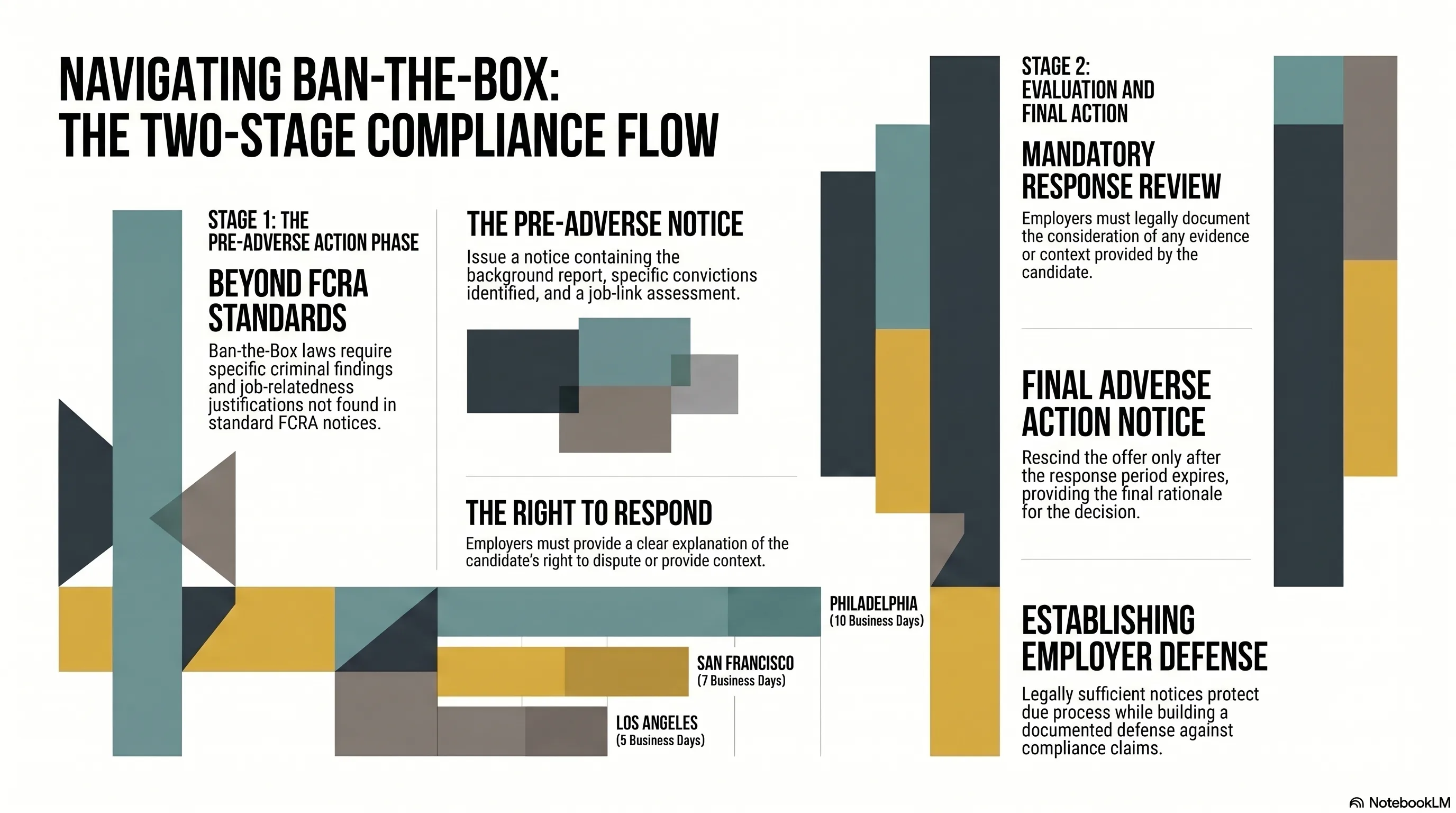
The Unique Requirements of Ban-the-Box Adverse Action Notices
Adverse action notices for criminal history decisions operate in a layered compliance environment. They must satisfy both the Fair Credit Reporting Act (FCRA) requirements and the additional, often stricter, requirements of state and local Ban-the-Box laws. Many employers mistakenly believe that a standard FCRA adverse action notice satisfies all requirements. This error has resulted in thousands of notices being legally insufficient, leaving employers unable to defend hiring decisions in litigation.
The distinction is critical: FCRA adverse action notices focus on the consumer’s right to obtain the investigative report and dispute inaccuracies. Ban-the-Box adverse action notices impose additional duties: employers must afford the candidate time and mechanism to respond, must articulate the specific criminal finding and how it relates to the job, and must document consideration of any response.
The governing framework includes 15 U.S.C. §1681e(b) (FCRA requirement to provide adverse action notice), the EEOC’s 2021 Enforcement Guidance on criminal records (which incorporates BTB principles into federal disparate impact analysis), and an overlapping web of state and local ordinances including San Francisco’s Chapter 12T, Philadelphia’s §9-4801, Los Angeles’ §104.01, and New York’s Fair Chance Act.
Best practice requires a two-stage notice process: first, pre-adverse action notice that provides the candidate with the criminal information and an opportunity to dispute; second, final adverse action notice after the candidate’s response period expires or after the candidate responds.
Pre-Adverse Action Notice: Content and Timing
The pre-adverse action notice (sometimes called a “notice of proposed denial”) must be provided before the employer makes a final decision to rescind the conditional offer. This notice is critical because it gives the candidate an opportunity to dispute inaccurate information, provide context about the conviction, explain rehabilitation efforts, or provide evidence of why the conviction should not disqualify them.
Required content in pre-adverse action notice:
Clear statement of the proposed adverse action: “We are considering withdrawing your conditional job offer based on a criminal background investigation.” Avoid ambiguous language.
Complete copy of the background report: The candidate has a FCRA-protected right to the report. Many jurisdictions (notably California and New York) also require this at the BTB stage. Provide the actual investigative report from your background check vendor, not a summary.
The specific criminal conviction(s) identified: List the offense, date of conviction, sentence, and any release date. “We found a conviction for felony drug trafficking on March 15, 2014” is sufficient. “We found criminal history on your record” is not.
Notice of FCRA rights: Include the FCRA standard language providing the candidate’s right to obtain a free credit report from each credit bureau, dispute any inaccuracy, and request the background check company’s results and procedures.
Notice of state/local BTB rights: Explicitly reference the specific statute or ordinance that applies. For example: “Your state Fair Chance law requires that we provide you a reasonable opportunity to respond to this proposed decision. Please see details below.”
Specific response opportunity: State clearly what the candidate can do to dispute the finding, provide context, or explain mitigating circumstances. Language such as “You have [10] business days from receipt of this notice to respond to our proposed decision. You may submit evidence of rehabilitation, character references, explanation of circumstances, or any other information you believe relevant to our final decision.”
Deadline for response: Provide a specific date and time, not a vague “within 10 days” formula. “Please respond by [specific date] at [time] by submitting written materials to [specific email or mailing address].”
Contact information: Provide the name, phone number, and email of the person the candidate should contact with questions.
Notice of decision timeline: Inform the candidate when you will make your final decision and whether you will notify them of the outcome.
Timing considerations: San Francisco requires at least 5 business days for response (Chapter 12T §12T.2(f)). Philadelphia requires 10 business days (§9-4801). New York Fair Chance Act requires a reasonable opportunity, interpreted by New York courts as typically 5-10 business days. Best practice is to allow 10 business days to provide a safety margin and demonstrate good faith.
State-Specific Notice Requirements
California
California Labor Code §432.7 does not explicitly require pre-adverse action notice, but FCRA §1681e(b) does. California applies strict interpretation of FCRA requirements. Background reports must show exactly what was found; inaccurate or outdated information cannot be used. Include explicit language: “Pursuant to the California Fair Employment and Housing Act, you have the right to dispute any inaccuracy in this criminal history information.” If the conviction is more than seven years old (and California law generally prohibits relying on it), do not include it in the report; if it appears, explicitly note its age and that it should not be considered.
New York
New York’s Fair Chance Act (NY General Business Law §296(16)) requires employers to provide the candidate with a copy of the criminal background report and afford a reasonable opportunity to respond. New York courts have interpreted this as requiring at least 5-10 business days. The notice must state: “New York law requires that you be given a reasonable opportunity to respond to this proposed decision. You may submit any documents, statements, or evidence that you believe should be considered in our final decision.” Include a specific contact person and deadline.
Philadelphia
Philadelphia Code §9-4801 imposes strict procedural requirements. The notice must include: (1) a copy of the background report, (2) a notice of the specific conviction(s) at issue, (3) the specific job-related reasons the conviction is being considered as grounds for denial, (4) notice that the candidate has 10 business days to respond with evidence of rehabilitation and other mitigating factors, (5) the name of the employer representative who will consider the response, and (6) language substantially as follows: “You have the right to respond to this proposed denial within 10 business days. Your response may include evidence of rehabilitation, references from employers or community members, education or training certificates, or other information you believe relevant to our decision.”
San Francisco
San Francisco’s Fair Chance Ordinance requires employers to provide written notice before taking adverse action. The notice must include the criminal conviction information, notification of the candidate’s right to respond within 5 business days, and the specific job duties or requirements that are being used to assess the conviction’s relevance. Chapter 12T §12T.2(f) specifies: “You may submit evidence of rehabilitation, character references, or other information you believe relevant to our hiring decision.” Failure to provide this notice can result in penalties of $500-$1,000 per violation.
Los Angeles
Los Angeles Municipal Code §104.01 requires employers to provide “a clear and conspicuous written notice” that includes the specific criminal findings and the specific job-related reasons those findings are relevant. The notice must afford at least 10 business days for response and must state that the candidate may provide “any information that shows rehabilitation and reform.” The ordinance specifically protects the candidate’s ability to contextualize arrests and convictions in light of other evidence.
Washington, D.C.
The D.C. Fair Chance Act (D.C. Code §32-531.01) requires that employers provide notice before denying employment based on criminal history. The notice must identify the specific conviction(s) and allow a reasonable time for response, though D.C. does not specify a minimum number of days. Best practice is 10 business days to align with other major jurisdictions.
Documenting the Candidate’s Right to Respond: Procedural Safeguards
The response opportunity is not merely a formality; it is a critical procedural safeguard that protects the candidate’s due process rights and strengthens the employer’s legal defense. When an employer takes an adverse action without documenting that the candidate was given a genuine opportunity to respond, courts interpret this as evidence of discriminatory intent or reckless disregard for the candidate’s rights.
Best practices for response procedures:
Designate a specific person or email address to receive responses. This ensures responses are captured and not lost in general inboxes. Document the designation in the notice itself.
Keep a log of all response submissions, noting the date and time received, the contents, and any attachments. This log is critical evidence that the candidate was given a fair hearing.
If a candidate does not respond, document the non-response. Retain a copy of the notice with proof of delivery (email read receipt or certified mail with return card) showing the candidate received the opportunity but did not exercise it.
Set a specific cut-off time for responses. “Responses must be received by 5 p.m. Eastern Time on [date]” is better than “by [date]” because it prevents disputes about what constitutes timely receipt.
Provide confirmation of receipt to the candidate. When a response is submitted, acknowledge receipt by email within 24 hours, confirming what was received and reiterating the decision timeline.
If the candidate requests an extension, document the request in writing (email is sufficient) and decide whether to grant it. Granting reasonable extension requests strengthens your position; denying a reasonable request creates inference of bad faith.
A sample response confirmation email might state: “Thank you for your response to our Notice of Proposed Adverse Action received on [date]. We have received your [describe documents, e.g., ’employment references and letter of explanation’]. We will review your submission as part of our final decision-making process and will notify you of our final determination by [date].” Keep a copy of this confirmation in the candidate’s file.
Evaluating and Documenting Mitigating Factors
Once the candidate responds, the employer must genuinely consider the response and document that consideration. This is the functional core of the individualized assessment requirement.
Common categories of mitigating evidence candidates submit:
Rehabilitation evidence: Educational degrees or certificates obtained after the conviction, completion of drug courts or other diversion programs, therapy or counseling documentation, letters from parole/probation officers confirming successful completion, and employment longevity since conviction.
Character references: Letters from previous employers, community leaders, clergy, social service providers, or family members attesting to the candidate’s character and work ethic since the conviction.
Context about the offense: Explanation of circumstances (economic hardship, substance abuse issues now in recovery, youth at time of offense), letters from family, evidence of changed circumstances, and documentation of underlying factors that no longer apply.
Employment history: Resume or work history showing continuous employment since conviction, promotions or positive performance reviews, and stability.
Documentation of the consideration process:
Create a written assessment of the mitigating evidence. This assessment should be completed before the final decision is made, not after. A template might include:
“Candidate Response Evaluation: [Candidate Name]
Offense: [specific offense and date]
Mitigating evidence submitted: [list what the candidate provided]
Relevance to Green Factors:
- Nature and Gravity: [how the mitigating evidence contextualizes the offense]
- Time Elapsed: [evidence of rehabilitation and changed circumstances]
- Nature of Job: [how the evidence relates to ability to perform the specific role]
Other factors:
- Employment history since conviction: [assessment]
- Character references: [summary of what was stated]
- Changed circumstances: [analysis]
Reconsideration of Initial Assessment: [whether the mitigating evidence changes the initial analysis]
Final Decision: [decision and specific rationale]”
This documentation approach accomplishes several goals: it demonstrates the employer genuinely considered the response (avoiding inference of pre-determined discrimination), it provides a contemporaneous record supporting the decision, and it helps identify whether the decision-maker is applying criteria consistently.
If the employer reconsiders and changes its decision to hire the candidate, this demonstrates the process worked. If the employer upholds the original adverse decision, the documented consideration of mitigating factors becomes the evidentiary foundation for that decision.
Final Adverse Action Notice and Decision Communication
After the response period expires or the candidate responds, the employer must issue a final adverse action notice. This notice differs from the pre-adverse action notice in that it contains the final decision and explains how the employer considered the candidate’s response (or non-response).
Required elements of final adverse action notice:
Statement of final decision: “After careful consideration of your response and all relevant factors, we have decided to withdraw our conditional job offer.” Use clear, unambiguous language.
Reasoning for the decision: Explain how the Green factors were applied to reach the conclusion. “While we appreciate the character references you provided, we determined that the nature of your conviction for theft—a crime of dishonesty—directly conflicts with the trust-based requirements of the finance position. Although your employment history since the conviction shows positive stability, the four-year gap between your conviction and current employment indicates a period of disruption that concerns us.” This level of specificity is critical.
How the candidate’s response was considered: Explicitly state whether the candidate submitted a response and how you evaluated it. “You submitted three character references and a letter explaining your rehabilitation efforts. We carefully reviewed these materials. [Describe what weight was given to each element.]”
Notice of appeal or further recourse rights: Check your jurisdiction for appeal rights. Some laws do not provide for internal appeals; others do.
Notice of FCRA and state law rights: Reiterate the candidate’s right to dispute the accuracy of the background report with the background check company and with credit bureaus if applicable.
Timing: The final notice should be provided promptly after the response period expires or within a defined period after the candidate’s response is received (e.g., “within 10 business days of receiving your response”).
A sample final notice might state:
“Dear [Candidate]:
We have completed our review of your response submitted on [date] to our Notice of Proposed Adverse Action dated [date].
We provided you with a copy of your criminal background report and gave you an opportunity to respond. You submitted the following: [list]. We have carefully reviewed all materials you provided.
Our Final Decision:
We have decided to withdraw our conditional offer of employment for the position of [Job Title]. This decision is based on the following factors:
[Nature of Offense]: Your conviction for [specific offense] on [date] involves [specific conduct that relates to job duties]. This crime involves a breach of trust/dishonesty/violence [select applicable element] which directly impacts your ability to perform the essential functions of a [specific function in the job].
[Time Elapsed]: Although [number] years have elapsed since your conviction, [analysis of rehabilitation evidence or its absence].
[Nature of Job]: The position of [Job Title] requires [specific relevant duties]. [Explanation of how the conviction impacts your ability to perform these duties.].
[Consideration of Your Response]: You submitted [describe]. We have given this careful consideration. [Analysis of how it was weighed]. However, after weighing all factors, we determined that [specific reason related to job requirements].
Your Rights:
Under the Fair Credit Reporting Act (FCRA), you have the right to obtain a free copy of your consumer report from any consumer reporting agency, to dispute the accuracy of any information in the report, and to request procedures used by the background check company.
Under [cite applicable state/local law], you have additional rights [describe if applicable, e.g., right to appeal if jurisdiction provides for it].
If you have questions, please contact [name, phone, email].
Sincerely,
[Company].”
Maintain this final notice in the candidate’s file indefinitely. It is the key evidence of the decision-making process if the candidate later files a discrimination charge or lawsuit.
Common Pitfalls in Ban-the-Box Adverse Action Notices
Many employers have lost legal cases because their adverse action notices contained preventable errors:
Generic language: “We reviewed your response and reaffirm our decision” without explaining what was actually considered is not sufficient. Courts view this as evidence the employer did not genuinely review the response.
Vague reasoning: “The conviction was disqualifying” without explaining how it relates to the specific job is legally vulnerable. The Green factors analysis must be explicit and tied to actual job duties.
Missing the pre-adverse action step: Employers sometimes skip the pre-adverse action notice and go directly to final denial. In BTB jurisdictions, this violates the statute. Provide both notices.
Failing to attach the background report: Many notices refer to “the report” but do not attach it. The FCRA and most BTB laws require provision of the actual report, not a reference to it.
Cutting off response time too early: Providing only 3 business days for response in a jurisdiction requiring 10 business days violates the law, regardless of whether the candidate’s response would have changed the outcome.
Making the adverse decision before the response period closes: If the candidate submits a response and you have not yet made the final decision, take time to genuinely review it. Indicating that you “have already decided” before the response deadline undermines the credibility of the process.
Failing to mention time elapsed: If a conviction is 15 years old, acknowledge this fact and explain why it does not weigh in the candidate’s favor. Silence on time elapsed suggests the employer did not conduct an individualized assessment.
Blanket language about the offense category: “All felons are not hired” or “All drug convictions are disqualifying” in the notice violates BTB laws because it indicates a blanket policy rather than individualized assessment. Each notice should discuss that specific candidate’s specific conviction in relation to that specific job.
Failure to preserve the notice: The notice should be saved in a way that it cannot be altered and can be produced in litigation with metadata proving its date of creation and issuance.
Template for State-Specific Notices
California-Compliant Notice
Include explicit reference to California Labor Code §432.7, note that the conviction [is/is not] more than seven years old and state law treatment of older convictions, provide the full background report, allow 10 business days for response, and include language: “You may provide evidence of rehabilitation, character references, or any other information you believe relevant to our decision. California law requires that we make an individualized assessment of your qualifications for this position in light of any criminal history information.”
New York-Compliant Notice
Include explicit reference to the Fair Chance Act, note that New York law requires individualized assessment, provide the full background report, state that the candidate has a reasonable opportunity (specify days) to respond, and include: “The position of [Title] requires [specific functions]. Your response should address how you believe your qualifications for these specific functions should be considered in light of any criminal history, evidence of rehabilitation, and other relevant factors.”
Philadelphia-Compliant Notice
Include Philadelphia Code §9-4801 citation, specify the job-related reasons the conviction is being considered, provide the full background report, explicitly state that the candidate has exactly 10 business days to respond, list what types of evidence may be submitted (rehabilitation, references, education), and include: “We will specifically consider any evidence of rehabilitation and any other mitigating factors you submit in making our final decision.”
San Francisco-Compliant Notice
Include Chapter 12T §12T.2(f) citation, provide the full background report, specify exactly 5 business days for response, explicitly state the specific job duties and how the conviction relates to them, and include: “You may submit evidence of rehabilitation, character references, employment history, or any other information you believe relevant to our final decision. We will carefully review and consider all materials you submit before making our final determination.”
Los Angeles-Compliant Notice
Include Los Angeles Municipal Code §104.01 citation, provide the full background report, allow at least 10 business days for response, specifically mention that the candidate may provide evidence “showing rehabilitation and reform,” and include: “We have determined that the position of [Title] involves [specific duties]. We will thoroughly consider any evidence you submit demonstrating your rehabilitation, character, and suitability for this role.”
Multi-Jurisdiction Notice
If hiring across multiple jurisdictions, create a master notice that provides the most stringent requirements (typically 10 business days, San Francisco language) to all candidates, allowing you to use a single template across all states and cities. This errs on the side of candidate protection and strengthens your compliance posture.
Record Retention and Litigation Readiness
The adverse action notice and accompanying documentation should be preserved as a cohesive file that demonstrates the entire decision process. This file becomes critical evidence if the candidate files a discrimination complaint with the EEOC, a charge with a state fair employment agency, or brings litigation.
A complete adverse action file should contain:
Copy of conditional offer letter with date extended and candidate acknowledgment.
Authorization form for criminal background check, signed and dated.
Criminal background report from the third-party investigator showing all findings.
Initial assessment document applying Green factors before the candidate’s opportunity to respond.
Pre-adverse action notice sent to the candidate with proof of delivery.
If candidate responded: copy of the candidate’s complete response, confirmation of receipt email, and a written assessment of how the response was evaluated.
Final adverse action notice with proof of delivery.
Any follow-up communications with the candidate.
This complete file, properly organized and indexed, serves as the foundation for the employer’s defense. Courts recognize that thorough documentation suggests good faith compliance, while thin or disorganized documentation suggests the employer did not take compliance seriously.
Preservation: Store physical notices and documents in a dedicated adverse action file, indexed by date and candidate name. Digital files should be stored in a location where they cannot be accidentally altered or deleted. Many employment lawyers recommend backing up these files in multiple locations because litigation holds often apply once a charge is filed, and destruction of these records after a charge is filed can result in additional damages for spoliation.
Title VII requires employment records be kept for at least one year. For adverse action decisions based on criminal history, retain records for at least three years to allow time for the candidate to discover the company and file a charge (which extends the statute of limitations). Some best practice advisors recommend keeping these records indefinitely.
Best Practice Implementation Checklist
- Create a written policy requiring pre-adverse action notice before any final decision to withdraw an offer based on criminal history.
- Draft pre-adverse action notice template that includes all required elements: specific conviction information, response opportunity, deadline, contact person, and FCRA/BTB rights language.
- Designate a specific person or email address to receive candidate responses and establish a log system to track submissions.
- Create a ‘Candidate Response Evaluation’ form that documents consideration of mitigating factors before the final decision is made.
- Draft final adverse action notice template with detailed Green factors analysis and explicit acknowledgment of how the candidate’s response (if any) was considered.
- Customize notices for each jurisdiction where you hire, ensuring compliance with state-specific requirements (response deadlines, content requirements, etc.)
- Train hiring managers and HR staff on the notice requirements and the importance of genuine, documented consideration of candidate responses.
- Establish a file management system ensuring pre-adverse action notice, response opportunity period, candidate response (if any), evaluation of response, and final notice are all preserved together in a way that demonstrates the process sequence.
- Implement a tracking system to ensure response deadlines are met and candidates receive notifications according to agreed timelines.
- Store all adverse action files in a secure location separate from personnel files, with backup copies preserved for a minimum of three years.
- Periodically review adverse action notices to ensure they reflect current law and best practices in your key jurisdictions.
- Audit your adverse action files annually to identify any where documentation is incomplete or notices contain legal defects.
References and Further Reading
- Fair Credit Reporting Act (FCRA), 15 U.S.C. §1681 et seq., particularly §1681e(b) (adverse action notice requirements)
- EEOC Enforcement Guidance on the Consideration of Arrest and Conviction Records in Employment Decisions (2021 update)
- California Labor Code §432.7
- New York General Business Law §296(16) (Fair Chance Act of 2015)
- Philadelphia Code §9-4801 (Ban-the-Box Law)
- San Francisco Administrative Code Chapter 12T (Fair Chance Ordinance)
- Los Angeles Municipal Code §104.01 (Fair Chance Initiative for Hiring Ordinance)
- D.C. Code §32-531.01 (Fair Chance Act)
- Green v. Missouri Pacific Railroad, 523 F.2d 1290 (8th Cir. 1975) (three-factor analysis for criminal conviction assessment)
- Chen v. City of Philadelphia, 2020 U.S. Dist. LEXIS 87815 (E.D. Pa. 2020) (adverse action process must be genuine, not pretext)
- Title VII of the Civil Rights Act of 1964, 42 U.S.C. §2000e et seq. (disparate impact liability)
- Uniform Guidelines on Employee Selection Procedures, 29 CFR §1607 (four-fifths rule and adverse impact analysis)
How Cadient Talent SmartSuite™ Helps
Cadient Talent’s SmartSuite™ platform automates compliance workflows, embeds regulatory guardrails directly into your hiring process, and maintains audit-ready documentation at every stage—so your team can focus on finding great talent while staying protected from costly violations.
