
Speed-to-offer benchmarks, same-day offer automation, and the competitive landscape for hourly talent.
The Speed Imperative: Offer Timing in a Competitive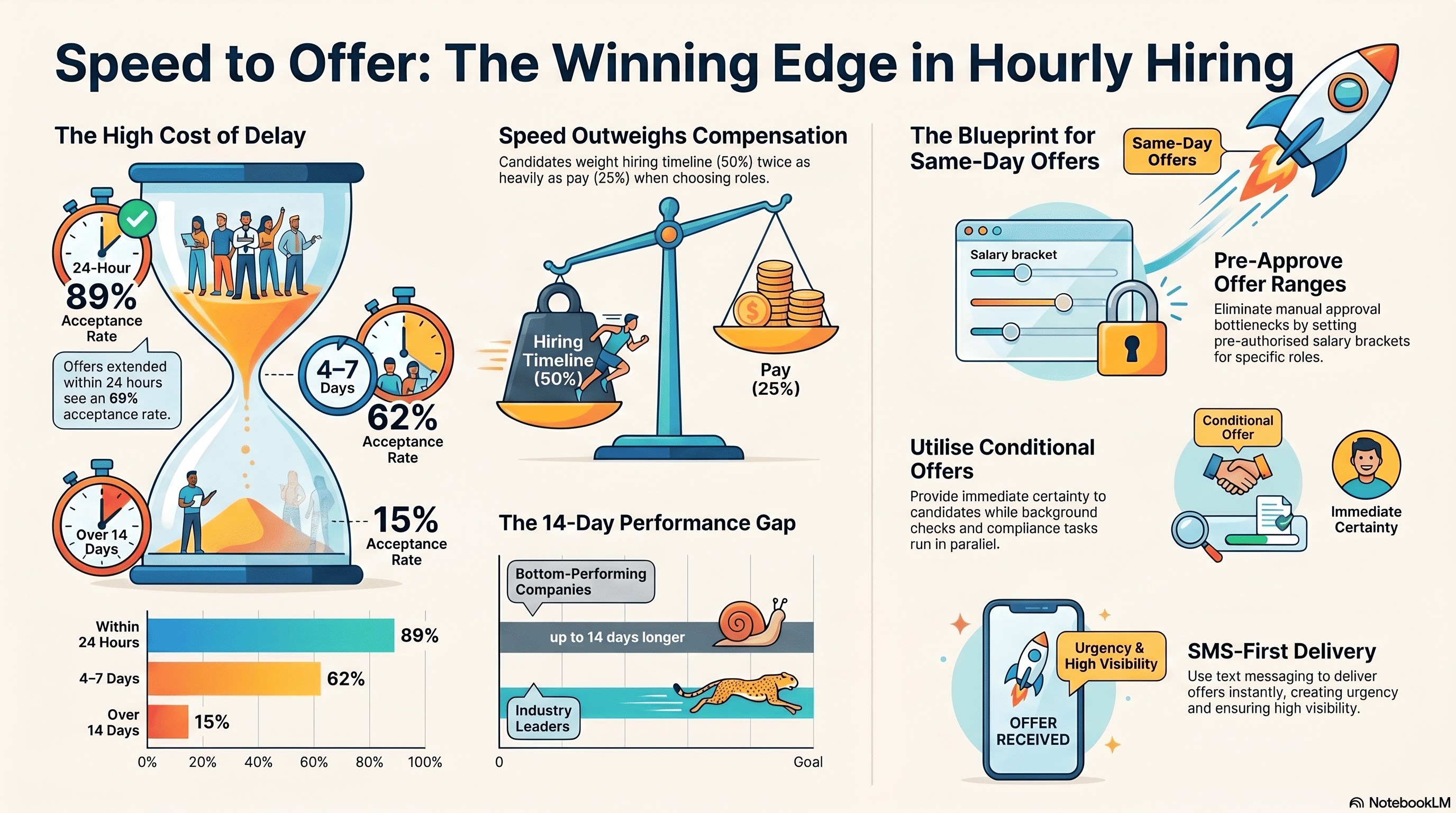 Market
Your candidate passed interviews, impressed the hiring manager, and is your top choice. But they’re not waiting passively for your offer. They’re interviewing at three other companies. One of those companies is moving faster than you.
The data is sobering: among passive candidates for hourly roles, 34% have competing offers within 48 hours of final interview. For competitive roles (experienced warehouse leads, kitchen staff, retail supervisors), 52% have competing offers within 24 hours.
When a candidate receives a competing offer, they don’t wait for you. They evaluate the offer they have, and if it’s reasonable, they accept it. Your offer, arriving 2 days later, is rejected because they’ve already committed elsewhere.
Speed-to-offer benchmarks by industry:
Retail: Median 8 days from final interview to offer
Hospitality: Median 12 days
Logistics/Warehouse: Median 6 days (faster)
Healthcare: Median 11 days
Manufacturing: Median 9 days
But benchmarks hide the extremes. Fast companies (top 25% by hiring speed):
- Retail: Same-day to next-day offers (1-2 days)
- Hospitality: 2-3 day offers
- Warehouse: Same-day offers
- Healthcare: 2-4 day offers
- Manufacturing: 2-3 day offers
Slow companies (bottom 25%):
- Retail: 14-21 day offers
- Hospitality: 18-28 day offers
- Warehouse: 10-14 day offers
- Healthcare: 18-25 day offers
- Manufacturing: 12-18 day offers
The gap between fastest and slowest is 10-14 days. In a competitive market, that gap is the difference between winning and losing candidates.
The Candidate Decision Timeline: When They’re Actively Deciding
To understand speed-to-offer timing, you must understand when candidates are actively deciding about multiple offers.
The window of active consideration:
Candidate interviews with Company A on Monday. They interview with Company B on Wednesday. They interview with Company C on Friday. All three companies will make decisions and extend offers in the next week.
During Monday-Friday, candidate is in “active decision mode.” They’re thinking about all three opportunities, mentally weighing pros/cons.
On Monday evening (after Company A interview), Company A extends offer. Candidate’s decision window is shortest (maybe 24 hours) before they commit.
On Thursday (after Company B interview), Company B extends offer. But Company A’s offer from Monday is already accepted. Company B loses.
On Sunday (after Company C interview delayed for weekend), Company C extends offer. Both Company A and Company B have moved on.
Data on offer acceptance by timing:
- Offer within 24 hours of interview: 89% acceptance rate (candidates haven’t received competing offers yet)
- Offer within 2-3 days: 78% acceptance rate (some competitors have moved; candidate comparing)
- Offer within 4-7 days: 62% acceptance rate (most competitors have moved; candidate has other options)
- Offer within 8-14 days: 41% acceptance rate (candidate has accepted elsewhere)
- Offer after 14 days: 15% acceptance rate (candidate is employed or committed to another role)
This data demonstrates a critical insight: your ability to extend offers quickly is the primary factor in offer acceptance rates. A great offer ($16/hr, flexible scheduling, benefits) loses to a mediocre offer ($15/hr) if the great offer arrives 2 weeks late.
A quick-service restaurant chain quantified this: their offer acceptance rate was 58% with average 11-day offer timing. They compressed timing to next-day offers. Acceptance rate jumped to 84%. Same offer package, same candidates, different timing = 26-point acceptance improvement.
Offer Acceptance Drivers: Compensation vs. Speed
What determines whether a candidate accepts an offer? Research from LinkedIn and the Bureau of Labor Statistics shows the hierarchy:
#1: Timeline (50% weight in candidate decision)
“Did you move fast?” matters more than “How much are you paying?” Candidates perceive fast-moving companies as serious, organized, and respectful of their time. Slow-moving companies signal bureaucracy and disorganization.
#2: Compensation (25% weight)
Does the offer match market rate and candidate expectations? For hourly roles, “match” is more important than “exceed.” A $16/hr offer matching their expectation is accepted more often than a $17/hr offer that required an unclear negotiation process.
#3: Role clarity (15% weight)
Does the candidate understand the role, schedule, and expectations? Vague role descriptions or shifting expectations during interviews cause rejection.
#4: Company/team (10% weight)
Did the candidate connect with the hiring manager or team? Do they believe they’ll enjoy working there?
This hierarchy reveals why many companies fail at offers: they focus on #2 (compensation) while ignoring #1 (timeline).
Companies say: “Our offer is competitive. Why are candidates rejecting?”
The answer: candidates aren’t rejecting the offer. They’ve already accepted elsewhere.
The speed advantage in compensation negotiation:
When you move fast, you don’t need to negotiate as much. Candidate receives your offer same-day, evaluates it without competing offers, and accepts a slightly lower number because you moved fast and they want the certainty.
When you move slowly, candidate has competing offers. They use those offers as leverage: “Company B offered $17, so I need $18 to take this role.” Negotiation elongates, and you either pay more or lose the candidate.
A logistics company standardized on same-day offers instead of 6-day offers. Before: 65% acceptance rate, heavy negotiation (candidates asking for 10-15% more). After: 84% acceptance rate, minimal negotiation (candidates accepting posted rate). Outcome: net savings in compensation while accepting more candidates.
Same-Day Offer Automation: Making Speed Operational
Same-day offers require removing administrative bottlenecks. Traditional offer process:
- Final interview concludes
- Hiring manager completes interview feedback
- Recruiter compiles feedback, talks to hiring manager
- Recruiter determines if candidate is strong yes/no
- If yes, drafts offer email
- Offer goes to HR for compliance review
- HR approves or requests changes
- Final offer goes to finance/leadership for approval
- Only after all approvals, offer is extended to candidate
Timeline: 3-7 days (multiple handoffs, email delays, approval bottlenecks)
Same-day offer process:
- Final interview concludes
- Hiring manager immediately completes structured scorecard (5 minutes)
- If score >75%, system auto-approves offer and calculates terms based on pre-approved offer ranges
- Candidate receives conditional offer same-day or next-day via SMS + formal offer document link
- Candidate reviews and signs
Timeline: same-day to next-day (automation replaces approval chain)
How to implement same-day offers:
Step 1: Pre-approve offer ranges
Leadership pre-approves offer ranges by role: “Cashiers: $14-16/hr. Warehouse leads: $18-22/hr.”
Once leadership defines range, individual offers don’t need re-approval (they’re within range).
Step 2: Automate offer generation
Your ATS generates offer automatically based on scorecard score and role:
- Score 20+: offer at top of range
- Score 15-19: offer at middle of range
- Score 10-14: offer at lower end of range
Offer is auto-generated within 30 minutes of scorecard submission.
Step 3: Template conditional offers
Conditional offer (contingent on background check) can be extended immediately. Final offer (after background check clean) follows in 3-5 days.
This gives candidate certainty while maintaining necessary compliance steps.
Step 4: SMS delivery
Instead of sending offer via email (which disappears in inbox), send via SMS: “Congratulations! We’d like to hire you. Offer details: [link]. Review and sign by [date]. Questions? Reply here.”
SMS creates urgency and ensures candidate sees offer immediately.
Technology requirements:
- ATS with offer generation (SmartSuite includes this)
- Pre-configured offer templates and ranges
- API integration to calculate offer terms automatically
- SMS capability for offer delivery
Cultural/organizational requirements:
- Leadership confidence in pre-approved ranges (trusting that pre-approval covers most offers)
- Hiring manager discipline to complete scorecards immediately after interviews (not delay)
- Comfort with automation (some leaders want to manually review every offer; this blocks speed)
A retail company implementing same-day offers achieved:
- Offer timing: 6 days → same-day/next-day
- Acceptance rate: 68% → 86%
- Negotiation time: 4 hours per candidate → 15 minutes
- Cost per hire: $3,200 → $2,800 (through reduced negotiation and re-recruiting)
- Time-to-hire: 16 days → 9 days
Conditional Offers: Speed with Compliance
Some offers require final background check, reference verification, or credential confirmation before they’re final. These compliance steps take 3-5 days.
But you don’t need to wait for compliance to extend an offer. Conditional offers provide certainty to the candidate while protecting the company.
Conditional offer structure:
“We’re excited to offer you the [Role] position at [Rate/Salary] contingent upon satisfactory completion of our background check and reference verification. Assuming those clear—which they should for you based on our discussions—you can expect a final offer within 3-5 business days.”
This conditional offer gives candidate certainty (they’re hired, subject to routine checks) while giving you protection (if something unexpected emerges in background check, you have out).
Candidate experience with conditional offers:
- Day 1 (interview): Candidate interviews
- Day 1 (evening): Conditional offer extended via SMS/email
- Day 2: Candidate receives formal conditional offer document
- Day 2: Candidate signs and authorizes background check
- Day 5: Background check clears
- Day 5: Final offer extended, start date confirmed
Total timeline: 4-5 days from interview to final offer
Candidate perceives this as fast (their offer was expedited despite compliance processes). Company maintains necessary background check protection.
Alternative: Parallel processing
More aggressive: extend conditional offer same-day while background check runs in parallel (starting immediately after interview, not after offer acceptance).
- Day 1 (end of interview): Background check initiated
- Day 1 (evening): Conditional offer extended
- Day 3: Background check completes
- Day 3: Final offer
- Day 4: Start date confirmed
Total timeline: 3 days from interview to final offer
This parallel approach requires confidence that background checks will clear. For most candidates, they will. For the rare candidate whose check doesn’t clear, you’ve already extended conditional offer, which you can withdraw.
This is aggressive but legally defensible (assuming your background check process is standardized and compliant with FCRA).
Market Competition: Understanding Candidate Options
To understand offer timing strategy, you must understand the competitive landscape for hourly talent.
Retail/Hospitality competitive intensity:
A candidate applying to your retail store is likely also applying to Target, Walmart, local boutiques, hospitality venues. These companies all move at different speeds:
- Target (large enterprise): 5-7 day standard hiring
- Walmart: 4-6 days
- Local boutique: 2-3 days (owner-operated, faster decision-making)
- Quick-service restaurant: 2-3 days (high volume, efficient process)
If you’re a medium-sized retailer at 7-8 days, you’re slower than Target and much slower than local competitors. Candidates go elsewhere.
Logistics/warehouse competitive intensity:
Warehouse jobs have fewer competitors (not every company operates warehouses). But the competitors that exist—Amazon, major DCs, third-party logistics—move very fast:
- Amazon: same-day to next-day offers
- XPO Logistics: 2-3 days
- DHL: 3-4 days
If you’re at 8-10 day standard, you lose every candidate to Amazon, which offers same-day.
Healthcare competitive intensity:
Healthcare has high barrier to entry (licensing requirements) so fewer competitors, but significant competition:
- Hospital systems: 6-9 days
- Staffing agencies: 2-3 days (they move fast because their business is speed)
- Clinics: 4-7 days
Staffing agencies win many placements not because they pay more, but because they move faster. Candidate accepts their offer before hospital system even extends theirs.
Competitive strategy:
You don’t need to beat everyone. You need to beat your primary competitors. If you’re hiring retail and your main competitors are local boutiques (2-3 days) and regional chains (6-8 days), you should target 2-4 days to beat boutiques and match chains.
If you’re hiring for warehouse and your competitor is Amazon (same-day), you probably can’t match them. But you can be “fast enough” (next-day) to compete for candidates who want something other than Amazon (better management, smaller team, benefits).
Measuring Speed-to-Offer and Offer Acceptance Rate Impact
Track two metrics:
Offer acceptance rate:
- Definition: What percentage of offers extended are accepted?
- Baseline: 60-72% (depending on industry)
- Target after speed optimization: 80-88%
- Metric: number of accepted offers / number of offers extended
Time-to-offer:
- Definition: How many days from final interview to offer extended?
- Baseline: 6-12 days
- Target: 1-3 days (same-day to next-day)
- Metric: date of offer / date of final interview
These two metrics are inversely correlated: the faster you offer, the higher acceptance rate.
Secondary metrics:
- Offer negotiation time: How long between offer extension and acceptance/rejection?
- Slow offer: 3-7 days (candidate is negotiating multiple offers)
- Fast offer: <1 day (candidate accepts quickly)
- Offer negotiation intensity: How much push-back on offer?
- Slow offer: 65% negotiate for higher pay
- Fast offer: 25% negotiate
Dashboard setup:
Monthly dashboard should show:
- Average time-to-offer by role
- Offer acceptance rate by role
- Correlation: show that faster offers = higher acceptance rates
- Competitive benchmarking: how you compare to industry
Data-driven optimization:
If your time-to-offer is 8 days and offer acceptance is 64%, and you compress to 2 days, and acceptance jumps to 84%, you’ve added value. That’s 20 percentage points acceptance improvement = 100 additional hires annually (if 500 offers extended) = $300,000 recruiting savings.
The business case for speed-to-offer is overwhelming. Every day of delay costs offers in lost hires.
References and Further Reading
- LinkedIn, “Candidate Decision Timeline and Offer Acceptance Research,” 2023
- Bureau of Labor Statistics, “Hiring Velocity and Job Offers,” 2023
- Society for Human Resource Management, “Offer Acceptance Rate Benchmarks,” 2023
- Cadient Talent SmartSuite Case Study, “Same-Day Offer Automation Impact,” 2024
- Harvard Business Review, “Speed as Competitive Advantage in Recruiting,” 2023
- Glassdoor, “Candidate Expectations for Offer Timing,” 2024
- Indeed, “Hourly Talent Competitive Landscape Study,” 2023
How Cadient Talent SmartSuite™ Helps
Cadient Talent’s SmartSuite™ platform automates compliance workflows, embeds regulatory guardrails directly into your hiring process, and maintains audit-ready documentation at every stage—so your team can focus on finding great talent while staying protected from costly violations.
