

The Ultimate Guide to Recruitment Metrics: Measure, Analyze & Optimize Hiring
Introduction to Recruitment Metrics
Ever wonder why some hiring teams seem to hit the bullseye every time while others scramble forever? The secret often lies in the data they track. Recruitment metrics give you a clear line of sight into every step of the talent acquisition journey, from posting a job to the new hire’s first day.
And when you can see the numbers, you can start tweaking the process. It’s not magic; it’s measurement.
Why metrics matter in modern hiring
Recruiting isn’t a gut‑feel game anymore. Companies that obsess over time to hire, cost per hire, and quality of hire consistently outperform peers. According to the 2024 HR Pulse Survey, firms using structured metrics cut vacancy time by 27% and saved roughly $12,000 per role.
So, what’s the real payoff? Faster onboarding, lower churn, and a healthier bottom line—all traceable back to the numbers you choose to monitor.
Difference between HR metrics and recruitment metrics
HR metrics cover the whole employee lifecycle—engagement scores, turnover rates, training ROI. Recruitment metrics, on the other hand, focus exclusively on the hiring funnel. Think of them as the “pre‑hire” cousin of broader HR analytics.
But don’t treat them as separate islands. The moment a candidate becomes an employee, the recruitment data feeds into the larger HR picture, informing future workforce planning.
Core Recruitment Metrics Everyone Should Track
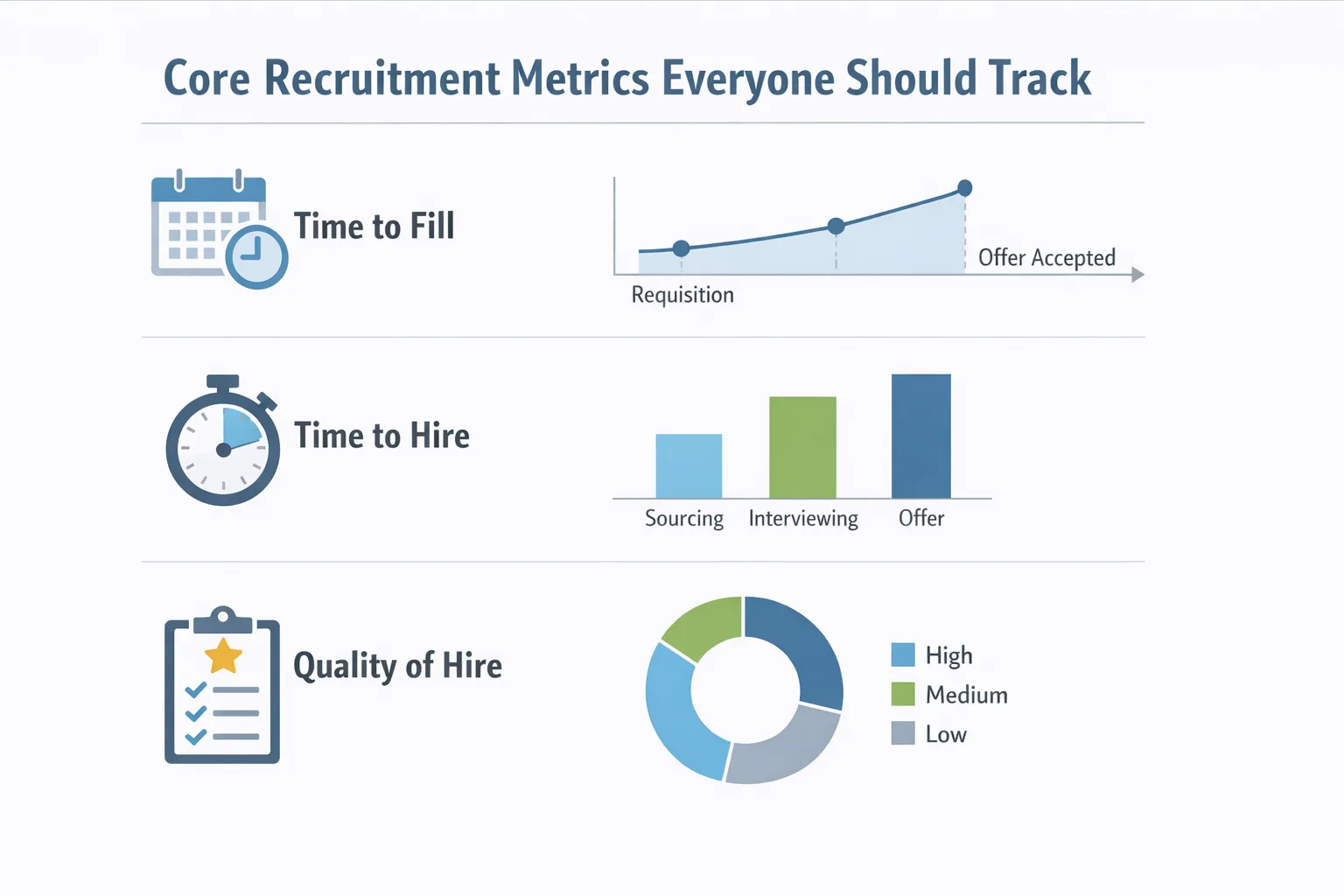
Time to Fill
Time to Fill measures the days from when a requisition opens to the day an offer is accepted. It captures the entire sourcing‑to‑onboard timeline, helping you spot sluggish stages.
For example, a tech startup found that their Time to Fill stretched to 68 days because the interview scheduling step was manual. Automating that step reduced the metric to 42 days.
Time to Hire
Time to Hire narrows the lens: it tracks the period from a candidate’s first application to the accepted offer. This metric shines a light on the candidate’s experience.
In a recent study, firms with a Time to Hire under 30 days saw a 15% higher Offer Acceptance Rate.
Cost per Hire
Cost per Hire tallies every expense tied to filling a role—ads, recruiter salaries, agency fees, travel, even onboarding kits. Breaking down the cost reveals hidden spend.
One mid‑size retailer discovered that their agency fees accounted for 45% of total cost per hire. Negotiating a flat‑fee model saved them $3,400 per position.
Source of Hire
Source of Hire pinpoints where the successful candidate originated—job board, employee referral, social media, or direct site traffic. Knowing the top source lets you double‑down on what works.
Did you know that referrals often produce a 30% higher Quality of Hire? That’s why many high‑growth firms run referral contests.
Quality of Hire
Quality of Hire assesses post‑hire performance, usually via performance ratings, ramp‑up speed, or retention after 12 months. It’s the metric that turns hiring into a strategic advantage.
When a SaaS company linked Quality of Hire to quarterly revenue, they saw a 12% boost after shifting to competency‑based interviews.
Offer Acceptance Rate
Offer Acceptance Rate tells you the percentage of candidates who say “yes” to your offer. Low rates can signal salary misalignment, cultural mismatch, or a poor candidate experience.
One finance firm discovered that adding a personalized “next‑steps” video increased their acceptance rate from 68% to 81%.
Applicant Drop‑off Rate
Drop‑off Rate measures the percentage of applicants who abandon the process at each stage. High drop‑off often points to a cumbersome application form or unclear communication.
After simplifying their application to three fields, a healthcare provider cut drop‑off by 22% and boosted their qualified applicant pool.
Interview‑to‑Offer Ratio
Interview‑to‑Offer Ratio tracks how many interviews you conduct before extending an offer. A high ratio may indicate overly broad screening or weak interview criteria.
Cutting the ratio from 8:1 to 4:1 saved a manufacturing firm $25,000 annually in interview logistics.
How to Calculate & Benchmark Each Metric
Simple formulas and supporting data points
- Time to Fill: (Date of Offer Acceptance – Requisition Open Date) ÷ Number of Positions.
- Time to Hire: (Date of Offer Acceptance – Candidate Application Date) ÷ Number of Hires.
- Cost per Hire: (Total Recruiting Spend ÷ Total Hires) – include ads, agency fees, recruiter time.
- Source of Hire: (Hires from Source ÷ Total Hires) × 100.
- Quality of Hire: Average performance rating of new hires after 12 months.
- Offer Acceptance Rate: (Offers Accepted ÷ Offers Extended) × 100.
- Applicant Drop‑off Rate: (Candidates Lost at Stage ÷ Total Applicants) × 100.
- Interview‑to‑Offer Ratio: Total Interviews Conducted ÷ Offers Extended.
Gather these data points from your ATS, HRIS, and performance management system. If something feels off, double‑check the date fields—one bad timestamp can skew the whole metric.
Industry benchmarks for 2024‑2025
Benchmarks vary by industry, but here’s a quick snapshot:
- Tech: Time to Fill 45 days, Cost per Hire $7,500, Offer Acceptance 78%.
- Retail: Time to Fill 32 days, Cost per Hire $4,200, Quality of Hire rating 3.7/5.
- Healthcare: Time to Hire 27 days, Offer Acceptance 85%.
- Finance: Interview‑to‑Offer Ratio 5:1, Source of Hire – Referrals 38%.
Use these as a compass, not a rulebook. Your company’s size, geography, and talent scarcity will shift the numbers.
Leveraging HR Analytics Platforms
Dashboards & real‑time tracking
Modern HR analytics tools give you live dashboards that update as soon as a candidate moves stages. No more waiting for monthly reports.
And with visual cues—traffic‑light colors, trend lines—you can spot a rising Time to Fill before it becomes a crisis.
Integrations with ATS and recruiting software
Seamless integration means your ATS feeds raw data straight into the analytics engine. You won’t waste time exporting CSVs or reconciling duplicate records.
Now imagine a scenario where your ATS flags a candidate who’s been in the pipeline for 30+ days. The platform automatically nudges the recruiter to follow up, reducing drop‑off.
Advanced & Emerging Metrics
Candidate Experience Score
The Candidate Experience Score (CES) aggregates survey responses, interview feedback, and communication timeliness into a single number from 1‑10. A score above 8 predicts a higher Offer Acceptance Rate.
One fintech startup piloted CES and saw a 9% lift in acceptance after improving email response times from 48 hours to 12 hours.
Diversity & Inclusion Ratio
Diversity & Inclusion Ratio measures the proportion of hires from under‑represented groups versus the overall applicant pool. It’s a vital KPI for companies aiming for inclusive growth.
For instance, a global consulting firm set a target of 30% diverse hires and tracked progress monthly, hitting the goal within 9 months.
Predictive Hiring Success Index
Predictive Hiring Success Index blends historical Quality of Hire data with AI‑driven candidate assessments to forecast a candidate’s future performance. Think of it as a hiring crystal ball.
Early adopters report a 14% reduction in early turnover when they acted on the index’s risk alerts.
Turning Metrics into Action
Identifying bottlenecks
Start by mapping your funnel and overlaying the metrics. If Time to Fill spikes while Time to Hire stays steady, the bottleneck likely sits in requisition approval.
But if both metrics creep upward, you may need to look at sourcing channels or interview scheduling.
Data‑driven process improvements
Use the insight to experiment. Shorten the interview round, automate background checks, or negotiate better ad rates. Track the metric before and after to prove impact.
And don’t forget to celebrate wins—publicly sharing a 20% reduction in Cost per Hire boosts team morale.
Stakeholder reporting best practices
When presenting to CEOs or finance leaders, keep it visual. One‑page scorecards, trend arrows, and a clear “so what?” statement do the heavy lifting.
Remember to tie each metric back to business outcomes—revenue per employee, time‑to‑productivity, or customer satisfaction.
Real‑World Case Study
Company background
ABC Manufacturing, a mid‑size producer with 800 employees, struggled with a 68‑day Time to Fill and a 55% Offer Acceptance Rate. Their recruiting budget was $1.2 M annually.
Metric challenges
The team relied on spreadsheets, manually tallied Cost per Hire, and lacked visibility into source performance. Diversity numbers were flat, and early turnover averaged 18%.
Implemented changes
- Adopted an integrated HR analytics platform with real‑time dashboards.
- Standardized metric definitions and set 2024 benchmarks.
- Introduced Candidate Experience Surveys to generate a CES.
- Launched a Predictive Hiring Success Index pilot for engineering roles.
- Created a referral incentive that boosted referral hires by 22%.
Results
Within six months, Time to Fill dropped to 42 days—a 38% improvement. Offer Acceptance climbed to 78%, saving $180,000 in lost talent cost. Cost per Hire fell by 16% thanks to lower agency spend. Diversity hires increased 12%, and early turnover decreased to 9%.
Bottom line: a data‑first culture turned a $1.2 M recruiting spend into a $2.4 M talent ROI.
Common Pitfalls & How to Avoid Them
Over‑reliance on single metric
Focusing only on Time to Fill can tempt you to rush hires, hurting Quality of Hire. Balance speed with performance data.
Ignoring qualitative feedback
Numbers tell a story, but candidate comments reveal the subtext. A low CES often explains a dip in Offer Acceptance Rate.
Quick Start Checklist for Recruiters
10‑step implementation plan
- Define the exact metrics you’ll track.
- Align metric definitions with finance and HR.
- Pull historical data from your ATS for baseline.
- Set realistic 2024‑2025 benchmarks.
- Choose an HR analytics platform that integrates with your ATS.
- Build real‑time dashboards for Time to Fill, Cost per Hire, and Quality of Hire.
- Launch a simple candidate survey to collect CES data.
- Train hiring managers on interpreting the new reports.
- Schedule monthly review meetings to adjust tactics.
- Document wins and share them company‑wide.
Now you have a roadmap you can start today, no massive overhaul required.
Wrapping It Up: Key Takeaways
Recruitment metrics aren’t just numbers—they’re the pulse of your hiring engine. By measuring Time to Fill, Cost per Hire, and Quality of Hire, you unlock actionable insights. Advanced KPIs like Candidate Experience Score and Predictive Hiring Success Index push you from reactive to proactive. And with a solid implementation checklist, you can start reaping benefits within weeks.
So grab that data, plot your dashboard, and watch your hiring performance transform. After all, the best hiring decisions start with the right metrics.
Frequently Asked Questions
How do I calculate Time to Fill versus Time to Hire?
Time to Fill is measured from the date a job requisition is approved until an offer is accepted, while Time to Hire starts when a candidate applies and ends with the offer acceptance. Subtract the appropriate start dates from the offer acceptance date and divide by the number of hires to get average values.
What strategies can reduce Cost per Hire without sacrificing quality?
Streamline advertising by focusing on high‑performing sources, leverage employee referrals, and automate screening with ATS tools. Negotiating vendor contracts and using internal recruiters for niche roles also lower expenses while maintaining candidate standards.
Which recruitment metric most accurately predicts future employee performance?
Quality of Hire, often measured by new hire performance ratings, retention after 12 months, and productivity metrics, is the strongest indicator of future success. Combining it with hiring manager satisfaction scores provides a fuller view.
How can I effectively track Source of Hire for each position?
Assign unique tracking codes or UTM parameters to each job board, social channel, and referral program, then capture the source data in your ATS. Regularly audit the data to ensure consistency and attribute hires to the correct source.
What tools automate the collection and reporting of recruitment metrics?
Applicant Tracking Systems (e.g., Greenhouse, Lever) and HR analytics platforms (e.g., Visier, Tableau) can pull data in real time and generate dashboards. Many also integrate with HRIS and BI tools for deeper analysis.

