

Ultimate Retention Strategy Guide: Keep Top Talent and Customers Engaged
When you think about a retention strategy, what’s the first thing that pops into your head? A fancy software suite? A pile of HR reports? In reality, a solid retention strategy is the glue that holds your people and your customers together, and it starts long before anyone walks out the door or cancels a subscription.
What Is a Retention Strategy
Definition and why it matters for employees & customers
A retention strategy is a set of deliberate actions aimed at keeping valuable assets—your employees and your customers—happy, productive, and loyal. For staff, it means lower turnover, higher engagement, and a workforce that actually wants to stay. For buyers, it translates into repeat purchases, higher lifetime value, and brand advocacy. Ignoring either side can cost you up to 30% of revenue, according to a recent Bain study.
And it’s not enough to treat them as separate silos. The best companies align employee experience with customer experience, because happy employees often deliver happier customers.
Core Pillars of an Effective Retention Strategy
Onboarding and orientation
First impressions count. A smooth onboarding process—think clear role expectations, a buddy system, and early wins—cuts new hire turnover by up to 25%. Using employee onboarding software can automate paperwork and free up managers for real conversations. In my last gig at a fintech startup, we shaved the ramp‑up time from 45 days to 28 days simply by adding a 30‑minute “Day One” video and a digital handbook.
Compensation, benefits and perks
Salary alone won’t win wars. Competitive pay paired with health benefits, tuition assistance, and even pet‑insurance can boost retention scores. A recent survey of ~2,000 tech firms showed that companies offering flexible PTO saw a 12% dip in voluntary quits.
Career development and mentorship
People crave growth. Structured mentorship programs and clear career ladders create a sense of purpose. One retail chain introduced a “skill‑swap” where cashiers taught digital marketing basics to store managers—turnover dropped 18% within a year.
Culture, engagement and work‑life balance
Culture isn’t just ping‑pong tables. It’s about psychological safety, inclusive leadership, and genuine recognition. When employees feel seen, they’re 3.5 times more likely to stay. We ran a quarterly pulse survey at a SaaS firm and saw an NPS jump from 38 to 61 after instituting “Ask Me Anything” sessions with the CEO.
Data‑driven insights and predictive analytics
Now comes the tech edge. Modern HR platforms can flag at‑risk employees before they hand in their notice. By monitoring metrics like healthcare HR metrics, engagement scores, and internal mobility, you can act proactively. In a mid‑size hospital, applying an AI churn model cut voluntary turnover from 18% to 11% in just six months.
Employee Retention Tactics
Flexible work arrangements
Remote or hybrid setups give people control over where they work. A 2023 Gallup poll found that 54% of workers would quit for a remote‑first role. Offer a mix of office‑only, remote‑only, and hybrid days, and let teams decide what works best.
Recognition and reward programs
Spot bonuses, peer‑nominated awards, and simple “thank‑you” shout‑outs keep morale high. At a logistics company we rolled out a digital badge system—employees could earn “On‑time Hero” badges. The simple gamification lifted quarterly retention from 87% to 93%.
Continuous learning platforms
Invest in on‑demand training libraries. When you tie learning paths to business goals, you get a win‑win. For example, a cloud services firm gave engineers free access to Coursera and saw a 20% rise in internal promotions.
Leadership accountability
Managers must own their people’s success. Tie a portion of leadership bonuses to team turnover rates. When a division head at a health‑tech startup was held accountable for a 10% turnover cap, they launched weekly check‑ins that slashed attrition dramatically.
Customer Retention Tactics
Seamless onboarding experience
First‑time users need a frictionless start. Interactive product tours, quick‑start guides, and dedicated onboarding specialists reduce churn in the first 90 days by up to 40%. One B2B SaaS firm cut churn from 9% to 5% by adding a 15‑minute video walkthrough and a real‑time chat widget.
Personalised communication and loyalty programs
Targeted emails, birthday offers, and tiered loyalty schemes make customers feel valued. A boutique fitness brand launched a points‑based rewards program that boosted repeat bookings by 22%.
Proactive support and issue resolution
Don’t wait for complaints to pile up. Use ticket‑triage bots and set SLA targets under 2 hours. After a telecom provider implemented a predictive support dashboard, first‑contact resolution rates jumped from 68% to 84%.
Value‑adding content and community building
Webinars, user forums, and how‑to blogs turn buyers into advocates. A cybersecurity startup created a private Slack community for admins; churn fell 15% after six months of peer‑driven knowledge sharing.
Measuring Success Metrics and ROI
Turnover rate churn rate NPS CLV
Track classic KPIs: employee turnover, customer churn, Net Promoter Score, and Customer Lifetime Value. When you combine these, you can see the full impact of your retention strategy on the bottom line.
Cost of loss vs cost of retention initiatives
Calculate the true cost of losing a top performer—recruiting fees, lost productivity, and knowledge drain can total 1.5× the annual salary. Contrast that with the modest spend on a mentorship program or a churn‑prevention AI tool, and the ROI becomes crystal clear.
Implementing Your Retention Strategy
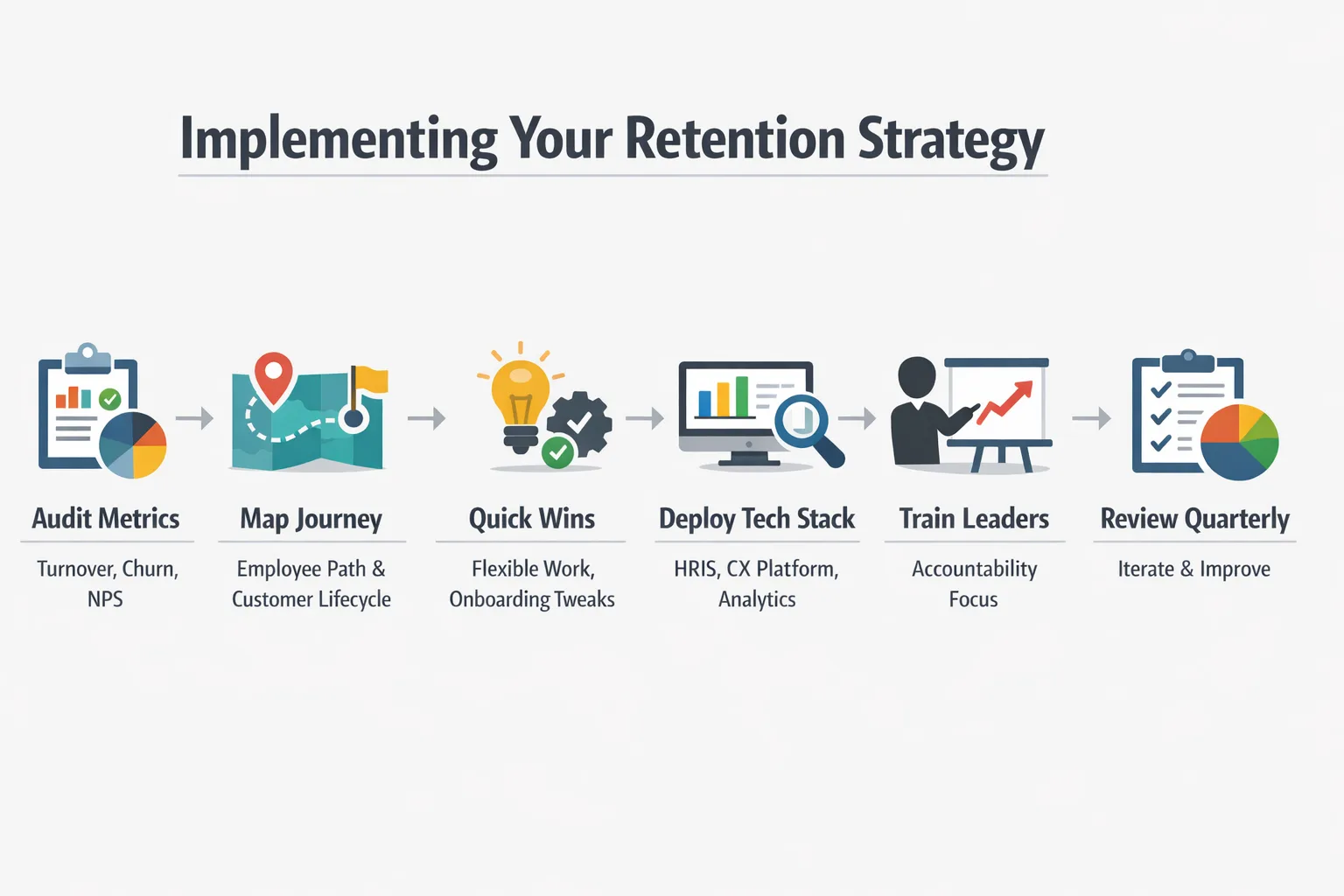
Step‑by‑step rollout plan
1. Audit current retention metrics (turnover, churn, NPS).
2. Map employee journey and customer lifecycle.
3. Prioritize quick wins—flexible work, onboarding tweaks.
4. Deploy tech stack (HRIS, CX platform, analytics).
5. Train leaders on accountability.
6. Review quarterly and iterate.
Cross‑functional ownership
Retention isn’t just HR’s job. Marketing, sales, and customer success need seats at the table. Create a “Retention Council” that meets monthly to align initiatives, share data, and adjust tactics.
Tools and software recommendations
For workforce management, look at platforms like BambooHR or Workday. For employee onboarding software, try Sapling or Click Boarding. Customer success teams love Gainsight or Totango for churn prediction. And don’t forget a unified analytics layer—Power BI or Looker can pull HR and CX data into a single dashboard.
Common Pitfalls and How to Avoid Them
Over‑reliance on salary alone
Money can attract, but culture, growth, and purpose keep people. Pair compensation reviews with pulse surveys to catch sentiment early.
Ignoring data signals
When you see a dip in engagement scores, act fast. Many firms wait for exits before investigating—by then the damage is done.
One‑size‑fits‑all programs
Different roles need different perks. A field technician values a vehicle stipend more than a remote designer values a home‑office stipend. Tailor your benefits to match role‑specific needs.
Future Trends 2025 2026
AI‑powered predictive churn models
Next‑gen AI can examine thousands of data points—pay patterns, project assignments, sentiment from Slack—to flag at‑risk employees weeks before they consider leaving. Early adopters report up to 30% reduction in unexpected quits.
Integrated employee‑customer experience platforms
Imagine a single system where a sales rep sees an employee’s recent training completions, and a support agent sees the employee’s internal engagement score. That holistic view will become mainstream as CX and HR tech converge.
Case Study Snapshot
Acme Health, a midsize provider, combined its HRIS with a CX platform to create a unified retention ROI calculator. By linking employee turnover cost ($85k per nurse) with patient churn cost ($12k per lost contract), they identified a $1.2 M saving opportunity in just six months. Their roadmap involved HR, finance, and patient services, proving that cross‑functional alignment isn’t just buzz—it delivers dollars.
Putting It All Together
Now you’ve seen the building blocks, the metrics, the tech, and the pitfalls. The real magic happens when you stitch everything into a single, living plan. Start with a quick audit, pick two high‑impact tactics, and assign a champion from each department. Track results, celebrate wins, and keep iterating. Your retention strategy will evolve, but the core idea stays the same: treat people—both employees and customers—as long‑term partners, not temporary transactions.
Remember, a great retention strategy isn’t a one‑time project; it’s a continuous conversation. Keep listening, keep learning, and keep improving. Your top talent and your most loyal customers will thank you—by staying.
Frequently Asked Questions
How can I measure the effectiveness of my retention strategy?
Track key metrics such as turnover rate, employee engagement scores, customer churn, and Net Promoter Score over time. Compare these metrics against baseline data before implementing the strategy and set quarterly targets to gauge progress.
What are the best tools for predictive analytics in retention?
Platforms like Visier, PowerBI with built‑in churn models, and specialized HR SaaS such as Culture Amp offer predictive analytics dashboards. They combine historical data, AI scoring, and scenario planning to flag at‑risk employees or customers.
How does offering flexible work arrangements affect employee retention?
Flexible schedules and remote options increase job satisfaction, reduce burnout, and have been linked to a 20‑30% lower turnover rate in many studies. Clearly defined policies and regular check‑ins ensure flexibility improves retention without hurting productivity.
What role does customer onboarding play in retaining clients?
A structured onboarding experience sets expectations, demonstrates product value, and builds early trust, leading to higher activation rates and lower early churn. Using guided tutorials, personalized checklists, and a dedicated success manager can boost retention within the first 90 days.
How often should I review and update my retention strategy?
Conduct a comprehensive review at least annually, with quarterly health checks on core metrics and feedback loops. Adjust tactics quickly when data shows rising turnover or churn signals to keep the strategy aligned with evolving employee and customer needs.

